Friday, 21 January 2022
Friday Five: Keep on Puzzling
Tuesday, 4 January 2022
Cold as Marble: A Likeness in Stone
In the powerful opening scene of
the novel, two divers exploring an old flooded house at the bottom of a
reservoir find a decomposed body in a wardrobe. We soon discover it is that of Helena
Warner, an undergraduate reading English at Somerville College, Oxford, who
went missing twenty years ago. At the time, Thames Valley Chief Inspector Bill
Driver, was convinced that she had been killed by her lover, Ian Gilmore, but
with no body, the case was never solved. Now it is re-opened by the new
policeman on the job, Detective Superintendent Rigby, who works with Driver to
try to bring Gilmore to justice. It may be set in the same cosy world as Morse
and Midsommer Murders (and it was made into a miniseries starring Andrew
Lincoln and Ruth Jones) but it is far more grim than that, because, “horror wasn’t
choosy. It manifested in the most unlikely of places, and in various guises.”
Of course, this is a mystery, so
nothing is as it initially appears, and submerged secrets rise to the surface,
as the timeline shifts back and forth. Helena was part of a group of friends who
don’t actually like each other very much and still have affiliations and
implications many years later. These three university associates are all
implicated in a very dark world which includes sadism and psychopaths.
Rigby and Driver must work
together to solve the case despite their different methods. Driver looks down
upon Rigby whom he dismisses as, “Well-dressed, intelligent-looking; no doubt
the product of one of these new-fangled schemes that sends graduates shooting
up a ladder Driver had to climb rung by painful rung, year after frustrating year.”
Women are victims; objects to be
possessed and preserved in youth before they age and supposedly lose their
beauty. Other examples of casual sexism and lazy stereotypes are scattered
throughout the novel. Artists are troubled and odd; mental health facilities
are a comfortable alternative to a hard life; computers are new (it was
published in 1997) and, apparently, the police one is female, “What’s more,
this little sweetie was a redhead. One false move and she could go off on one,
no trouble.”
Friday, 31 December 2021
Friday Five: Favourite Films of 2021
Normally, this post would cover my five favourite films of the year. But, as I think we can all agree, there is no such thing as 'normal' in 2021, so I'm having ten, even though it's a Friday Five. The films just have to have been released this year in Australia (where I live). So here they are, in alphabetical order:
- De Gaulle: Has a strong vibe of Darkest Hour for French people, and Tim Hudson plays a wonderful Winston Churchill.
- The Deep House: A couple exploring a haunted house with dark secrets is a familiar genre. He is controlling to the point of exploiting her fear and vulnerability for his own amusement. She craves his affection; he craves ‘likes’ on his social media pages (and we know that controversy generates more attention). Putting this claustrophobic setting and relationship underwater is inspired. The house is at the bottom of a lake and the couple dive deep into all sorts of metaphors and horror tropes as they run out of air, escape routes and plot credibility. The narrative holes and limited acting ability are mitigated by the underwater photography and the perspective-shifting concept. If you like budget horror that explores psychoses, then this is disturbingly good.
- Don’t Look Up: It's an American satire: neither of those things are noted for their subtlety, indeed exaggeration is one of the defining features of the genre - 'satire: artistic form, chiefly literary and dramatic, in which human or individual vices, follies, abuses, or shortcomings are held up to censure by means of ridicule, derision, burlesque, irony, parody, caricature, or other methods, sometimes with an intent to inspire social reform' - so I’m not sure why people are criticising it for that reason. In this story, a comet is hurtling towards earth and will wipe us out, but the conspiracy theorists think, 'That's what they want you to believe, sheeple'. Of course it's obvious, but like the man says, it's based on truly possible events. Oh, and it's got a star-studded cast playing up stereotypes to the max.
- Lapsis: Director, writer and editor, Noah Hutton, gives us an epic work about the exploitation of gig-economy workers and the evils of capitalism through a low-budget but high-concept sci-fi action thriller. Perhaps if we joined together and helped one another rather than constantly competing for individual success, we would all gain, rather than just the big bosses profiting from our labour. Oh, wait, that's socialism - it will never catch on; at least not in America.
- News of the World: Travelling the country and reading snippets from the newspapers to illiterate communities sounds like my ideal job. The ever-reliable Tom Hanks is the ideal person to do it. Oh, and he also takes it upon himself to return an 'abducted' child (Helena Zengel) to her aunt and uncle on the other side of Texas. Paul Greengrass directs a solid Western which is almost a love letter to the genre, with all the usual tropes viewed from a different angle. The contemporary politics are a touch too obvious as there is a lot of colonial guilt for which to atone, but it's a generally uplifting film which attempts to sow some seeds of hope for the future.
- Nobody: Incredibly violent and full of stylised toxic masculinity, but Bob Odenkirk is an extremely likable actor and his character is kind to a kitten in the first scene, so I've given him (and consequently the film) an extra star.
- Nomadland: Frances McDormand plays Fern, a woman who is 'not homeless but houseless' as she travels the United States looking for work as if in a modern version of The Grapes of Wrath. She is seen cleaning toilets in truck stops, boxing up goods in the soulless Amazon warehouse, or sorting beets in Hardy-esque scenes, but there are also wide sweeping vistas of the incredible scenery of this beautiful country. There is only a finite space for self-made millionaires, capitalist growth and rampant individualism - the rest of us have to share the planet, and the conversations held at a closed dinosaur park are laden with metaphor.
- The Power of the Dog: Excellent slow-burner with intense and toxic relationships against a stunning backdrop of Central Otago (standing in for Montana). Jane Campion knows how to bring out subtle nuances, which don’t stand out like dog’s balls, but reward the audience’s attention. It would be nice if women were given a little more agency (because Kisten Dunst deserves an equally dynamic role as Benedict Cumberbatch, Kodi Smit-McPhee and Jesse Plemons) but then I guess at least that’s probably true to life.
- Promising Young Woman: Carey Mulligan is amazing and the treatment of this horrendous material is well-handled by director, Emerald Fennell. At times it has a graphic novel/ raunchy thriller vibe, because, like, how else are you going to get the entitled would-be rapist frat-boys to watch it, right? These are the boys that whine, ‘Why do you have to ruin everything?’ when a woman dares to stop their 'fun' with an accusation of abuse. Yes, we’re f*#^ing angry!
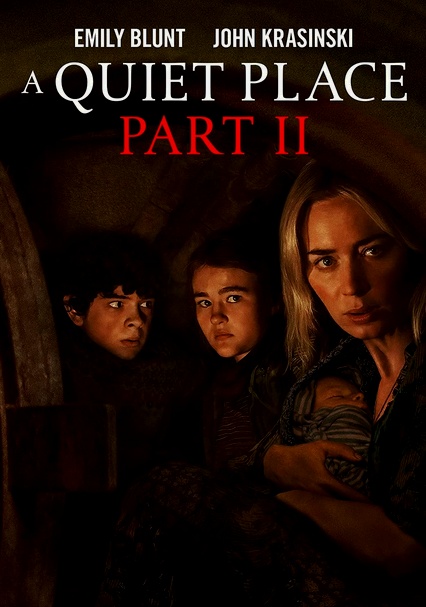
- A Quiet Place Part II: In which the younger generation step up, Cillian Murphy learns some essential sign language, and the sound editing deserves all the awards.
Tuesday, 28 December 2021
As the Worlds Turn: The Gospel of Loki
The tone of his narrative is
gossipy and engaging, with wry asides and perceptive commentary. Loki is arrogant
and confident; he loves causing chaos and tricking people into believing what
he wants them to. He is seduced from the world of Chaos by Odin who brings him
to the world of Order and sets him up as his son, but he is never accepted by
the other gods and feels his difference. He also understands, however, that he
can never return to his former way of life, as Sturt, god of the world of Chaos,
will never take him back. As a result of this, he is brutally aware that he
will have to take care of himself. His chapters are in the form of lessons with
subtitles, such as “Never trust a ruminant”; “Never trust a wise man”; “Never
trust a relative”; until he comes to the conclusion, “Basically, never trust
anyone”.
While he likes some aspects of
this world, not everything meets with his approval, and he is particularly
dismissive of sentiment and love. “Love is boring. People in love are even more
so… As far as I could understand, love made you weak and boring.” Loki doesn’t
understand the concept of punishment either, which he criticises with a wry
aside at modern culture. “Punishment is futile, of course. It doesn’t stop
crime, or undo the past, or make the culprit sorry. In fact, all it does is
waste time and cause unnecessary suffering. Perhaps that’s why it’s the basis
of so many world religions.”
Loki’s account takes a modern
world view: one in which we have to protect our world or risk losing it. But he
is quick to point out the difference between the civilization and the earth,
which will survive with or without us. “The Worlds have ended before, many
times, and been remade. Nothing lasts. History spins its yarn, breaks threads,
spins again, like a child’s top, going back to the beginning.” It is not the
planet we seek to save, but ourselves, and he understands that we may have left
it too late: change is inevitable. This is a frightening commentary on the
hate-filled, virtue-signalling, self-preservation, capitalist society in which
we live.
Friday, 24 December 2021
Friday Five: Best Theatre of 2021
![]() |
| A Slightly Isolated Dog perform Don Juan |
Following on from last year, it was still difficult to see much theatre over the last twelve months, what with COVID shutting down shows with moments to go, and the arts industry in a perilous position. I did manage to see approximately 20 productions this year, however, so I am able to list my top five, with honourable mentions.
- Animal Farm - shake & stir theatre co., The Playhouse: This is an absolutely fantastic interpretation of one of my favourite novels. People are falling over themselves to draw parallels between the Trump administration and the propaganda within the play, but it remains as firmly rooted as ever in Orwell’s concerns about communist doublespeak. The ensemble of actors portrays all the anthropomorphised animals with excellent gestures and expressionism, maintaining an outstanding physicality throughout. The set is bleak and brilliant in equal measure. Lighting and sound blend artfully into the overall presentation and despite the grim truths of the production, there are still laugh-out-loud moments - the hen rebellion is dealt with humour until it suddenly isn't, and the transformation of beasts into men and back again is wry and poignant. A teacher of year eights (13-14) said her class went to see it and were disappointed that it didn't feature real animals. I never thought I'd say this, but sometimes theatre is wasted on the young.
- The Appleton Ladies Potato Race - Ensemble Theatre, The Playhouse: Written by Melanie Tait, this charming, heartfelt and positively affirming play provides five great roles for women and a story that is both specific and universal. The small country town of Appleton is disturbed when returning resident and new GP Penny Anderson (Sharon Millerchip) discovers that the famous Potato Race awards $1,000 prize money to men and $200 to women. As she takes on the organisers, the competitors and the spectators she comes face to face with those who want change and those who see no problems with the way things are. Director, Priscilla Jackman teases out all the niggles, nuances, resentments and rejections as the characters try to understand and accept each other for who they really are. It's as like a fusion of Made in Dagenham with The Dressmaker served with an added side of potato puns.
- Don Juan/ Jekyll & Hyde - A Slightly Isolated Dog, Bicentennial Hall, Queanbeyan Performing Arts Centre: Pretending to be a famous French theatre troupe – ‘We are very famous’ ‘And very French’ – gives this Kiwi ensemble of five actors the perfect opportunity to have fun with flamboyant stereotypes and outrageous accents. Theirs is a modern and collaborative approach and they encourage photos, which they then later share through their social media channels - direct marketing for the non-traditional theatre goers. Through a mixture of audience interaction (nothing confronting), song, dance, visual interpretations (a boat tossed on a stormy sea is a cardboard box on a tarpaulin, shaken about by the audience), and a voice distortion box, one night we learn a different side to Don Juan from any we had previously known. Another night, they bring bring their seemingly chaotic but totally controlled performance style to the story of Jekyll and Hyde. All of the ensemble get a go at being the man with a dark side within (‘but he pushes it down’) donning a wig and glasses to play the evil alter-ego, but their physicality is more important than their props and they literally embody character acting. The sound and lighting production is excellent and the timing is superb – it takes a lot of hard work to make something look this effortless, and they are a joy to watch. Both this and the previous offering are conducted in traverse staging, drawing the audience into the unfolding drama in a non-confrontational manner; the performances are short and leave the audience laughing and wanting more – they are a triumph.
- A German Life - The Gordon Frost Organisation, The Playhouse: Robyn Nevin delivers this fantastic script by Christopher Hampton as if she were born to play this role. Brunhilde Pomsel is an unassuming woman with good shorthand skills who, almost by chance, came to work in Joseph Goebbels’ Propaganda Ministry. She survived the war and its aftermath (after five years in prison) and now, near the end of her life and in a nursing home, she recounts what she recalls of those days. The sparsely furnished room for an elderly resident throws up echoes of incarceration while projections of Nazi rallies, mass evacuations, ruined cities and concentration camps, are starkly presented in black and white on the walls for all to see. It is disturbingly intimate and asks us to question how much we think she knew (every time she denies knowledge, she stumbles over her words or questions her receding memory) and what would we honestly do in her situation. Neil Armfield directs one woman to capture our attention throughout the running time, and the play raises many questions about personal responsibility, communal culpability and the veracity of memory. She opines, "Nowadays, I don’t think people would be stupid enough to fall for the kind of nonsense we fell for. All that hot air, I don’t think you can get that past people anymore.” Well, the audience all felt uncomfortable at that moment - apart from the smug ones who missed the point.
- Milk - The Street, The Street Theatre: I believe the theatre is a forum for sharing stories; exploring the past; questioning the present; and preparing for the future. ‘Milk’ does all of the above with superb staging and atmospheric sound and lighting featuring pivotal moments in liminal spaces. If Dylan Van Den Berg wrote this as an ode to his daughter, she is one very lucky human. We stand with you. We pay our respects to the traditional custodians of the land on which we live.
- Carpe DM - Canberra Youth Theatre, Gorman's House: A bold, thoughtful and intelligent new work as past of a project with Canberra Youth Theatre's Emerge Company. Devised works exploring contemporary themes can be a little self-indulgent, but the moments of honesty and reflection make up for the understandable cliches as young people think they are the first to ever have these thoughts.
- The Governor's Family - Canberra Repertory Society, Theatre 3: Plaudits to Rep for taking on this confronting work. It's not often a community theatre company with a traditionally conservative audience would program a play tackling themes of cultural appropriation, gender diversity, incest and political revolution.
- The Stranger - Ainslie and Gorman Arts Centres and Bare Witness Theatre Company, Ralph Wilson Theatre: Outstanding work by Christopher Samuel Carroll to command the audience with a one-man show and deliver fresh insight to a work of existentialist nihilism. Considering I detest the original novel by Albert Camus, I was impressed beyond all expectations at the translation, staging and performance. Chapeau!
![]() |
| Christopher Samuel Carroll standing on a beach staring at the sea in a production of The Stranger |
Tuesday, 14 December 2021
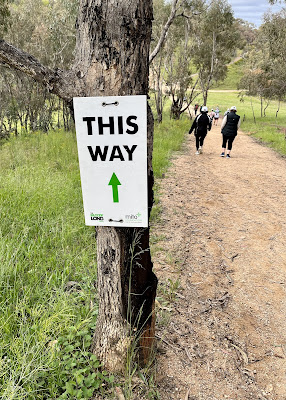
Bloody Long Walk
Tuesday, 7 December 2021
Rookie Errors: Knots and Crosses
In a new introduction, Ian Rankin
explains that he didn’t know Detective Sergeant John Rebus was to become such a
huge fictional figure going on to star in more than a dozen novels. He notes
his rookie errors in giving Rebus a complex back story and knowledge about
things he might not have known (art and literature), combined with lack of
understanding of things that he should, such as police procedure.
There is more than an element of
Colin Dexter’s Inspector Morse about Rebus as Rankin is keen to show off his
education with mixed metaphors and a classical background. “The skies were as
dark as a Wagnerian opera, dark as a murderer’s thoughts.” He has faith, but
does not hold with organised religion and he reads his Bible for comfort. “Ah,
but it was not a nice world this, not a nice world at all. It was an Old
Testament land that he found himself in, a land of barbarity and retribution.”
Rebus is patronising towards ideological
students; needing to disassociate himself from others’ language; to prove himself
better than that (he reads Dostoevsky’s Crime
and Punishment, don’t you know), he positions himself above the students
who come into ‘his’ city. “Edinburgh was all appearances, which made the crime
less easy to spot, but no less evident. Edinburgh was a schizophrenic city, the
place of Jekyll & Hyde sure enough, the city of Deacon Brodie, of fur coat
and no knickers (as they said in the west).”
Much is made of the city’s
underside, hidden from the tourists and the students, but known to the likes of
him. Rankin has created this world and he is proud of its darkness. As it
becomes clear there is a criminal delighting in killing girls and taunting
Rebus, many are shaken that this occurs in the Scottish capital. “But here, in Edinburgh! It’s unthinkable. Mass
murderers belonged to the smoky back streets of the South and the Midlands, not
to Scotland’s picture-postcard city.”
Rebus has a secret past – of course
he does; he was a Para and trained for the SAS with a special Crack Assignments
group. He has buried his SAS experience
in his subconscious, but it is clearly important to the case he finds himself
investigating. Indeed, there are so many references and near flash-backs that the
reader knows this trauma has something to do with the crime, even if he doesn’t.
When he decides to delve into his subconscious, it is no surprise that the mind
is a deep and curious place, with many layers, just like Edinburgh itself.
As well as being firmly fixed in
place, Rankin sets his novel in a particular time, where pubs served different
measures, and computers and digitisation are new. Rebus’s colleague tells him
that the time is coming when all files will be on computers and work-horses
like him will be obsolete. “It’s progress, John. Where would be without it? We’d
still be out there with our pipes and our guess-work and our magnifying
glasses.”
Unfortunately, another thing that
anchors this novel in its time is the casual sexism and portrayal of women. Gill
Templar is suspected of being a “ball-crusher” because she has opinions and
stands up for herself, although she has appallingly unnatural dialogue. When she
inevitably has sex with Rebus she is described less as a woman than as a doll. “She
smelt good, like a baby on a fireside towel. He admired the shapes of her
twisted body as they awoke to the thin, watery sunlight. She had a good body
all right. No real stretch-marks. Her legs unscarred. Her hair just tousled enough
to be inviting.” At least she fares better than another woman he picks up, who
is written more like a cow in a herd than a human individual with thoughts and
feelings.