- The 39 Steps - N.U.T.S., Ralph Wilson Theatre: Exactly what one might expect of a student production; their friends and family will love it, and everyone involved will be thoroughly pleased with themselves. For someone without connection to the participants it drags, despite some of the delivery being too shrill and fast to be intelligible, and some of the performances tip into self-indulgence. There are too many unearned pauses and lack of comedic understanding. James Seymour in the lead role of Richard Hannay is the only one who looks like they know what they are doing - basically trying to entertain an audience and further a plot - despite the lack of direction and focus-pulling from the rest of the cast. Extensive breaks for set changes between scenes are unnecessary and lose the frenetic energy the piece should have, making it instead an exercise in drama school self-satisfaction. The famous hat scene was chaotic and not in a good way. I agree with the line, 'Just get on with it'.
- Helios - Wright and Grainger, The Courtyard: The collaboration of Alex Wright (words) and Phil Grainger (music) brings modern interpretations of Greek myth to a global audience, via Yorkshire. Helios and Selene played on alternate nights and back-to-back and, with each show calling in at about an hour, you can experience them both in an evening, which is what I did, starting with Helios. The myth, attributed to Euripides, concerns Helios, whose winged-horse chariot draws the sun across the sky each day, and his son, Phaeton, who insists he be allowed a go, only to find his abilities do not match his bravado, as he loses control of the steeds and the chariot threatens to plunge to earth. Of course, Zeus intervenes and strikes Phaeton down with a lightning bolt. Here, one man, Alexander Wright himself, commands the stage, standing in a sacred circle of lightbulbs and connecting with the audience as he tells us his story. It is as simple as that, and yet an incredibly enriching experience. He weaves a narrative of fast cars and teenagers, boasts, dares and risk, loss of concentration, and blinding sunrises on bridges. The bond between a busy father and a stroppy son is all too real and utterly heartbreaking. As he literally invites the listeners into his tale (handing out printed sheets for them to read when he needs another voice for a character), he proves that storytelling is an art and, when done well, it is absolutely spellbinding.
- Selene - Wright and Grainger, The Courtyard: And as night follows day, we come to Selene, the sibling show. It is gloriously calm and strong, described as 'a story about the goddess and the dark side of the moon'. As in the previous show, it focuses more on the offspring than the titular god, in this case, Pandida (known in her youth as Panda), the daughter of Zeus and the moon goddess, Selene. Her coming-of-age tale involves scholastic arguments with boys, a profound interest in the moon landings, midnight moonlight swims, night clubbing raves, and the majesty of an eclipse. Megan Drury is the performer who guides and supports us through this story, with warmth and compassion in what is a deeply tender and transformative experience.
- Playback (Or, a Play About But Not Starring a Famous Politician) - The Street Presents (Resident Street Program), Street 2: In childhood development, 'playback' refers to how children process, practice, and replicate experiences through play. This cycle allows them to make sense of the world by reenacting real-life scenarios, testing rules, and consolidating their cognitive, linguistic and social skills. In theatre terms, playback refers to an interactive style of improvisational theatre in which audience members share real-life personal stories and watch actors enact them on the spot. This play draws on the playwright's (Tom Glassey) experience working in the Canberra press gallery and explores how media framing, editing, soundbites and deconstruction of truth shape modern politics. Blending traditional stage elements, live-video projections and screen editing, the production captures the media landscape in a totally engrossing manner. Deborah Grant who was 'aged out' of broadcast television now hosts the Proper Gander podcast and has the opportunity to interview Scott Morrison. She has painstakingly prepared and has questions she is determined he will not evade. She is assisted by a Young Man who turns up wanting to be an intern but with no apparently relevant skills and who threatens to be more hindrance than help. Casting Andrea Close as Deborah is a stroke of genius - as well as being a fantastic actor, she was also a journalist and presenter for the ABC for a decade and subsequently a media and communications manager for several high-level organisations. Her understanding of the inherent manipulations and machinations is confident and captivating, bringing both pathos and humour to the role that reveals the personal face of federal politics. Meanwhile, Tyker Jenkins is a quick-witted foil to her anguish, his improvisation skills perfectly suited to the chameleon character of the unprincipled ambitious apprentice, or the many faces of the former PM. Criag Alexander's direction is as tight and slick as the videography which highlights and supplements the on-stage action to deliver a resoundingly good play. Full disclosure: I was involved in an initial workshop of this play back in December 2024, so it is fascinating to see how far it has grown.
- The Good Boy Game - Q the locals, The Q: An interesting play, but the production lacked any cohesion or vision with certain style elements (mainly sound) prioritised over substance (acting and theatrical unity). A young man, James (Alastair McKenzie) writes in his diary that he wishes to kill his classmates, so his parents, Mary-Beth (Giuliana Baggoley) and Sam (Bruce Hardie) lock him in the loft and try to de-radicalise his teenage urges. Meanwhile, Mary-Beth is seeing a counsellor, Judith (Elaine Noon), who suggests she try a points-based reward system - the Good Boy Game of the title - to encourage James to more acceptable behaviour. Apparently, this is a world premiere of a new work by Petrick Vermillion, so the overwhelming similarities with Bartek Bartosik and Naqqash Khalid's script for the film, Good Boy must be entirely coincidental. Baggoley and Hardie have limited rapport and barely seem to be listening to the other actors; McKenzie is suitably entitled and whiny (albeit with diction and projection issues) but lacking in strength, anger and threat, and Noon has an intelligence and commitment to the character which is in such contrast to the others that she seems to be in a different play. The set delineates the spaces well although much of the decisive action is at the back of the stage, and garage/ grunge intros to scenes are highlighted with projections of time and place. Unfortunately, it smacks of enfant-terrible-directing (Caitlin Baker); wanting to be provocative but unable to translate into a clear vision. There are too many disparate elements to make a harmonious production. Reading the play opens up many avenues of enquiry – this production doesn’t follow any of them through.
Showing posts with label Helios. Show all posts
Showing posts with label Helios. Show all posts
Friday, 17 July 2026
Friday Five: Light and Dark Theatre Productions

Tuesday, 12 October 2021
How Beauteous Mankind Is!: Circe

Circe by Madeline Miller
Bloomsbury
Pp. 333
The retelling of classical stories and myths from the female perspective
is currently all the rage (The Penelopiad
by Margaret Atwood; The Silence of the
Girls by Pat Barker; A Thousand Ships
by Natalie Haynes) and Madeline Miller is part of this welcome revolution. Here
she tells the story of Circe, a semi-goddess often described as a witch, best
known for her role in Homer’s Odyssey,
where she detained Odysseus and his men, turning some of them into swine.
Miller relates this tale in the first person, providing a back-story and
reasons for Circe’s behaviour, like the unravelling of a fairy-tale.
 |
| Circe (1911) by Beatrice Offor |
Circe is the daughter of Helios, Titan god of the sun and, from
childhood, she is ridiculed for not shining brightly enough in his eyes. Her name
means Hawk because of “my yellow eyes, and the strange, thin sound of my crying”.
The gods think her voice is weedy and screechy, but it transpires it is simply like
that of a mortal. She is fascinated by humans and shares an affinity for them
with Prometheus, who shaped man out of mud. As a child, Circe asks Prometheus what
a mortal was like and he tells her, “There is no single answer. They are each
different. The only thing they share is death.” She questions how they bear the
burden of this knowledge and he replies, “As best they can”.
Bored with the smooth symmetry of the gods, Circe loves the diversity of
humans. She is fascinated by mortals, and her words are like those of Miranda
in Shakespeare’s Tempest or reminiscent
of Doctor Who, who admires mortals
but is not one. She has no god-like powers, although she does have knowledge of
herbs and potions; medicine to be used for healing and harm, the Greek word for
which is pharmakis, ‘a preparer of
drugs, a poisoner, a sorcerer’, from which we derive the word pharmacy, and
which wisdom led her to be called ‘witch’.
 |
| The Wine of Circe (1900) by Edward Burne Jones |
Just as she studies the mortals, she also philosophises about the gods. She
knows that they are cruel and curious, and that they rule by fear through a
hierarchical chain that recalls various political parties and governments.
The gods also “love their monsters” because it gives them something to
threaten mortals with, and something for heroes to challenge. They look down
upon mortals and heroes, and enjoy toying with them – the Trojan War and its
consequences are all a result of their petty squabbles – and they like to see
what the mortals will do next when put into impossible situations. “Gods love
novelty… They are curious as cats.” These gods are equally childlike and cruel,
with a unique morality. “They do not care if you are good. They barely care if
you are wicked. The only thing that makes them listen is power… They take what
they want and in return they give you only your own shackles.” They also punish
those who help mortals; they want the mortals to be afraid because they give
better offerings.
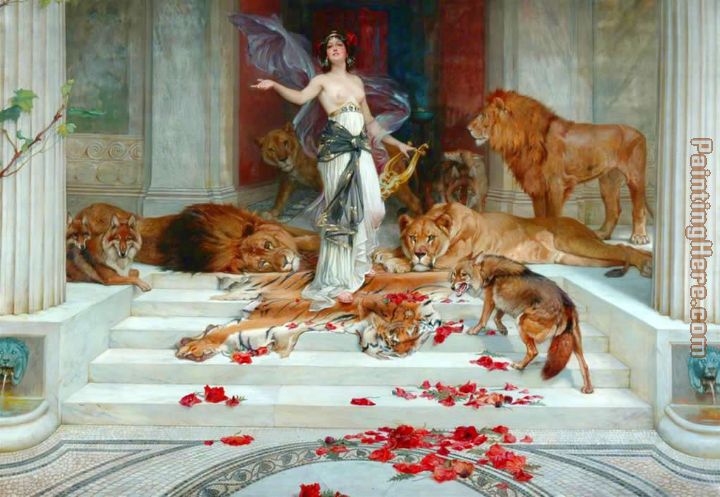 |
| Circe (1889) by Wright Barker |
The most important thing to these gods is their reputation. They are
similar to the Knights of King Arthur, who vied for quests to prove their
honour, but these gods want only fame – they don’t care how they come by it. Most
mortals also want fame above anything: when Odysseus travels to the underworld
to consult Tiresias, the blind seer, Achilles tells him it is better to live a
quiet life than die a hero’s death. He disagrees. When Telemachus turns down
Athena’s offer of adventure, she is bewildered. “There will be no songs made of
you. No stories. Do you understand? You will live a life of obscurity. You will
be without a name in history. You will be no one.”
Miller uses the style of Homeric language and epithets about Helios, “My
father’s chariot slipped into the sea and began to douse itself in the waves” but
she also has an individual style as she reinterprets classic myth from a modern
angle and damns the ostensible glory of the gods.
After displeasing her father, Circe is exiled to an island, Aiaia, which
she cannot leave, but she can receive visitors (including Hermes, Jason and
Medea, Daedalus, and, of course, Odysseus). She becomes a magnet for reckless
and randy sailors (these are the ones she turns to swine as they try to rape
her) and her island a place for disgruntled fathers to send their
disobedient daughters, like some mythical convent. She casts her feminist
viewpoint on her treatment. “Brides, nymphs were called, but that is not really
how the world saw us. We were an endless feast laid out upon a table, beautiful
and renewing. And so very bad at getting away.”
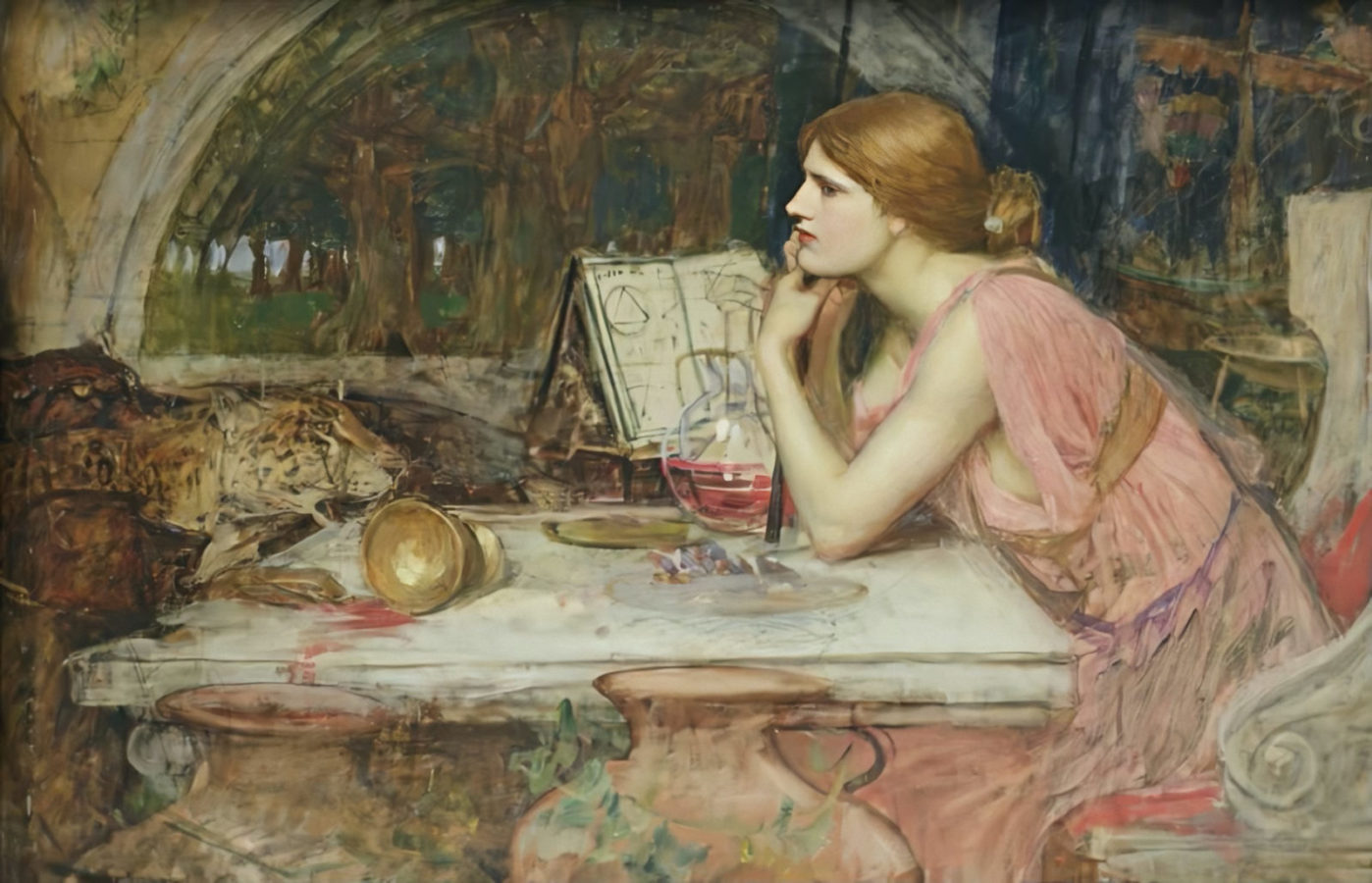 |
| The Sorceress (1911) by John William Waterhouse |
Circe’s story is one that has only previously been told through the eyes
of others and the tangential effects she has on their narrative. Miller
presents us with another side to wily Odysseus, “The spiral shell. Always
another curve out of sight.” She also shows us a fresh perspective on Penelope
when Odysseus’ wife and son visit Circe on Aiaia, and the use of the word ‘weaving’
to describe spells and craft unites the women through something other than the
lover and mother trope.
 |
| Circe and Her Swine (1896) by Briton Riviere |
Subscribe to:
Posts (Atom)