- Caligula - Performative Theatre Company, ACT Hub: Albert Camus' absurdist 1944 play explores the existential crisis of the Roman Emperor Caligula following the death of his sister and lover, Drusilla. Convinced that all life is meaningless, he determines to behave exactly how he wants, which is with hedonism that inspires terror, treating those around him as playthings and becoming a conspirator in the plot to end his life (and reign) through a journey into insanity. Mischa Rippon delivers a magnificent performance in the titular role commanding the stage and demonstrating a great rapport with the audience and other characters, managing to portray the switches between charming and chilling that the pyschotic Roman Emperor demands. The fantastically creative use of the space (another triumphant set design by Kathleen Kershaw) - soft benches/tables, shiny screens, and the all-imposing cracked marble bust - hint towards an asylum-esque atmosphere, while the superbly developed costumes (Alex Elwood) are adapted to suit character and tone. Likewise the lighting design (Euan Tregurtha) is an innovative mix of front, back and side lighting with judicious and effective black outs, while the underlying sound (Paris Scharkie) creates tension and segues from external to internal, so the audience feel the constant anguish of the 'mad' protagonist. Despite a couple of technical set issues, this is a sublime performance of a production that can be desperately dull and ponderous. Director Isaiah Pritchard is to be celebrated for the creative vision evident in the cohesion of elements and design from acting, sound, lights, set and costumes. There is evident method in this madness.
- Kerosene - Off the Ledge Theatre, The Courtyard: This 50-minute solo monodrama (didn't we use to call it a one-person play?) by Benjamin Nichol is a great vehicle for a performer, as they explore themes of love, loneliness, obsession, abuse, and revenge. Winsome Ogilvie has great energy playing Millie as she narrates the events of her deteriorating relationship with her best friend that culminate in a catastrophic cathartic event (the clue is in the title). Her diction and delivery are accomplished and her rapport with the audience is similarly impressive, although there are elements of stasis in which the highs and lows weren't quite high or low enough, leaving the performer with nowhere to go, and a few more pauses would have assisted tension. It is difficult to tell if the limited variation is due to performer or direction. Director Lachlan Houen has set it on a completely bare stage with no props, meaning the lights (Lachlan Houen and Liah Naidoo) and sound have to do a lot of heavy lifting. The lights do indeed highlight mood and intensity through innonative positioning, and there is some astute use of sound (Fergus Mashman), although bearing in mind the lack of other elements, more would have added contrast and points of interest. In general, this is a bold presentation of emotion and storytelling but it is not entirely engaging and drags in places.
- 5 Lesbians Eating a Quiche - Everyman Theatre, ACT Hub: In another great vehicle for five female presenting actors to enjoy some solid characterisation, the play centres around the members of the Susan B. Anthony Society for the Sisters of Gertrude Stein - an all-female community group that deeply worships quiche and promotes strict, wholesome 1950s domesticity; trad wives of the middle American kind. During their annual breakfast and quiche-judging competition, atomic sirens sound causing the women to barricade themselves in their basement fallout shelter, where secrets and hidden desires can't help but surface. It's improbable and ridiculous but works, as comedy always does, because the actors are committed to their roles and play the laughs straight, allowing the audience to discover the fun themselves. All of the actors bring strong performances, especially Sian Harrington as Ginny, the newcomer to the group, with intelligent choice of accent (Geordie), expressions and genstures providing excellent individual and ensemble work which is a delight to watch. The others are skilled at the comedy as Steph Roberts plays Wren with just the right level of restraint (although her accent is all over the shop), Ylaria Rogers is brittle and charming as Dale in a fun role for her with an innocent conviction that is almost poignant, and Meaghan Stewart bravely delivers a 'New Yoik' gangster accent (which also wavers a lot) and a can't-go-wrong-with-it Rosie the Riveter stance. As the ostensible leader, Crystal Mahon is slightly overshadowed as Lulie by the other big performances, and appears reluctant to leave the actor behind to become the character, resulting in a relatively monotonous performance. The costumes (Fiona Leach) are a visual treat, being wonderfully evocative of time and character, practically telling a story of their own and Nikki Fitzgerald does solid work with the sound and light gags, as highlighted per script. Director Jarrad West also designed the set, which is well-suited to the piece - functional and aesthetically engaging. He brings out the best in his cast and creatives to honour the intent of the piece without heavy-handed intrustion. Having said that, this is designed as a 75-minute one-act comedy (beloved of fringe festivals), and while I understand the need for bar sales, the introduction of an interval meant the second half drags - the play loses its way a little after the metaphorical bombshell, and the first-half fun, frivolty and engagement seems a little distant towards the end.

- Izzard: The Tragedy of Hamlet - Bohm Presents, The Playhouse: Eddie Izzard presents a one-person take on Hamlet, with no set or costume changes and very few lighting or sound effects (except for the ghostly battlements and the playing of the ghost of Hamlet's father). As a lover of Shakespeare, I found it intriguing to see how she portrays all the different characters with moderations to voice and expression, drawing on her experience as a street performer. Others, less familiar with the tragedy of the Great Dane, found it extremely difficult to follow. Ophelia's scene of betrayal and bemusement and her bestowing of flowers and herbs is touching, and the fights that Hamlet has with Laertes are amusing as the sight of a person best known for their comedy fighting with themself will by necessity be played for laughs. Rosencrantz and Guildenstern are presented as hand puppets, which also adds an element of levity to the drama, although it must be confusing to comprehend Claudius' reaction to the play within the play that Hamlet devises to 'catch the King' without prior knowledge of the plot. It is delighfully restrained and not at all hammy, which would be easier and tempting to produce. I would not recommend this for a newcomer to the play, but for officionados who wish to concentrate on the delivery of the text, there can be few better exercises.
- The Glass Menagerie - Canberra Repertory Society, Canberra REP Theatre: It is an interesting choice to produce this lesser-known version, which pays off in an engaging production in which the characters feel believable rather than the museum pieces they so often are. The technical aspects add to the vision in a cohesive production which is a pleasure to watch. Rob de Fries plays Tom as an older man looking back on his past, with believable cynicism and superciliousness, although the spell is broke occasionally when the accent drops out. As his mother, Victoria Tyrrell Dixon plays Amanda with a fierce delusion that powers the production, and his sister, Laura, is given a fine portrayal of innocence and lack of ambition by Jamie Johnstone. As Amanda attempts to force her daughter into society (where her sole job is to get a husband and a means of financial support), she cringes back into her fantasy world of glass animals with a hint of guile that makes her intriguingly irritating rather than the simple victim often depicted. Shattering this far-from-peaceful idyll comes Jim (John Whinfield), Tom's work colleague who is set up as a beau for Laura on very little evidence other than that he has a penis and a pulse. Whinfield delivers a strong performance with a loathsome sense of entitlement and mansplaining that makes one want to wipe the smirk off his face. Tennessee Williams is so specific about his lighting that this is often tiresome, but here it heightens the falsity of memory aspect. The highlighting of the menagerie and the portrait of the departed father figure are perfect, and I am a sucker for a mirror ball. I have seen this play many times, but not this version as a 'memory play'. I think this works admirably and is one of the few times I have ever seen the technical specifications of Williams interpreted so well.
- The 39 Steps - N.U.T.S., Ralph Wilson Theatre: Exactly what one might expect of a student production; their friends and family will love it, and everyone involved will be thoroughly pleased with themselves. For someone without connection to the participants it drags, despite some of the delivery being too shrill and fast to be intelligible, and some of the performances tip into self-indulgence. There are too many unearned pauses and lack of comedic understanding. James Seymour in the lead role of Richard Hannay is the only one who looks like they know what they are doing - basically trying to entertain an audience and further a plot - despite the lack of direction and focus-pulling from the rest of the cast. Extensive breaks for set changes between scenes are unnecessary and lose the frenetic energy the piece should have, making it instead an exercise in drama school self-satisfaction. The famous hat scene was chaotic and not in a good way. I agree with the line, 'Just get on with it'.
- Helios - Wright and Grainger, The Courtyard: The collaboration of Alex Wright (words) and Phil Grainger (music) brings modern interpretations of Greek myth to a global audience, via Yorkshire. Helios and Selene played on alternate nights and back-to-back and, with each show calling in at about an hour, you can experience them both in an evening, which is what I did, starting with Helios. The myth, attributed to Euripides, concerns Helios, whose winged-horse chariot draws the sun across the sky each day, and his son, Phaeton, who insists he be allowed a go, only to find his abilities do not match his bravado, as he loses control of the steeds and the chariot threatens to plunge to earth. Of course, Zeus intervenes and strikes Phaeton down with a lightning bolt. Here, one man, Alexander Wright himself, commands the stage, standing in a sacred circle of lightbulbs and connecting with the audience as he tells us his story. It is as simple as that, and yet an incredibly enriching experience. He weaves a narrative of fast cars and teenagers, boasts, dares and risk, loss of concentration, and blinding sunrises on bridges. The bond between a busy father and a stroppy son is all too real and utterly heartbreaking. As he literally invites the listeners into his tale (handing out printed sheets for them to read when he needs another voice for a character), he proves that storytelling is an art and, when done well, it is absolutely spellbinding.
- Selene - Wright and Grainger, The Courtyard: And as night follows day, we come to Selene, the sibling show. It is gloriously calm and strong, described as 'a story about the goddess and the dark side of the moon'. As in the previous show, it focuses more on the offspring than the titular god, in this case, Pandida (known in her youth as Panda), the daughter of Zeus and the moon goddess, Selene. Her coming-of-age tale involves scholastic arguments with boys, a profound interest in the moon landings, midnight moonlight swims, night clubbing raves, and the majesty of an eclipse. Megan Drury is the performer who guides and supports us through this story, with warmth and compassion in what is a deeply tender and transformative experience.
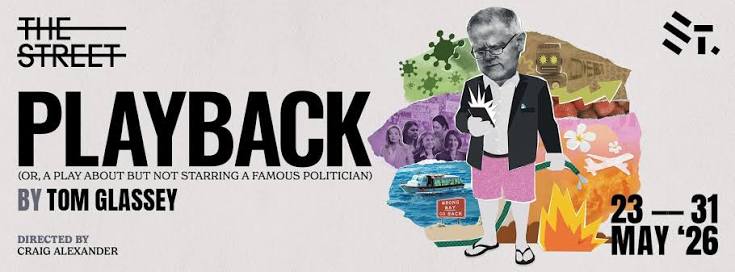
- Playback (Or, a Play About But Not Starring a Famous Politician) - The Street Presents (Resident Street Program), Street 2: In childhood development, 'playback' refers to how children process, practice, and replicate experiences through play. This cycle allows them to make sense of the world by reenacting real-life scenarios, testing rules, and consolidating their cognitive, linguistic and social skills. In theatre terms, playback refers to an interactive style of improvisational theatre in which audience members share real-life personal stories and watch actors enact them on the spot. This play draws on the playwright's (Tom Glassey) experience working in the Canberra press gallery and explores how media framing, editing, soundbites and deconstruction of truth shape modern politics. Blending traditional stage elements, live-video projections and screen editing, the production captures the media landscape in a totally engrossing manner. Deborah Grant who was 'aged out' of broadcast television now hosts the Proper Gander podcast and has the opportunity to interview Scott Morrison. She has painstakingly prepared and has questions she is determined he will not evade. She is assisted by a Young Man who turns up wanting to be an intern but with no apparently relevant skills and who threatens to be more hindrance than help. Casting Andrea Close as Deborah is a stroke of genius - as well as being a fantastic actor, she was also a journalist and presenter for the ABC for a decade and subsequently a media and communications manager for several high-level organisations. Her understanding of the inherent manipulations and machinations is confident and captivating, bringing both pathos and humour to the role that reveals the personal face of federal politics. Meanwhile, Tyker Jenkins is a quick-witted foil to her anguish, his improvisation skills perfectly suited to the chameleon character of the unprincipled ambitious apprentice, or the many faces of the former PM. Criag Alexander's direction is as tight and slick as the videography which highlights and supplements the on-stage action to deliver a resoundingly good play. Full disclosure: I was involved in an initial workshop of this play back in December 2024, so it is fascinating to see how far it has grown.
- The Good Boy Game - Q the locals, The Q: An interesting play, but the production lacked any cohesion or vision with certain style elements (mainly sound) prioritised over substance (acting and theatrical unity). A young man, James (Alastair McKenzie) writes in his diary that he wishes to kill his classmates, so his parents, Mary-Beth (Giuliana Baggoley) and Sam (Bruce Hardie) lock him in the loft and try to de-radicalise his teenage urges. Meanwhile, Mary-Beth is seeing a counsellor, Judith (Elaine Noon), who suggests she try a points-based reward system - the Good Boy Game of the title - to encourage James to more acceptable behaviour. Apparently, this is a world premiere of a new work by Petrick Vermillion, so the overwhelming similarities with Bartek Bartosik and Naqqash Khalid's script for the film, Good Boy must be entirely coincidental. Baggoley and Hardie have limited rapport and barely seem to be listening to the other actors; McKenzie is suitably entitled and whiny (albeit with diction and projection issues) but lacking in strength, anger and threat, and Noon has an intelligence and commitment to the character which is in such contrast to the others that she seems to be in a different play. The set delineates the spaces well although much of the decisive action is at the back of the stage, and garage/ grunge intros to scenes are highlighted with projections of time and place. Unfortunately, it smacks of enfant-terrible-directing (Caitlin Baker); wanting to be provocative but unable to translate into a clear vision. There are too many disparate elements to make a harmonious production. Reading the play opens up many avenues of enquiry – this production doesn’t follow any of them through.