Showing posts with label Pro Hart. Show all posts

Tuesday, 23 January 2024

What Lies Beneath? The Opal Desert


The Opal Desert by Di Morrissey
Macmillan
Pp. 406

Di Morrissey sets place extremely well. In her dozens of novels, the scenery and landscape are immediate and infinitely better drawn than her characters or plotlines. The Opal Desert is, unsurprisingly, set in Lightning Ridge, Broken Hill, Opal Lake, and White Cliffs, where most people are exceptionally friendly and we learn about the precious stones and the community who mine them. The three women around whom Morrissey tells her tale, Kerrie, Shirley and Anna, are all fairly predictable stereotypes who overcome their personal obstacles in life-affirming ways, which may not be realistic, but are heart-warming.

Kerrie is our main character who realises, after her sculptor husband dies, how much he absorbed her life into his, and that she doesn’t get on with his children. For spurious reasons (a recommendation from a friend’s lawyer), she decides to head to opal country to find herself and reconnect with her own artistic side. She encounters a land rich with visual treasures, art galleries and bush art, inspired by painters such as Pro Hart and Jack Absalom. She admires the light and bright colours.
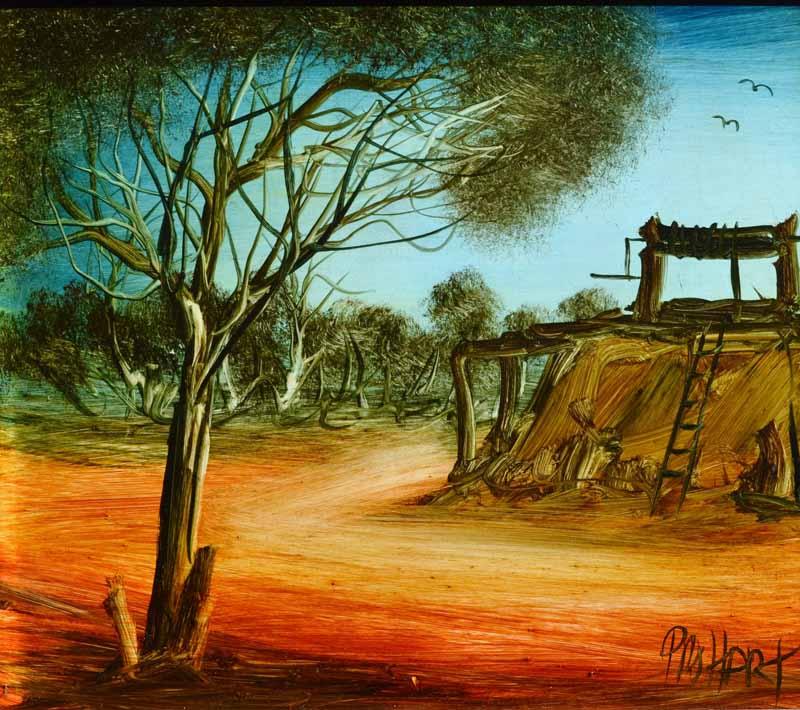
The Windlass by Kevin Charles (Pro) Hart

Naturally, Kerrie also learns about the flash of opals – white, fire, black – and their addictive appeal. She appreciates the act of opal mining because it is “relatively small-time… unlikely to ever become a huge and invasive industry like gas, oil and iron ore.” As well as the beautiful stones, she learns, “Sometimes miners dig up fossils of shells and sea creatures, even dinosaurs.” She is told that, “Australia is the only place in the world which has opalised animal fossils. They’re not only beautiful, but important scientifically.” There is some friction between those who want to collect the fossils for their historical value, and those who want to break them up and create unique pieces of jewellery for sale. This is an interesting aspect of the book and even non-geologists will appreciate the basic descriptions of which rock formations lead to which varieties of opals.

Our next character is Shirley, an elderly woman who lives in a dugout she rarely leaves (due to a mysterious past event), but she socialises with everyone. “Shirley’s just Shirley, but she knows a bit about everything. She’s our local historian, sort of. Lovely, lovely lady.” Shirley decides to record the stories of the old miners so they might pay testament to a way of life that was fast disappearing. “The mantle of keeper of the stories, the one who held remnants of a life that might otherwise be forgotten, settled gently and easily on Shirley’s shoulders.” Di Morrissey’s evocation of time and place make her a type of archivist too.

People who mine (and live underground) are often a little odd; they live on the fringes and have personal reasons for being there. One character states, “I like going out to the opal fields. Special people out there, too. There’re some gems, some oddballs, some creative types and those with opal fever. It’s a place that affects everyone. There are friendly people, and most don’t ask questions, but there are also shady characters and blatant sexism. When the young woman, Anna, is introduced, she has justifiable concerns about the tactile and intrusive nature of some men she encounters. Others become paranoid, afraid of gangs coming to steal their stones. “It’s not always sunshine and glittering opals… the dark underbelly of the opal fields… murders, mystery, ratters and ratbags.”

Beneath the rose-tinted idealism, lies hidden bias and unconscious racism. Young Shirley tells her partner, Stefan, “Our history comes from the continent itself, the landscape, and the opportunities for people to carve their own paths, using their skills and knowledge.” This becomes complicated when she ignores Aboriginal history, “It must be stultifying being lumbered with thousands of years of history. Here, in Australia, you have the opportunity to be creative and original without the burden of the past. This country is like a clean slate.” Clearly this was written before the words ‘young and free’ in the Australian national anthem were changed to ‘one and free’ in an attempt to ‘foster a spirit of unity’, acknowledge ‘the fact that we have the oldest continuous civilisation on the planet right here with First Nations people’ and ‘honouring the foundations upon which our nation has been built and the aspirations we share for the future.’

Many people head to the opal fields for a change of pace, which is admirable. One character states, “We all need time out, as they say, on occasion. But that’s all it should be, a space between decisions. It becomes very easy to drift. You see it happen out here and before you know it, you’ve lost a great chunk of your productive life.” This begs the question, why must you be productive; what is the definition of produce – is it capitalist growth, and is that why Indigenous culture is ignored because it doesn’t visibly contribute to the GDP? What is wrong with “drifting”? Perhaps it has to do with the nature of Morrissey’s storytelling, in which all is tied up neatly at the end. It seems easy to get to be a curator, train for world athletic events or have an exhibition of paintings. Other character’s mysterious circumstances are cleared up in a page or two and everyone gets closure. This makes the people instantly forgettable (so much for recording their stories) but the landscape lingers in the mind.

Lightning Ridge

Friday, 17 March 2017

Exposure to the elements: Broken Hill Regional Art Gallery

Rick Ball in front of three of his paintings
The artists featured in the Broken Hill Regional Art Gallery are unsurprisingly obsessed with the elements - many of the works incorporate earth, wind, fire and water (or rather, the lack of it). The area relies heavily upon the water found in the Murray Darling River systems, and it is diminishing rapidly. Apparently, when full, the four lakes of the Menindee Lake System hold more than three times the volume of water of Sydney Harbour.

Curiously, there has been a lot of rain recently, and Lake Menidee is full for the first time in three years. This does not lessen the ecological crisis gripping the region and environmental concerns for the future of the towns. When we visited, the exhibition, Contemporary Primeval, highlighted the work of Rick Ball and Ann Evers, and through paintings and sculpture they both addressed this issue.

Rick Ball's expansive canvases relate in an abstract fashion to his surroundings. Having lived in Broken Hill for the last 25 years, he also acknowledges the influence of mining in his images. He claims to be an interpreter for the land rather than a painter, and he layers natural pigments and substances onto each creation. Paint, sand, crushed shells, vermiculite and tennis-court whiting are all present, recalling handfuls of colourful mining deposits thrown against the linen.


Many of his works are triptychs or multiple canvases positioned side to be side to try to capture the enormity of the landscape. Sydney and the Bush is awash with purples, pinks, reds; great gobs and streaks of oil as the city seems to emerge from the bush over it's iconic bridge, or is it being swallowed up and returned to nature? In Evening stroll beside Lake Menindee before the water disappeared we see long human shadows at sunset, or are these aerial images of dried-up riverbeds? Questions are left unanswered, but the physicality of the work is unmissable. In a co-operative touch, each artist has supplied a brief introduction to the other's art.
“All ideas of art being a ‘beautiful illusion’ have been banished from the room. Instead we are surrounded by images that are both strange and familiar in equal measure. One is reminded of the stories of those first Europeans as they confronted this continent’s trees, animals and human culture. While very young, Rick says that he felt inundated by the ancientness of the natural world, while his human world was generally obsessed with newness.” – Ann Evers 
Singing in the Barrier Ranges by Ann Evers
In turn, he writes of her art;
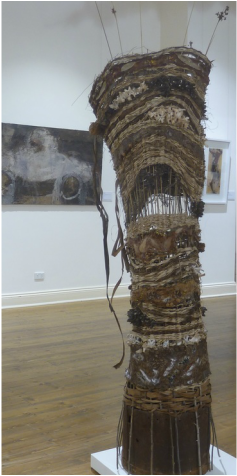
Ann Evers’ unusual fibre art holds the element of surprise. Her clever use of materials as a weaver is like a bird’s use of skin, bones and feather for flight. Evers is no mere basket-maker. Each piece of her work, large or small, is a story of time and of place. She is a weaver of stories and materials, of nature and culture. She weaves the north to the south. Sharp humour abounds alongside an equally abundant earthy circumspection, obvious in any exhibition of her work.– Rick Ball
She incorporates found objects into her sculpture giving them elements of both traditional and contemporary reference. Into pit-fired pots woven with natural fibres, bark and wire, she places bones, sticks, rocks and seeds. Three tall twined vessels of Singing in the Barrier Ranges include arid land snail shells, baby clams, local seedpods and capsules; all held together with rock sida, lignum and sedge, used as uprights. 

Ann Evers with some of her creations
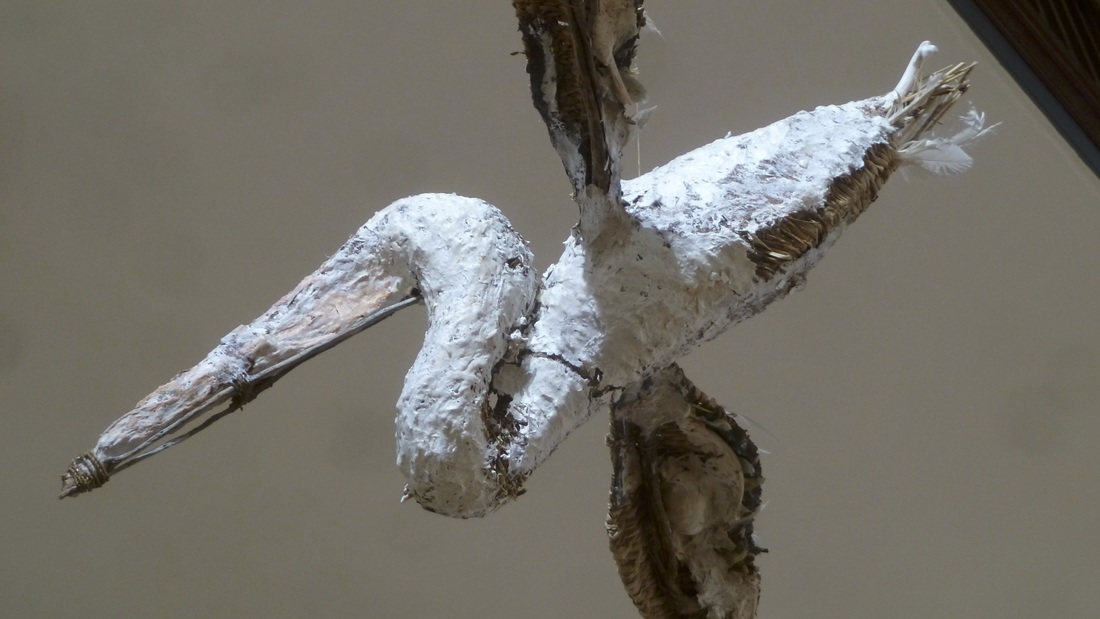
Waiting for Water comprises six figures in flight made from handmade paper and pigment, handmade string and linen thread. All other materials are collected on and around the beach of the "now-empty lake Menindee". Serving as monuments to times past and receptacles of foretold growth, these creations hang from the ceiling indicating impermanence and fragility. 

Waiting for Water by Ann Evers
The gallery is housed in the former Sully's Emporium and has won numerous heritage awards for the restoration and refurbishment of the building. Its wooden floors and dramatic staircases provide a fantastic counterpoint to the artworks. There are all the usual still lifes; portraits; landscapes; naïf art; abstracts; Aboriginal animal spirits; story poles; dot art and granite sculptures, but some pieces stand out to make a statement. 

Clarendon Spring, Make Sure the Sun Wipes It's Feet (1984) by John Olsen
I love the riot of colour primarily mustard yellows – as swirls and tendrils connect like cells in John Olsen's vivid Clarendon Spring, Make Sue the Sun Wipes Its FeetLana Roberts has rolled up ties and stitched them together, separated by beads, into a series of necklaces called Men’s Dress Ties Revisited­. Sidney Nolan's Little Boy Lost is both disturbing an uncomfortable as a small child all in white and wearing a sunhat stands starkly against a background of red earth and ominous sky, calling to a primal fear in all of us of alienation and abduction.

Little Boy Lost (1983) by Sidney Nolan
Another iconic Australian artist, Kevin Charles (Pro) Hart is featured with The Yabbie Catchers, as little figures in bright colours both stand out from and are dwarfed by the enormity of their environment - the trees and river are far more timeless and enduring than their uncertain activities.

The Yabbie Catchers (1987) by Pro Hart
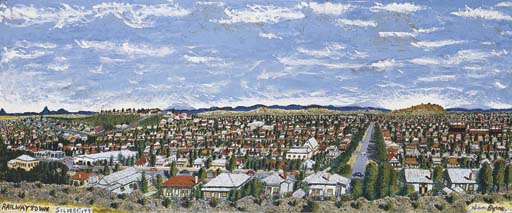
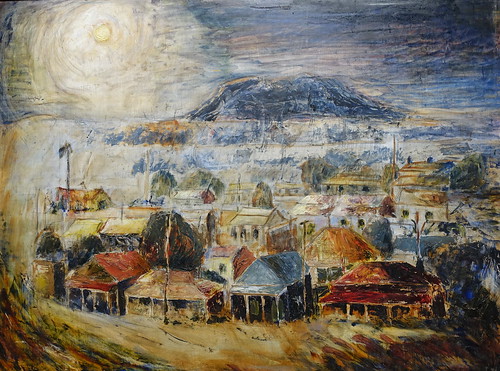
Images of Broken Hill itself range from the sublime to the surreal. Sam Michael Byrne gives us bright colours and highlighted dots to display prosperous streets with a Toytown perspective in Silver City (1957), whereas Eric Minchin's North Mine (1970) is in bleached tones with dramatic greys and streaks of orange. Meanwhile the houses in the foreground of May (Florence) Harding's Broken Hill, Nocturne (1967) are all but overshadowed by the burning orb and the looming mine, which dominate the landscape. 

Silver City (1957) by Sam Michael Byrne
Broken Hill, Nocturne (1967) by May (Florence) Harding
A spectacular red gum sculpture highlights the work of Badger Bates and his symbolic lino cuts. Plesiosaur and Ngatyi: The Past, the Present and the Future (2003) represents the future of the Darling River through the fact that an opalised Plesiosaur was found at White Cliffs, bringing tourists, scientists and historians to examine the archaeological marvel. Ngatyi is the Rainbow Serpent of Aboriginal mythology; a creator god, which gives life through its association with water, but acts as a destructive force when angry - once again reminding us of the elements and the regional geography. In this carving the two beasts are intertwined with their heads together symbolising reconciliation, as we must work together to protect our country. 

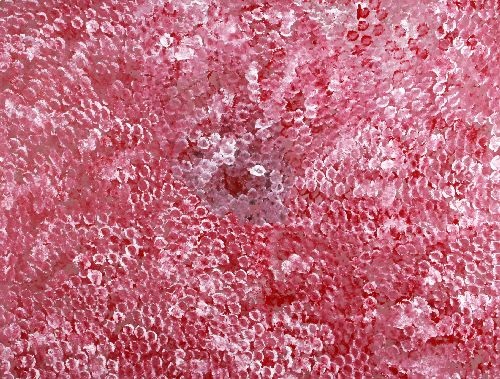
But I'll finish this post with this powerful picture of a flood of pink flowers in calming, swirling patterns; blooming with unexpected beauty in the middle of the desert - just as Broken Hill itself is a small oasis of society in the middle of a vast swathe of nothing.

Wildflowers Dreaming by Emily Kame Kngwarreye