Showing posts with label The Opal Desert. Show all posts

Tuesday, 23 January 2024

What Lies Beneath? The Opal Desert


The Opal Desert by Di Morrissey
Macmillan
Pp. 406

Di Morrissey sets place extremely well. In her dozens of novels, the scenery and landscape are immediate and infinitely better drawn than her characters or plotlines. The Opal Desert is, unsurprisingly, set in Lightning Ridge, Broken Hill, Opal Lake, and White Cliffs, where most people are exceptionally friendly and we learn about the precious stones and the community who mine them. The three women around whom Morrissey tells her tale, Kerrie, Shirley and Anna, are all fairly predictable stereotypes who overcome their personal obstacles in life-affirming ways, which may not be realistic, but are heart-warming.

Kerrie is our main character who realises, after her sculptor husband dies, how much he absorbed her life into his, and that she doesn’t get on with his children. For spurious reasons (a recommendation from a friend’s lawyer), she decides to head to opal country to find herself and reconnect with her own artistic side. She encounters a land rich with visual treasures, art galleries and bush art, inspired by painters such as Pro Hart and Jack Absalom. She admires the light and bright colours.
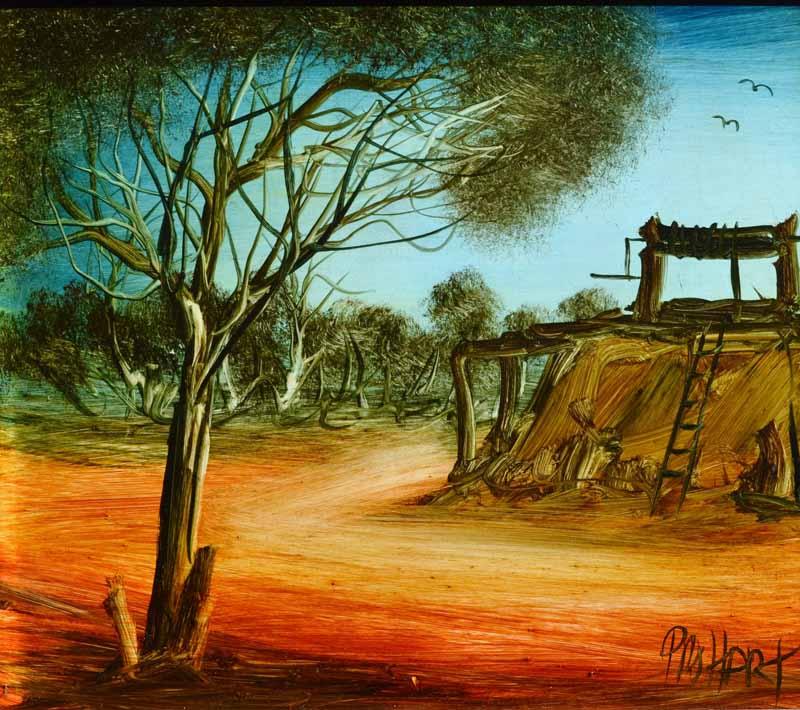
The Windlass by Kevin Charles (Pro) Hart

Naturally, Kerrie also learns about the flash of opals – white, fire, black – and their addictive appeal. She appreciates the act of opal mining because it is “relatively small-time… unlikely to ever become a huge and invasive industry like gas, oil and iron ore.” As well as the beautiful stones, she learns, “Sometimes miners dig up fossils of shells and sea creatures, even dinosaurs.” She is told that, “Australia is the only place in the world which has opalised animal fossils. They’re not only beautiful, but important scientifically.” There is some friction between those who want to collect the fossils for their historical value, and those who want to break them up and create unique pieces of jewellery for sale. This is an interesting aspect of the book and even non-geologists will appreciate the basic descriptions of which rock formations lead to which varieties of opals.

Our next character is Shirley, an elderly woman who lives in a dugout she rarely leaves (due to a mysterious past event), but she socialises with everyone. “Shirley’s just Shirley, but she knows a bit about everything. She’s our local historian, sort of. Lovely, lovely lady.” Shirley decides to record the stories of the old miners so they might pay testament to a way of life that was fast disappearing. “The mantle of keeper of the stories, the one who held remnants of a life that might otherwise be forgotten, settled gently and easily on Shirley’s shoulders.” Di Morrissey’s evocation of time and place make her a type of archivist too.

People who mine (and live underground) are often a little odd; they live on the fringes and have personal reasons for being there. One character states, “I like going out to the opal fields. Special people out there, too. There’re some gems, some oddballs, some creative types and those with opal fever. It’s a place that affects everyone. There are friendly people, and most don’t ask questions, but there are also shady characters and blatant sexism. When the young woman, Anna, is introduced, she has justifiable concerns about the tactile and intrusive nature of some men she encounters. Others become paranoid, afraid of gangs coming to steal their stones. “It’s not always sunshine and glittering opals… the dark underbelly of the opal fields… murders, mystery, ratters and ratbags.”

Beneath the rose-tinted idealism, lies hidden bias and unconscious racism. Young Shirley tells her partner, Stefan, “Our history comes from the continent itself, the landscape, and the opportunities for people to carve their own paths, using their skills and knowledge.” This becomes complicated when she ignores Aboriginal history, “It must be stultifying being lumbered with thousands of years of history. Here, in Australia, you have the opportunity to be creative and original without the burden of the past. This country is like a clean slate.” Clearly this was written before the words ‘young and free’ in the Australian national anthem were changed to ‘one and free’ in an attempt to ‘foster a spirit of unity’, acknowledge ‘the fact that we have the oldest continuous civilisation on the planet right here with First Nations people’ and ‘honouring the foundations upon which our nation has been built and the aspirations we share for the future.’

Many people head to the opal fields for a change of pace, which is admirable. One character states, “We all need time out, as they say, on occasion. But that’s all it should be, a space between decisions. It becomes very easy to drift. You see it happen out here and before you know it, you’ve lost a great chunk of your productive life.” This begs the question, why must you be productive; what is the definition of produce – is it capitalist growth, and is that why Indigenous culture is ignored because it doesn’t visibly contribute to the GDP? What is wrong with “drifting”? Perhaps it has to do with the nature of Morrissey’s storytelling, in which all is tied up neatly at the end. It seems easy to get to be a curator, train for world athletic events or have an exhibition of paintings. Other character’s mysterious circumstances are cleared up in a page or two and everyone gets closure. This makes the people instantly forgettable (so much for recording their stories) but the landscape lingers in the mind.

Lightning Ridge

Friday, 28 July 2023

Friday Five: Books Read in July


Books read in July:
  1. Quichotte by Salman Rushdie - Shortlisted for the 2019, Quichotte, is a breathtakingly sophisticated novel of postmodern genius, featuring a picaresque style and a desperately ordinary protagonist. Sam DuChamp is an Indian-born writer living in America, who has written a number of unsuccessful spy thrillers. Hoping to write a book "radically unlike any other he had ever attempted", he creates the character of Ismail Smile, a travelling pharmaceutical salesman. Having worked for unscrupulous companies and suffered a stroke in old age, Smile begins obsessively watching reality television and becomes infatuated with 'celebrity' and former Bollywood star, Salma R. Despite having never met her, Smile sends her love letters under the pen name of Quichotte and begins a quest for her across America with his imaginary son, Sancho. It is a spectacular piece of literary satire, which confounds simple synopses, as it is impossible to separate what is 'real' and what is not. That is clearly no accident in this post-truth society in which we find ourselves. 
  2. The Opal Desert by Di Morrisey - Di Morrissey sets place extremely well. In her dozens of novels, the scenery and landscape are immediate and infinitely better drawn than her characters or plotlines. The Opal Desert is, unsurprisingly, set in Lightning Ridge, Broken Hill, Opal Lake, and White Cliffs, where most people are exceptionally friendly and we learn about the precious stones and the community who mine them. The three women around whom Morrissey tells her tale, Kerrie, Shirley and Anna, are all fairly predictable stereotypes who overcome their personal obstacles in life-affirming ways, which may not be realistic, but are heart-warming. Many people head to the opal fields for a change of pace, which is admirable. One character states, “We all need time out, as they say, on occasion. But that’s all it should be, a space between decisions. It becomes very easy to drift. You see it happen out here and before you know it, you’ve lost a great chunk of your productive life.” This begs the question, why must you be productive; what is the definition of produce – is it capitalist growth, and is that why Indigenous culture is ignored because it doesn’t visibly contribute to the GDP? What is wrong with “drifting”? Perhaps it has to do with the nature of Morrissey’s storytelling, in which all is tied up neatly at the end. It seems easy to get to be a curator, train for world athletic events or have an exhibition of paintings. Other character’s mysterious circumstances are cleared up in a page or two and everyone gets closure. This makes the people instantly forgettable (so much for recording their stories) but the landscape lingers in the mind.
  3. Bewilderment by Richard Powers - Shortlisted for the 2021 Booker Prize, Bewilderment is a deeply moving and powerful novel, set in the near future. It concerns the degradation of the planet in tandem with a father's love for his neuro-divergent son. In an interview for the Booker Prize, Powers said, "It is, in part, a novel about the anxiety of family life on a damaged planet, and for that, I'm indebted to writers as varied as Margaret Atwood, Barbara Kingsolver, Evan Dara, Don Delillo, and Lauren Groff." It is a rich novel full of connections as, grieving for the loss of the wife and mother, the two embark on a camping trip in the wilderness to heal through nature. When they return to the 'real' world of work and school - competition, conformity and bullying - they are introduced to AI technology which can help connect to memories of others and suggest life in parallel universes. Some reviewers have considered it didactic and claustrophobic. Perhaps this is intentional as, if we continue to ignore the environmental portents, are we endangering our own species as the world closes in on us? 
  4. Shit, Actually by Lindy West - Lindy West is a New York Times opinion writer and best-selling author who used to be the in-house movie critic for Seattle’s alternative newsweekly The Stranger – with a genuine adoration for nostalgic trash. In this humorous feminist revisionism re-evaluation of cult and classic films (re-watched during lock-down), she ranks all films against The Fugitive, which she thinks is the perfect film – Love Actually is the worst (why don’t any of the women actually talk?). Featuring rants, all-capital letters and italics, slang, swearing, and erratic punctuation, it reads like a teenager’s texts, complete with hashtags and initialisms such as YOLO and BTW. Other than Love Actually and Harry Potter and the Philosopher's Stone (called Harry Potter and the Sorcerer's Stone here), all the films are American blockbusters. As West writes, “I’m sorry but if there’s a British guy in a suit who talks in the first five minutes of your movie, he’s the villain! If it’s Tom Wilkinson, you’re fucked.”
  5. Lessons in Chemistry by Bonnie Garmus - I have read this for not one but two book clubs, for which it is the perfect fare. Although a brilliant chemist, Elizabeth Zott is not taken seriously because she is a woman in the 1950s and, “When it came to equality, 1952 was a real disappointment.” Because she is beautiful and intelligent, the only thing the men can think of to do with her is either mock her when she spurns their sexual advances, or suggest she present a cookery show. In scenes familiar from Julia Childs' biographies, Elizabeth teaches women about self-worth as much as cooking. She focusses on the chemical aspects of cooking as she continues to refute social norms and expectations. There are some tough, hard-hitting moments, but it feels overall uplifting, and the bright primary colour scheme of the mid-century domestic sphere will look enchanting on the small screen in the inevitable TV adaptation. As she defends the importance and influence of women, Elizabeth points out, "Chemistry is inseparable from life – by its very definition, chemistry is life. But like your pie, life requires a strong base. In your home, you are that base. It is an enormous responsibility, the most undervalued job in the world that, nonetheless, holds everything together.” 
  6. After Sappho by Selby Wynn Schwartz - Mostly what we have of Sappho’s work is of fragments of writing, and this novel emulates that style with short vignettes that feel like excerpts of longer works, all relating to great female creative artists; their work, loves and lives. They work together even if they have never met in a style of sisterhood. It includes snippets of laws passed against women and miniature biographies, which lead to further exploration. Men have been cut from the stories, as women have historically been, and their absence is no great loss, as they have dominated the narrative for too long. As the author writes, “What was a man’s life but the inalienable right to verbs of action? What might Vita [Sackville-West] have become, given the transitive and a pair of sturdy boots?”