Showing posts with label William Shakespeare. Show all posts

Friday, 6 February 2026

Friday Five: Books Read in January


The Secrets She Keeps by Michael Robotham (Sphere) - Male authors seem to think that all women want babies and will do anything to have them. Apparently, baby fever drives us crazy, which must be comforting for them to think that it isn't their oppressive patriarchal behaviour which has this effect. Meghan has a baby and Agatha wants it, so she befriends her to steal it (not a plot spoiler because it's obvious from the cover design). Despite being from supposedly different cultural backgrounds and socio-economic circumstances, the two women are written interchangeably in the first person, and its fortunate that each alternate chapter is introduced by their name or there would be no distinction between the two. Apart from the fact that one has a baby and one doesn't. Because, lest we forget, it is motherhood, or lack thereof, that defines the status of women. One of the characters, let's call her Megatha, literally says, "I am not a real woman because I cannot have a baby." Tedious. 
Hamnet by Maggie O'Farrell (Tinder Press) - Maggie O'Farrell has written a story about grief at the death of a child. That's a tricky subject and one she addresses well. She has made the child the son of William Shakespeare, although her refusal to name him as such and refer to him as the playwright in London or the Latin tutor or the son of a glove-maker seems perverse and artificial. There are wildly overblown sections of prose as she tries to talk about Shakespeare without talking about Shakespeare, including descriptions of the layout of the home of his birthplace, the attitude to ghostly figures, the very essence of iambic pentameter. The novel includes several quotes and themes from Shakespeare's plays and is written in the present tense, which becomes cloying as many things are revealed that are obvious with contemporary hindsight. In trying to diminish William Shakespeare and elevate Anne (called Agnes here) Hathaway, Maggie O'Farrell has done a disservice to both them and us in what feels like little more than fan fiction.
We Solve Murders by Richard Osman (Penguin) - Richard Osman created the wildly popular Thursday Murder Club, and now he has published a standalone novel, We Solve Murders, which looks perfectly set to be the beginning of a new series. The main characters are Amy Wheeler, an assassin/ private security officer to billionaires and her father-in-law, Steve Wheeler, who used to be in the business but now likes spending time with his cat, Trouble, and his quiz team down the pub. It is a fast-paced thriller packed with guns and humour. Influencers are being murdered in a spat between money launderers, but no one really cares about influencers because they are so shallow, until we meet Bonnie Gregor, one with a family and a conscience. Amy is meant to be protecting famous author, Rosie D’Antonio who loves flirting – with danger and men – as they encounter lots of action in multiple locations. There is a cast of hundreds and it’s quite hard to keep track of who is whom. It doesn’t really matter though, as the action, locations and opportunity for cameo roles all combine to make this novel a dying-to-be-made-into-a-film script, with actors queuing up to play the characters. It’s a very decent book with a central character who talks to his dead wife while sitting on a small bench by a quiet pond and is trying to come to terms with his grief and her absence.
Small Things Like These by Claire Keegan (Faber) - There is so much weight in such a small book (114 pages) as Claire Keegan questions, what is decency and humanity? "Was there any point in being alive without helping one another?" Bill Furlong is a coal and timber merchant trying to do the best he can for his family in a small, rural Irish town where half the population is emigrating. The Catholic Church dominates the village, the schools and the workforce, and folk turn a blind eye to some of their more insidious practices, such as the Magdalen laundries. With a solid nod to Dickens' A Christmas Carol, Bill has his eyes forced opened just before Christmas, and he has to make a decision rather than merely going with the flow. The language is exquisite as it settles into natural rhythms and their inevitable outcomes, with a beautiful Irish tilt. "So many things had a way of looking finer, when they were not so close. He could not say which he rathered: the sight of the town or its reflection on the water." In this instance less is definitely more.

Wednesday, 6 October 2021

My Newest Favourite Thing: Pieces of Shakespeare

Shakespeare's London
I have been posting updates on my blog about the puzzles I have been doing, but I feel that this one deserves a post of its own. This beautiful and rich image is by Adam Simpson; the puzzle is by Laurence King Publishing; and it was lent to me by Purple Lady.

There is an accompanying sheet (text by Neil Carter) that tells us all about the picture - it's superbly educational for younger folk interested in the bard, or those of any age starting out on their knowledge gathering, or those with experience who just want a bit of fun recognition. It states, "Shakespeare's London is alive with activity. The River Thames winds past the Globe Theatre on the South Bank, under London Bridge, and by the Tower of London in the east. Houses are tightly packed together in the city centre, but the outskirts quickly give way to open spaces and woodland nearby."

Naturally, when piecing the puzzle together, I did the river first, partly because the colour stood out, and partly because it is my river. I then did The Globe, because, well, it's the Globe.
 
The Globe
Henry V
The bear pit
Inside the Globe, there is a rehearsal for A Midsummer Night's Dream featuring the characters of Bottom, Titania and Oberon with an entourage of fairies and (my favourite thing) William Shakespeare with script and quill in hand overseeing the rehearsal. Outside "a man stands on a box addressing the crowd, wearing a crown and armed with sword and shield: this is Henry V delivering his rousing 'Once more into the breach, dear friends' speech." Nearby is the bear pit in which a bear has escaped its chains and is chasing its keeper, with a nod to the famous stage direction, ‘exit pursued by a bear’ from The Winter's Tale.

Macbeth
A Midsummer Night's Dream
Gravediggers on the edge
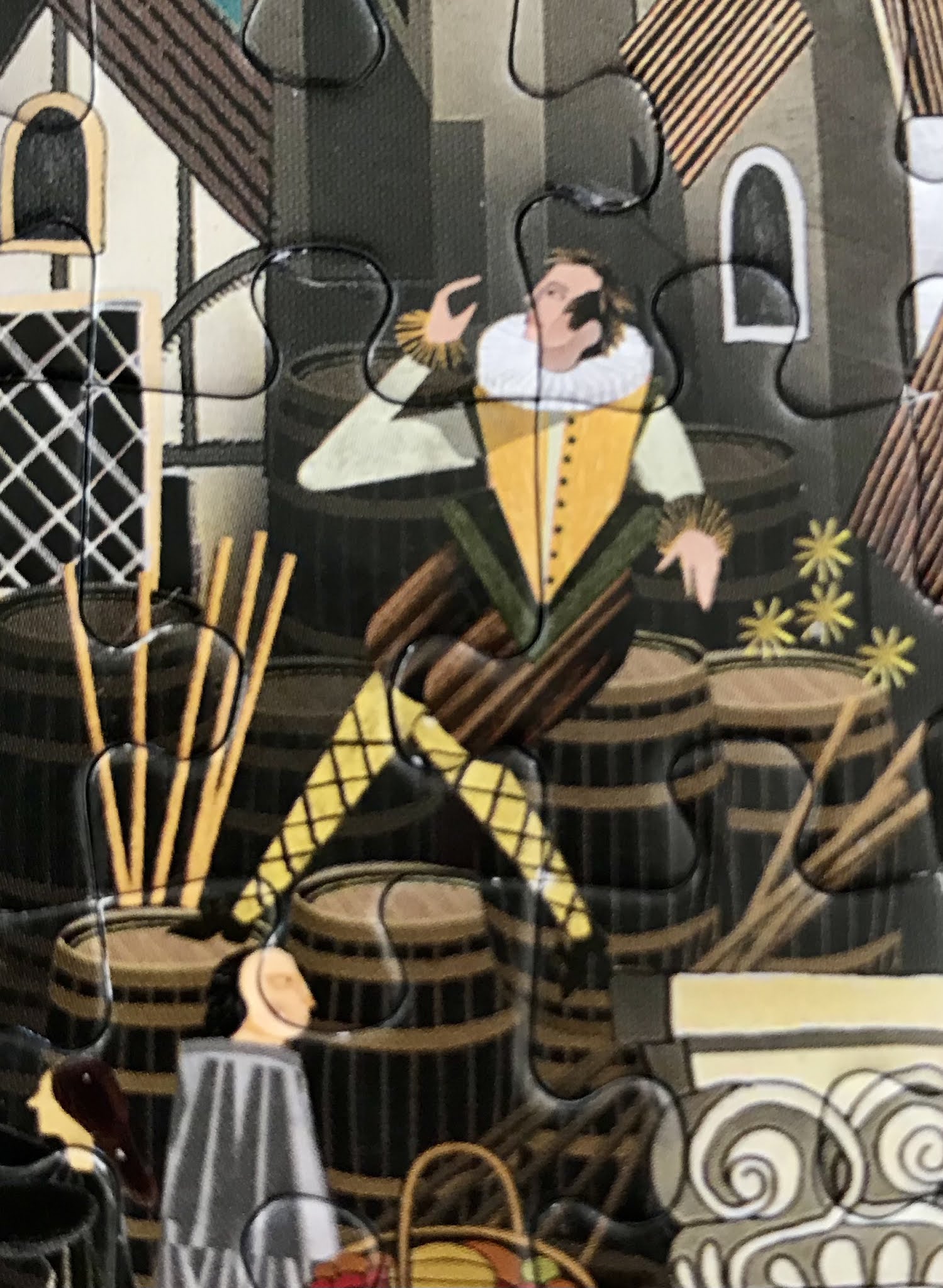
Next, I did the Macbeth scene, where the three witches are "engaging in nefarious practices", as Macbeth and Banquo ride up on their horses. At the edge of this scene are the pairings from A Midsummer Night's Dream (Demetrius; Lysander; Helena; Hermia) watched by Puck from the tree marvelling at 'what fools these mortals be'. In another section of the puzzle, the gravediggers from Macbeth lean on their spades for a break in their work. 

Hamlet
Romeo and Juliet
King Lear
Julius Caesar
Scenes from all the greatest hits are scattered throughout the picture. Let's start with the tragedies... Hamlet offers Yorick's skull to Ophelia in front of Gertrude and Claudius, while the ghost of Hamlet's father hovers above the scene. Romeo climbs up some steps to get to Juliet, who is hanging out of a tower, while Tybalt and Mercutio fight a deadly duel below. King Lear is flanked by his daughters Goneril and Regan, "desperately haranguing him on each side, while a third quieter and more beautiful daughter (Cordelia) watches from the sidelines." He is also accompanied by his fool and a mad beggar (Edgar).  

The Julius Caesar scene is interesting because, as a way of getting around the fact that it is totally anachronistic (even more so than the play itself), this is described as, "in a field a group of children playing dress-up in Roman costume are having a mock battle in the vein of Julius Caesar". Lurking on the edge of this vignette is an alchemist, trying to turn base metals into gold, "watched from the shadows by Ben Jonson frantically scribbling notes for his next play." This is not the only time Simpson places one of Shakespeare's contemporaries in the periphery.

A tavern featuring a scene from Othello in the foreground and Falstaff on the roof
Andrew Aguecheek and Sir Toby Belch from Twelfth Night
Malovolio from Twelfth Night
Outside one of the taverns, “Othello and Iago are watching another man, Cassio, talk to Desdemona. Iago is whispering poisonous lies into Othello’s ear.” I love the fact this occurs underneath a pub sign of Shakespeare. Behind this tavern, "some are settling debts with a moneylender (perhaps even Shylock from The Merchant of Venice).”

On the roof, “Falstaff is in full drunken flow, holding court and being extremely obnoxious, with his flagons of ale held aloft. The tavern is lively. Andrew Aguecheek and Sir Toby Belch (both of whom hail from Twelfth Night) debate loudly as they eat and drink their fill.” Meanwhile, “Malvolio sits forlornly at the side of the bridge in his cross-garnered yellow stockings, wondering where it all went wrong.”

Prospero and Miranda from The Tempest
Caliban from The Tempest
Dogberry and Verges from Much Ado About Nothing in the centre of the scene
The Tempest is alluded to by Prospero in the brow of a boat “with his staff in the air attempting to conjure up a storm while his daughter, Miranda, waits at his feet, slightly annoyed.” Looking back at the pair from on land, Caliban “can also be found lurking on the riverbank.” Okay, he looks more like the Jolly Green Giant than 'abhorred slave', 'hag-seed', 'monster of the isle', 'a most perfidious and drunken monster', 'moon-calf', 'a born devil on whose nature/ Nurture can never stick', and an 'abominable monster', but at least he gets in the picture. 

Between Caliban and the King Lear grouping on the path, we see that, “Two bumbling night watch constables totter along the riverbank (Dogberry and Verges from Much Ado About Nothing). They are being pursued by rats, which populate many areas of the city and cause recurring plague epidemics.”

The Tower of London
Richard III
The Comedy of Errors
The Tower of London is another fantastic setting which includes a number of references to Shakespeare's plays and contemporaries. As well as the previously mentioned Hamlet consortium, we have a scene in which, “Two young boys - could they be the Princes in the Tower? - are playing watched on by someone who looks suspiciously like Richard III.” Meanwhile, “in the tower’s inner courtyard two masters are discussing comically confusing orders for twin servants (referencing The Comedy of Errors).” 'Comically confusing' is an interesting description of that play, and I'm not sure all would agree. Incidentally, the figure leaning out of the window of the Tower above them is Walter Raleigh who "is being held prisoner: he gazes out on to the water longingly.”

Benedick and Beatrice from Much Ado About Nothing
QEI
Sir Francis Drake on the Golden Hind
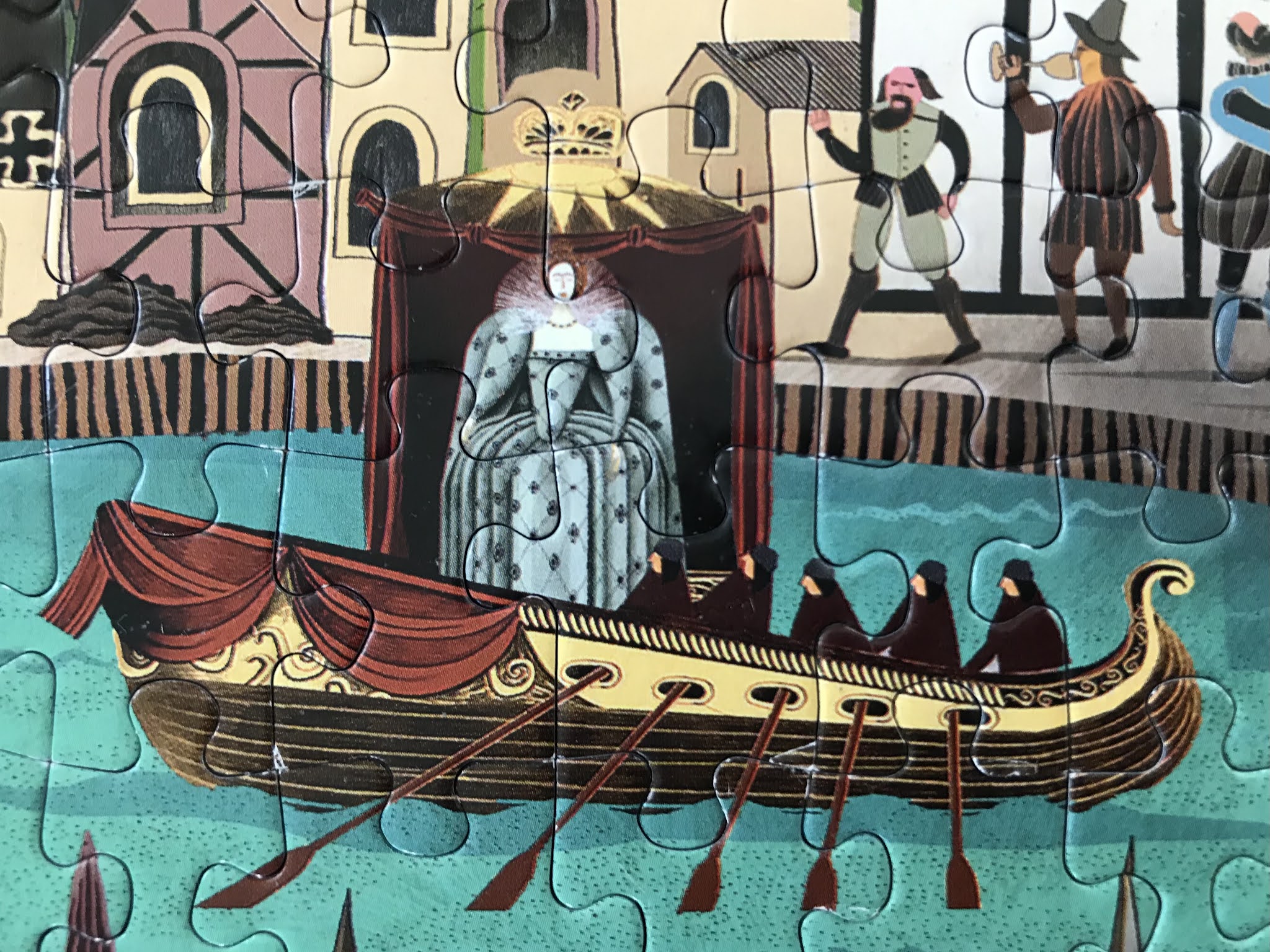
I wouldn't have guessed these characters, but apparently “Two small boats are quite close to each other and Benedick and Beatrice are quarrelling across the water.” There are other great figures upon the water too: at one side of the picture is Gloriana, Queen Elizabeth I herself, “on the deck of her royal barge, attended by various lords, making her way to the theatre” and at the other side, downriver, Sir Francis Drake buckles his swash on the deck of his famous ship, the Golden Hind.

Christopher Marlowe
John Donne
Christopher Marlowe is featured being stabbed, recalling the rumours of his death in a fight over a bill. It is described thus: “In a back alley behind the theatre a drunken brawl is taking place, and Christopher Marlowe is fighting a loosing battle with an assailant.” Another contemporary at the edge of the puzzle is John Donne. “In a room in the city’s northeastern outskirts John Donne is reluctantly waking up, light streaming through the window, which annoys him (referencing  his famous poem ‘The Sun Rising’).” Interestingly, the annoyance felt in this poem is because the poet would rather linger in bed with his lover, although in this sanitised version, he is alone. The makers would like this puzzle to be pieced together by children, and clearly violence and death is a lot more acceptable to show them than sex and healthy physical relationships. This bothers me on many levels, but this is not the place...

London Bridge
Heads on spikes
Speaking of the violence, there are heads on spikes at the end of London Bridge. The Old Medieval Bridge (1209-1830) was lined with buildings, shops, houses and churches. For over 600 years this bridge was the key crossing point of the Thames in London, ferrying people, goods and livestock across the river. It was an iconic feature of the City of London, not least due to those heads. (Digression alert.)

In a very informative blog, Paul Asling tells us all about it. The severed heads served as a warning to anyone thinking of challenging the Crown. The first head to be placed there is thought to be that of William Wallace in 1305 after the Scot was found guilty of leading a campaign against Edward I. Other celebrity dead heads included Jack Cade (who led a rebel army to overthrow the government), Thomas Moore (who refused to accept Henry VIII as the supreme head of the Church of England), Guy Fawkes (part of the Gunpowder Plot of 1605), and some of those who had signed the death warrant of Charles I (in 1660 when the monarchy was restored with Charles II). They ended the practice in 1678 when the heads of the most important traitors were displayed at Temple Bar instead.

The silent heads became a tourist attraction, drawing visitors from far and wide. To ensure longevity, the heads were parboiled and coated in pitch. Once put on the spike on one of the gates at the end of London Bridge, they were left to the elements to rot and eventually fell into the Thames; when the original bridge was pulled down, workers found skulls in the mud. The Keeper of the Heads had full managerial control over this section of the Bridge. I wonder if the power went to his head... (Digression over.)

May Day fete
I love the charmingly skewiff perspective. I love the little drawings of dogs and musicians popping up all over the place. And I love the inclusion of entertainments such as jugglers outside the Globe, and the merriment of the May Day fete. “The land between the South Bank and the city’s eastern edge (towards Bermondsey) is host to a May Day fete, with food and drink flowing freely, and displays of maypole dancing and archery.” 

This is an utterly charming puzzle and I am very grateful to Purple Lady for letting me borrow it. I shall now look out for others in their range, which include The World of Charles Dickens; The World of Jane Austen; The World of Frida Kahlo; Pop Art Puzzle; The Story of the History of Impressionism; The Dream of Surrealism (in 1,000 jigsaw pieces); The World of Sherlock Holmes; The Wonderful World of Oz; Inside the Chocolate Factory and The Mythical World, among others. 

Friday, 22 January 2021

Friday Five: Kings and Queens (and a Bonus Oddball) of Scotland

When we visited Stirling Castle, we saw an exhibition about the kings and queens of Scotland and their relations with the castle itself. It began with a family tree, which claimed to illustrate the direct blood link between Kenneth MacAlpin and Robert the Bruce. A cautionary note warned that 'the route between was often complicated'. This was written by the master of understatement.

Now, I have no illusions that I am any good at this sort of thing, and this is certainly not any attempt at providing a definitive history. There are, however, a few names that capture the imagination here.


1. Kenneth MacAlpin (842-858) - Kenneth (snort); it just doesn't seem like a very regal name. He was, however, apparently a notable warrior and the first leader to establish power over the Picts and the Scots to unite them in the kingdom of Alba, now known as Scotland. 

2. Macbeth (1040-1057) - There is a section of the long line (or tenuous ribbon if you prefer) of divine monarchical inheritance which reads, 'Duncan I 1034-1040; Macbeth 1040-1057; Lulach 1057-1058 ; Malcolm III (Canmore)1058-1093'. 

It would seem that Duncan I launched an attack on Moray, Macbeth's lordship, and was killed in action by Macbeth's troops. Macbeth subsequently became King of Alba where he ruled peacefully for 17 years with apparently little opposition. His only major confrontation during his reign was an English invasion in 1054, led by Siward, Earl of Northumbria on behalf of Edward the Confessor. Macbeth was killed at the Battle of Lumphanan in 1057 by forces loyal to the future Malcolm III. He was buried on Iona, the traditional resting place of Scottish kings. Macbeth was briefly succeeded by his stepson, Lulach, who only ruled for a few months before being killed by Malcolm III, whose descendants continued to rule Scotland for another two hundred years.

Wikipedia tells us, "Macbeth is today best known as the main character of William Shakespeare's tragedy Macbeth and the many works it has inspired. However, Shakespeare's Macbeth is based on Holinshed's Chronicles (published in 1577) and is not historically accurate." Wait, Shakespeare fudged the facts? Well, I never...


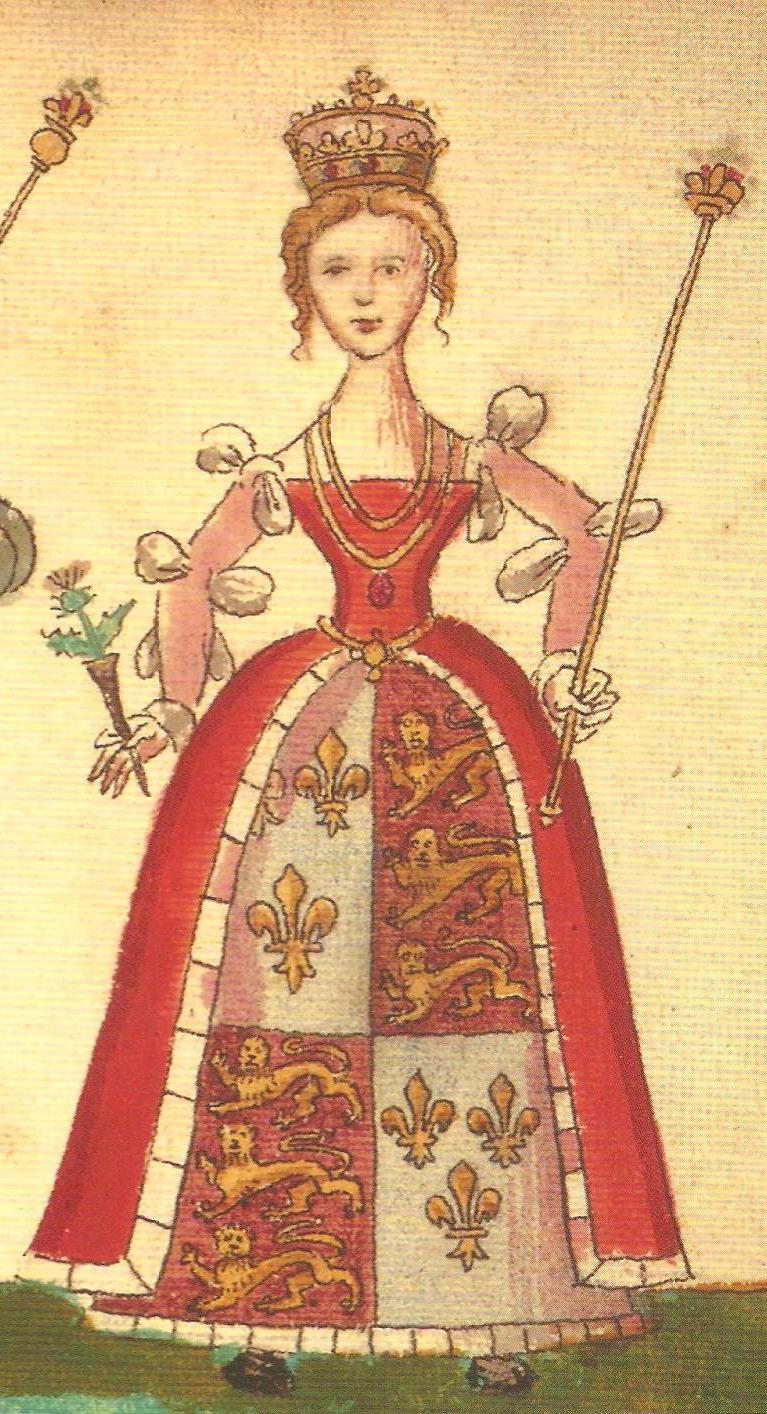
3. Joan Beaufort (1424-1437 & regent 1437- 1439) - She was twenty when she married James I: he made her co-monarch and gave her Stirling Castle as a wedding present, which was nice.  When James I was assassinated in 1437, Queen Joan smuggled their young son, James II, to Stirling Castle for safe-keeping. She then ruled from here as regent, surely making her one of the most powerful women in the land.

4. James IV (1473-1513) - Apparently this James was a passionate supporter of arts and culture (hurrah!). He was clever and well-educated, spoke seven languages and surrounded himself with poets, musicians, writers and philosophers. He was influenced by Classical ideas and the culture of the European Renaissance. He also seemed to rather like building (or at least, having other people build things for him). While at Stirling Caste he commissioned building works on a grand scale including the old Chapel Royal, the Great Hall the Forework and the King's Old Building.
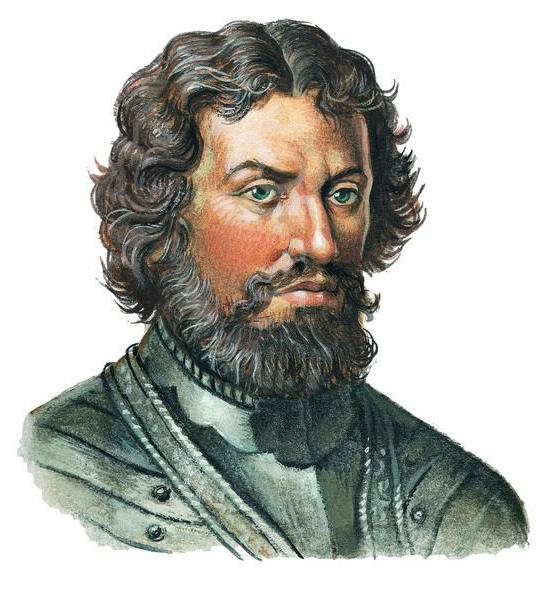
Also, somewhat importantly, in 1502 he signed the rather ambitious-sounding Treaty of Perpetual Peace with England, and the following year married Margaret Tudor, daughter of the English king, Henry VIII. Well, that's all nicely settled then.


5. John Damian - Not a king, but a fascinating figure nonetheless. He was an Italian alchemist who believed he could transform base metals into gold.  As James IV's court welcomed artists, scientists, and classically-trained poets and thinkers, Damian's claims intrigued the king and he was set up with a laboratory at Stirling Castle. "Despite the generous royal funding, Damian had no success." I wonder why...?
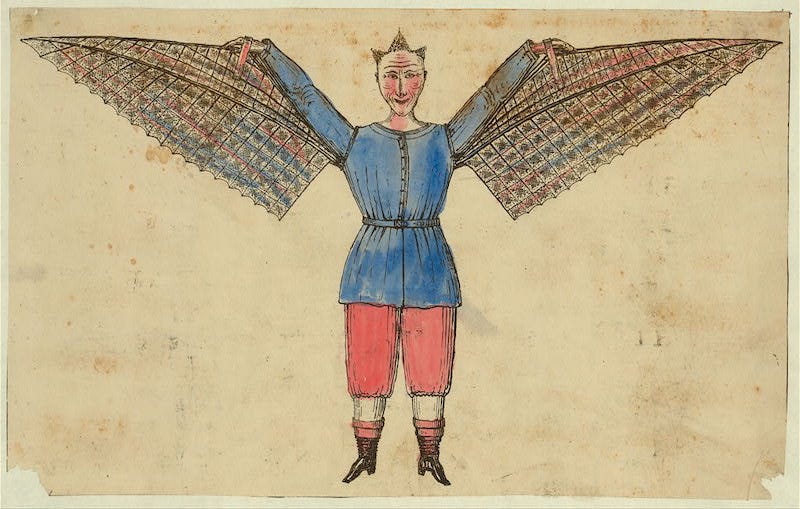
In 1507, in an attempt to retain the king's support, Damian tried a new experiment. He made wings from chicken feathers and announced he would use them to fly to France from the walls of the castle. His doomed flight from the Ladies' Lookout on the west side of the castle ended in a dunghill. Damian blamed "the wrong kind of feather". Is there a play about this? If not; there should be.


6. Mary Queen of Scots (1542-1587) - All joking aside (because she's not exactly known for her sense of humour), Mary is probably the queen that the country knows best. She lived at Stirling Castle until 1548 when she was sent to France "for safe-keeping". She returned to Scotland in 1561. 

As an adult, Mary spent much of her seven years at Stirling Castle. In 1566 the Old Chapel Royal was the setting for the baptism of her son, the future James VI. No expense was spared. Mary borrowed twelve thousand pounds (about two million today) to fund the event. During a great ceremony to impress the foreign emissaries, Mary laid on three days of "feasting, fireworks, music and masquing" in a celebration to rival anything Europe had ever seen.

Friday, 24 July 2020

Friday Five: NT Live


The theatres are closed and many of us have been missing live performances terribly. Since the beginning of this pandemic, the National Theatre has been screening live productions of its plays, which has helped me get my fix. It's not the same as being there, but it certainly helps. I hope we all remember the importance of this artistic medium when we are able to face the world again, and that, just as the arts have supported us through this crisis with cultural sustenance, we support them right back with financial assistance. 

5 National Theatre Live Productions:


  1. Frankenstein (2011) - I watched both versions which played in tandem, one with Benedict Cumberbatch playing Dr Frankenstein while Jonny Lee Miller undertook the part of The Creature, and the other one where they swap roles and everything else remains the same. This is more than just a gimmick: BC's Creature is angry and bitter; his Creator deeply troubled, whereas JLM's Creature is more humorous and quizzical; his Creator angry and arrogant. The supporting set, costumes and acting from the rest of the cast are sublime and the experimental steampunk element that director Danny Boyle introduces is a clear forerunner to his Olympic Games Opening Ceremony the following year, with its stark aesthetic and musical underpinning by Underworld.
  2. One Man Two Guvnors (2011) - I took my parents to see this in London, with a different cast but the same production. It is positively frenetic, and James Corden is a tour de farce. The reverence with which the source material is treated, complete with knowing asides and dollops of dramatic irony make this a great piece of entertainment (director, Nicholas Hynter, dropped it into the middle of a 'serious high-minded season' for light relief). The perfect blend of verbal and physical humour will have them lol-ing in the aisles. 
  3. Present Laughter (2019) - actors are a tricky bunch: they are naturally dramatic but want to be taken seriously. Noël Coward probably knew this more than most, and his depiction of Gary Essendine, a highly-strung bi-polar actor with an entourage, is portrayed with infinite intricacy by Andrew Scott. I tried to find a male noun for a flamboyant person but they all alluded to the individual's sexuality rather than their mental state, and any term for throwing tantrums, being temperamental or emotionally demanding had a female gender bias such as diva or prima donna. According to modern media, male meltdowns are either comedy fodder or concerning spirals into mental illness; Matthew Warchus' contemporary production of this 1940s classic explores this dichotomy from a fresh angle, only occasionally tipping the scales too far in the balance of mania.
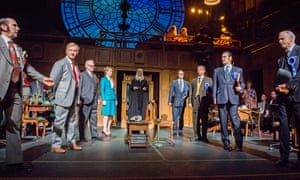
  4. Crossing party lines in This House
  5. This House (2013) - Party politics can often seem farcical, and so they adapt seamlessly to the stage in this premier production of the timely drama written by James Graham and and directed by Jeremy Herrin. The setting is the turbulent years of 1974-1979 in the UK, when Labour struggled to keep enough numbers in the Commons to pass bills and enact legislation. The tally of members is calculated on an ever-changing chalk board, including people being brought in from their death beds to vote, and promises of bigger offices and newer furniture. The party whips are metres apart in the corridor, and claustrophobically close on stage (while the auditorium doubles as the benches of 'this house' with members emerging from the audience) while they indulge in the literal fisticuffs and petty point scoring more at home in a school playground. It is a building full of bullies, bawdy humour and the fledgling sexism of the 70s, which makes a ripe background for satire and commentary on the class roots of the major parties.   
  6. Twelfth Night (2017) - The Shakespearean play best know for cross-dressing and gender fluidity is an obvious choice for blind casting. Initial reservations at seeing a Malvolia rather than a Malvolio are swiftly overcome by the skill of Tamsin Greig's acting and the sensitivity of Simon Godwin's directing. The twins are well matched through personality with Tamara Lawrance and Daniel Ezra displaying a similar sense of fun, and the Count (Oliver Chris) and Countess (Phoebe Fox) are both a lot more appealing and less pompous than in many productions. The festive element is heightened with party hats and feather boas, but occasionally teeters towards excessive camp. The slick set changes are remarkable, and a fountain on stage is always a highlight. 
Tamara Lawrance as Viola and Oliver Chris as Orsino in Twelfth Night