Showing posts with label childhood. Show all posts

Wednesday, 13 January 2021

You'll do girl, you'll do: Finding Baba Yaga


Finding Baba Yaga by Jane Yolen
Tom Doherty Associates
Pp. 131

This contemporary retelling of an iconic myth is written entirely in blank verse. It is reminiscent of the artful design of a Russian Matryoshka nesting dolls, as elements of Slavic myth, Russian folklore and fairy tales cleverly fit among the contours of American realism. It also explores a number of themes including the nature and power of language, the journey from childhood to adulthood, the relationship between religion and language, ‘good’ and ‘bad’ words, the unique dynamic of female friendships and the mother/daughter relationship. Yolen begins her tale, “You think you know this story. / You do not.”

Teenaged Natasha lives with her parents, and knows she must get away from them and their constant fighting. Ever since her father has discovered religion, it has become worse as he monitors her language and behaviour. She runs away into the forest but, although the woods, stones and water are a recurring fairy tale image or reference, this is not the one familiar from storybooks and the settings are slightly skewed; “The forest opens like a yawn,/ as if it knew I was coming,/ has seen me before,/ can’t be bothered to resist.” We recognise the motifs of the lost child in the woods, but Yolen suggests there is more to the story if we look, listen, and abandon our preconceptions. At the end of Chapter Two, The Runaway, in This Is Not a Fairy Tale she writes, “Expect no princes./ Expect no magic rings./ Expect no glass slippers./ Expect no fairy godmothers. / Expect no singing dwarfs. / Expect no talking dragons. / Expect only/ seven deadlies delivered:/ exhaustion,/ boredom,/ regret,/ hunger,/ anger,/ danger,/ death./ All part of God’s taketh away.”

And then she encounters Baba Yaga, with all of her traditional traits. She lives in a house which turns about on its chicken legs: “It is like living on a house boat:/ the swell of the waves, the turn of the tides,/ a moment of emotion, with the ‘e’ removed.” She is a tough old woman with an iron nose, and the contemporary references to strong women are apparent; “She’s tougher than Clinton or Thatcher ever were.” This clash of realism and magical imagery continues as she explains how Baba Yaga flies through the sky in her mortar, guided by her pestle, but no one see her “unless you count bad dreams”. She flies “across tundra, taiga, major highways,/ avoiding traffic jams, roundabouts,/ only bothering the occasional helicopter/ or low-flying private planes.”

Natasha learns to tell her story, and that “A story is, not always means.” It may be grim – “I think I know now/ there are no happy evers./ Only happy moments.” – but she grows as a narrator, examining the meanings of words and exploring postmodernism through form and structure, drawing attention to the artifice of the narrative. “I am becoming a poet./ I am thinking in metaphors./ I am walking through a poem.”

As Natasha rewrites the myth with herself as the hero of her own story, she discovers that “Stories retold are stories remade.” After all, if we believe critical analysis, there are only seven stories anyway, so we need to refresh them every now and then. In searching for (and finding) Baba Yaga, Natasha is really on a quest to discover her own inner vice, strength and truth. By the end of the book she states, “So, this is a tale/ both old and new,/ borrowed, narrowed,/ broadened, deepened,/ rethreaded, rewoven,/ stitches uneven,/ re-plastered, re-harled, rehearsed, reworked/ until it’s my own.” It is familiar and unique. It is brilliant.

Wednesday, 16 September 2020

Goodbye to the Greek Island: The Garden of the Gods


The Garden of the Gods by Gerald Durrell
Penguin Books
Pp. 198

This is the third and final instalment in Gerald Durrell’s stories about his years in Corfu with the family, begun in My Family and Other Animals and continued in Birds, Beasts and Relatives. The tone has been set by the previous two, and this continues with more idyllic scene-setting and animal anecdotes.

These are halcyon days as the children have outstanding freedom in their unaccompanied travels: Gerry potters about in his boat; Margo swans off to the mainland; Leslie wanders the countryside with guns; Larry invites complete strangers to come and stay at their villa.

Gerald Durrell has a highly evocative way of writing that makes the countryside sound divine, and there are Homeric epithets in his descriptions of the sea. When he writes of the approaching seasons, his naturalist’s eye combines with his rustic poeticism and, as always, his main preoccupation is zoological. “For me, spring was one of the best times, for all the animal life of the island was astir and the air full of hope.”

He is keen to amass more creatures for his ever-growing menagerie, but he knows that certain members the family (particularly Larry), do not like his animal collection so he tries to get Mother and Margo on side, and they often feel sorry for abandoned animals. One of the peasants, wanting to get rid of unwanted puppies, buries them alive, by which fact Mother is understandably outraged. She exclaims, “These peasants! I can’t understand how they can be so cruel.”

The Greeks are examined almost as another species, which can be uncomfortably racist to a modern reader. Margo has many affairs of the heart, but always with Greeks rather than English boys (friends of Larry’s), saying of the local peasant boys, “They’re so handsome and so sweet. They all sing so well. They have such nice manners. They play the guitar. Give me one of them instead of an Englishman any day.” On the subject of changing attitudes with time, the family are remarkably accepting of potential paedophilia, commenting of a guest, Colonel Velvit, “Since his retirement his one interest in life was the local Scout troop and, while there were those unkind enough to say that his interest in Scouts was not entirely altruistic, he worked hard and had certainly never yet been caught.”

Mother accepts all the guests and offers outstanding hospitality, even to horrible or boring people, warning Margo, “We’ve never done anything nasty to anyone that’s stayed with us – I mean, except as a joke or by accident – and we’re not going to start.” One visitor friend of Larry’s believes he can levitate and keeps trying, invariably falling through the trellis

Gerry embellishes stories for comic effect, and sees them through a boy’s eyes, but some of the details are harrowing, such as when a Turk visits them (at Margo’s invitation) with three wives, aiming to make Margo his fourth.

They live in a weird limbo land without news of the outside world because, “we did not have the dubious benefits of a wireless and so, for the most part, lived in a state of blissful ignorance.” Part of this lack of ‘outside interference’ means they have to rely upon themselves for entertainment, and they do so with spectacular results. Gerry’s descriptions of the food, drink and company at these events are exquisite, and his depictions of a bygone era are sumptuous and appealing. He paints pictures with words that inspired a generation to travel and take an interest in nature. Some of the attitudes are outdated, but if he instils a sense of conservationism, they can be excused as the results of age. It’s tough to farewell these tales of childhood on an island paradise.

Tuesday, 11 August 2020

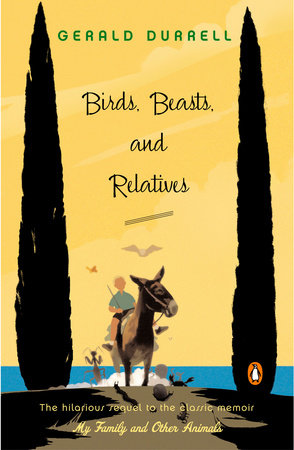
Childhood entitlement: Birds, Beasts and Relatives


Birds, Beasts, and Relatives by Gerald Durrell
Penguin
Pp. 245

This is the second instalment of Gerald Durrell’s Corfu Trilogy in which he continues with stories from the first book because the family say he has missed out all the best bits. As it is the same time period as the previous work, we don’t really need re-introductions, although it is interesting to see what the family members thought of their portrayal.

Gerry introduces several extra characters to us, mentioning Larry’s many friends who come to visit, including Max and Donald, and Sven who plays the accordion. We are also introduced to Countess Mavrodaki, “the recluse par excellence”., and we learn about his tutors, such as George, and his final (for this book) tutor, Kralefsky, a keen aviculturist (a person who keeps and rears birds) and a storytelling fantasist. He also provides greater depth to characters we have already met, and he describes his meeting with Theodore Stephanides, to whom the book is dedicated ‘in gratitude for laughter and learning”.

Gerry still collects animals for his menagerie: an owl called Ulysses; three dogs; and “there were rows and rows of jam jars, some containing specimens in methylated spirits, others containing microscopic life. And then there were six aquariums that housed a variety of newts, frogs, snakes and toads. Piles of glass-topped boxes contained my collections of butterflies, beetles and dragon-flies.” I remember things that I learned from reading these books as a child, such as the fact that snails are hermaphrodites.

Gerry has a child’s viewpoint and assumes that people and things exist for his entertainment. He experiences bucolic activities such as harvesting olives, but also is witness to live birth, and his reaction is less palatable. The description is anatomical but also unpleasantly dispassionate, perhaps because the human is foreign. “I was so used to the shrill indignation of peasants over the most trivial circumstances that I did not really, consciously, associate Katerina’s falsetto screams with pain. It was obvious that she was in some pain. Her face was white, crumpled, and old-looking, but I automatically subtracted ninety percent of the screaming as exaggeration.”

Furthermore, his description of the gypsies is somewhat uncomfortable in a modern setting. “I had always wanted to get on intimate terms with the gypsies, but they were a shy and hostile people… and although they would allow me to visit their camps, they were never forthcoming, in the way that the peasants were in telling me about their private lives and their aspirations.”

When Mother receives unwanted attention, and even a proposal of marriage, from a ‘disgusting old brute’, Captain Creech, she is naturally horrified and a little bit afraid. The children all laugh and ridicule, and she counters, “When there’s a real crisis, you children are of absolutely no use whatsoever.” Yes, this is an amusing anecdote, but she is a single woman in a foreign country in the 1930s with no respectable family to protect her.

Gerry writes of people as though they were specimens to be studied as his animals, birds and insects; because they are foreign (or female), they are other and this dispassionate approach is a little off-putting. These are still great stories of their time, but a deeper look reveals some more unsavoury aspects, which can be excused from a child’s account, but not really as an adult reader.

Friday, 27 November 2015

Friday Five: Women in Books

Recently I read How to Be a Heroine, Or, What I've Learned from Reading Too Much by Samantha Ellis, in which the author revisits the books she read as a child and young woman to see if she still admired the same female characters who had a profound effect on her in her youth.

I will return to this book in a later post, but it made me think about my childhood literary heroines, and whether I still feel the same way about them. The answer is yes - does this mean I had great taste back then, or rather, that I've never grown up?


5 Literary Heroines from My Younger Years:
  1. George from The Famous Five books by Enid Blyton: George firmly believes her gender shouldn't prevent her from doing what she wants; she tackles 'the great outdoors' with gusto and is unashamedly physical; she is greatly concerned about animal welfare; her personal integrity crosses class boundaries; she is intelligent without being intellectual; she is fiercely loyal towards her friends. Sure, she scowls a lot, but I still wanted to be her (way more than I ever wanted to be Pollyanna). And I wanted her rowing boat. And her island. 
  2. Becky Sharp from Vanity Fair by William Makepeace Thackeray - I love the novel, and her cheeky, irreverent adaptability. She is a social outsider, who uses cunning and charm to claw her way to respectability, yet never achieves it. She is also radically non-maternal; one of the few female characters who doesn't go all pathetic and uninteresting once she's had a baby. And she had a thoroughly modern moniker, unlike Pamela, Clarissa or Hester.
  3. Susan Pevensie in The Chronicles of Narnia by C.S. Lewis: as the eldest sister, she is compassionate enough to care for her family and brave enough to fight for them and stand up for her beliefs. She has arrows that never miss their target (who wouldn't want those?) but she is the voice of reason and commonsense - often she prefers to take the easy route rather than plunging recklessly into battle - even as a child, I saw the virtue in that. At the end of the series, she doesn't enter Narnia with the others, because she is more interested in 'nylons and lipstick and invitations'. In other words, she discovers sex and and drugs and rock and roll (or real life, if you prefer), and gets to grow up.
  4. Jane Eyre, from the eponymous novel by Charlotte Brontë: she's honest, forthright and powerful, acting with dignity and grace even when burning with shame and rejection. And she addresses the reader directly. She may be plain and unrefined, but she has nothing at all to hide
  5. Anne Frank - this is sort of cheating because she was a real person, but I first read her diary as though she were a fictional character, and I related to all her family frictions and teenage pretentiousness, even if I (thankfully) have never had to deal with Nazis battering down the door. Her words and ways to live have a power she could never have expected.