Showing posts with label seasons. Show all posts

Thursday, 10 September 2020

Get Orf My Land: The Shepherd's Life


The Shepherd's Life: A Tale of the Lake District by James Rebanks

Penguin

Pp. 287

Sheep are big business. Last month (August 2020) in Lanark, Scotland, a sheep called Double Diamond sold for a world-record sum of £367,500. James Rebanks knows that sheep are important. As a shepherd, he understands that farming and shepherding are crucial to the economy and the livelihood of many. He explains that this is hard work but that he loves it and enjoys the connection that he gets from the land. What he doesn’t seem to understand is how privileged he is and how many of the people he scorns would love to have been given his opportunities.

The Shepherd’s Life is not particularly well-written but Rebanks received an advance from an agent before he had written it. Although he appears to despise people who don’t do his work, they seem to be interested in him. He writes a sort of auto-biography, which also contains a lot of information about farming and a lot of assumptions about what non-farmers think of him and his industry. Many of his blunt and antiquated attitudes are irritating and arrogant, such as his inherent sexism and antipathy towards intellectuals, but the sections on sheep-farming itself are interesting and the most engaging.

As a child he followed his grandfather around the place knowing that he would inherit the farm because he is male. He has sisters, but it was “different for girls…their role is to leave and do something else to earn respect.” This knowledge of his purpose in life means that he feels ownership of the land. “We owned the earth. We’d been here forever. And we always would be. We would get battered from time to time, but we would endure and win.”

For him and his family, “our sense of belonging is all about participation. We belong because we are part of the work of this place.” And what if we can’t inherit a farm? Will we never ‘belong’? He dislikes Alfred Wainwright, Chris Bonnington and William Wordsworth because they’re ‘not from round here’ and so have no right to talk about ‘his’ land; he thinks climbers, poets, walkers and daydreamers are pointless, and that tourists are “minor irritants, like ants – they got in the way and they had strange ideas, but a little bit of bad weather and they’d be gone again to get on with stuff that mattered.”

The book itself is poorly written, grammatically clunky and very repetitive; a lot of sections start out telling us what someone is doing in the present tense, as he tries to set a basic scene: “My father is wielding a white-handled meat saw…” “My mother is sitting on a wooden chair in our barn…” “We are working in the sheep pens.” The use of generic pronouns is also problematic, for example, he writes of his grandfather, “He had a rough whiskery face when you kissed him goodnight.” This begs the questions, when did I kiss him, and what was his face like when I didn’t? He acknowledges, “We are, I guess, all of us, built out of stories” and yet, he doesn’t narrate his own very well.

He became inspired by books when he picked up a copy of A Shepherd’s Life by W.H. Hudson (the story of a shepherd called Caleb Bawcombe) and says he admires “the brilliant plain storytelling, no messing about”. It is predictable when he talks of reading; it is of male authors – Camus, Salinger, A.J.P. Taylor, Orwell – and that his biggest inspiration is the hyper-masculine Hemingway. After criticising the poets, he tries to write his own, and I certainly hope he’s a better sheep farmer.


He is at his best when writing about the sheep, the dogs, and the cyclical nature of farming. When told without prejudice, these snippets are interesting and engaging, including the shepherding chores of lambing, making hay, shearing (“It is a carefully choreographed thing in which the sheep is turned, shuffled and rolled in clever purposeful ways”), dipping, and training sheepdogs.

He divides the book into four seasons, as everything they do is connected to the weather and the natural cycle. In many respects, shepherding and farming have not changed in centuries. “You could bring a Viking man to stand on our fell with me and he would understand what we were doing and the basic pattern of our farming year. The timing of each task varies depending on the different valleys and farms. Things are driven by the seasons and necessity, not by our will.”

If you remove the tractors and the machinery, the farming practices are ancient, and it upsets him that these traditions, skills and knowledge are being lost or dismissed. He commends the ‘old ways’ and wants future generations to see the reality of farming and agriculture. His book is almost a call to arms to protect the natural mechanics and importance of farming.

James Rebanks is a tough person to like – he has some interesting things to say about sheep and the farming of them in the Lakeland fells, but he tells them in a didactic and hectoring tone. If he could climb down from his privileged perch, his message about sustainable farming might be easier to hear.

Monday, 6 November 2017

Gathering Swallows Twitter in the Skies


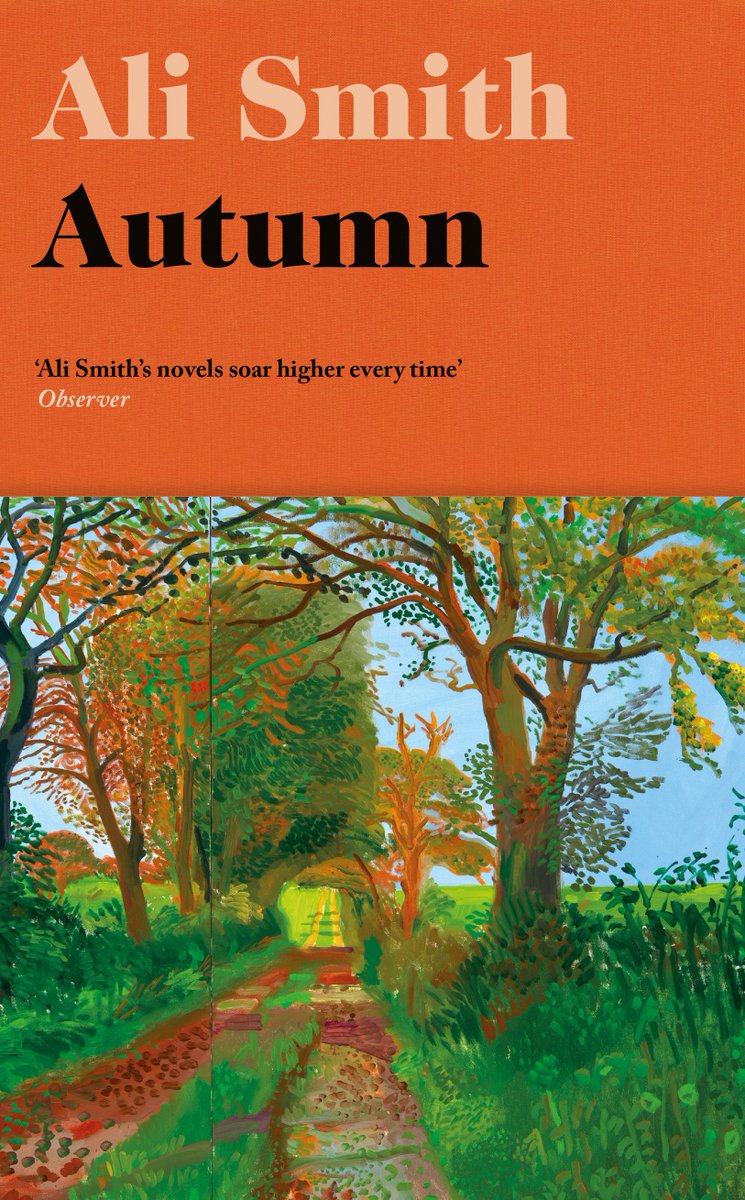
Autumn by Ali Smith
(Penguin), Pp. 260

Shortlisted for The Booker Prize and hailed as the first post Brexit novel, Ali Smith’s Autumn shoulders a weight of expectation for a slim novel. While it stands steady on its exquisite legs, it is also part of a series of novels due to represent all four seasons. It recalls the ode to autumn with its mists and mellow fruitfulness; there is a sense of melancholy but it is also suffused with hope, colour and a love of all things bright and beautiful.

Elisabeth Demand befriends her elderly neighbour, Daniel Gluck, and slowly learns his stories, while he challenges her imagination and perceptions of society. Her mother is horrified that she chooses to spend time with an adult male and cannot conceive that it is entirely innocent. Is it? The novel flicks back and forwards through time but with helpful explanations such as ‘It was a Tuesday evening in April in 1993. Elisabeth was eight years old.’ Daniel described artworks and paintings to her, including the works of the first female pop-artist, Pauline Boty.

Elisabeth later becomes a lecturer in art history, two topics which are intrinsically intertwined. She was told by a lecturer that there were no female pop artists and she is determined to champion Pauline Boty, who refused to fit the boxes created for female artists and died prematurely in 1966. With her witty collages and subversive paintings, Boty becomes a symbol of all those who are “Ignored. Lost. Rediscovered years later. Then ignored. Lost. Rediscovered again years later. Then ignored. Lost. Rediscovered ad infinitum.” Time is fluid; it is linear but cyclical; very messy and frequently repetitive. Now Daniel is in a nursing-home coma and Elisabeth visits him, pretending to be family: he has erotic fantasies about which she will never know. He had experiences of the Holocaust, and there are clear parallels drawn between the treatment of foreigners then and now.

It is self-consciously literary and also aware of the cyclical nature of history. From the opening line – “It was the worst of times, it was the worst of times.” – it is clear that everyone is feeling unsettled as the country tears itself apart.

“All across the country, there was misery and rejoicing… All across the country, people felt it was the wrong thing. All across the country, people felt it was the right thing. All across the country, people felt they’d really lost. All across the country, people felt they’d really won. All across the country, people felt they’d done the right thing and other people had done the wrong thing.”
Britain has just voted to leave the EU. Half of the village isn’t talking to the other half. A mysterious barbed-wired compound has sprung up nearby complete with security cameras and patrolling guards. Elisabeth’s mother, who is obsessed with antiques, decides to get herself arrested by throwing items of historic significance at the enclosure, “bombarding that fence with people’s histories and with the artefacts of less cruel and more philanthropic times”. A house in which immigrants live has the words GO HOME spray-painted on the wall. But later, the words, WE ALREADY ARE HOME, THANK YOU have been added, and bouquets of flowers left by supporters and well-wishers. There are seeds of hope and humanity scattered in this forlorn and morally bereft landscape.

Ali Smith acknowledges the pain of division and the beauty of inclusion. From nature with its seemingly haphazard approach to procreation and fertility, to the apparent clinical approach to grammar and semantics, she suggests that organic development will always triumph over control. Daniel dreams of becoming imprisoned in a tree and returning to the earth. Smith admires the polyglot of languages with words coming from all over the world (such as an intriguing section on a book young Elisabeth reads about a gymkhana).

This is a time of fear and certainty based on lies and fabrications. Daniel explains that the power of the lie is “Always seductive to the powerless.” We make sense of our world through the stories we tell and the ones we hear, whether they are presented as anecdotes or news. “Whoever makes up the story makes up the world, Daniel said. So always try to welcome people into the home of your story. That’s my suggestion.” We need more inclusion; we need more acceptance; we need more open-mindedness; and we need more books by Ali Smith.

Wednesday, 3 May 2017

To every thing there is a season

Mr Wigg by Inga Simpson
(Hachette) Pp. 292


Mr Wigg is a widow who potters about his orchard, preserving fruit, listening to cricket, mourning his wife, telling stories to and cooking with his grandchildren, and watching as his new neighbours plant vines on the old farm land. The tagline is, “A novel that celebrates the small things in life”, and there is a gentle feel to the prose as it follows the seasons with planting, pruning, harvesting and preserving. This is deceptive, however, as there are spectres looming at the edges of progress and destruction; Vietnam and family rifts; ageing and loss.

Mr Wigg sees his fruit trees as personalities and imagines that they talk to each other with personalities and petty jealousies. The orchard encapsulates all his memories and aspirations. Inga Simpson writes of the different fruit like a poetic greengrocer, but always in Mr Wigg’s words, conjuring them and their stories from the air and the soil. Who knew that the provenance of these common fruits would be interesting? It is, because Mr Wigg remains in awe of the fruits he grows, engaging the reader with his ruminating non-didactic style.

Fruit isn’t always sweet, and neither, for all its bucolic images of collecting eggs, pruning fruit trees and chopping wood, is farming. Mr Wigg’s son frequently visits him to remind him of the things he can no longer do with his Parkinson’s and forgetfulness. Mr Wigg used to help the blacksmith and now has his tools; making things in his shed with the honest labour of the land. He invents a fruit-drying machine, but when he attempts to build one from his sketches, he has an accident with the bench saw. He fights against modernisation because he enjoys the old ways; why should he use time-saving devices when he doesn’t know what to do with his extra time?

His attitudes are also archaic, and it is his inherent sexism which caused a family schism. It never occurred to him to interest his daughter in the running of the farm; always assuming his son would take over. When he gives the farm to his son and nothing to his daughter, she is understandably upset, and lawyers become involved.

His late wife dominates his thoughts, as one would expect. Their relationship was full of love but not without irritation. He captures the momentous (such as family conflict and illness) along with the mundane: “His wife had buttoned his shirt cuffs for him even before the Parkinson’s came on. His dress shirts, in particular, had such tiny buttonholes.” He initially struggles with the pointlessness of existence without her, but he comes to realise that, “Life had a way of going on whether you were interested or not, and then you found yourself taking pleasure in a few small things, and a few more.”

Future generations provide continuity, and his happiest moments are with his grandchildren, cooking and telling stories. “Not everything that is new is better”; but not everything that is new is bad, either.