Wednesday, 6 October 2021

My Newest Favourite Thing: Pieces of Shakespeare

Shakespeare's London
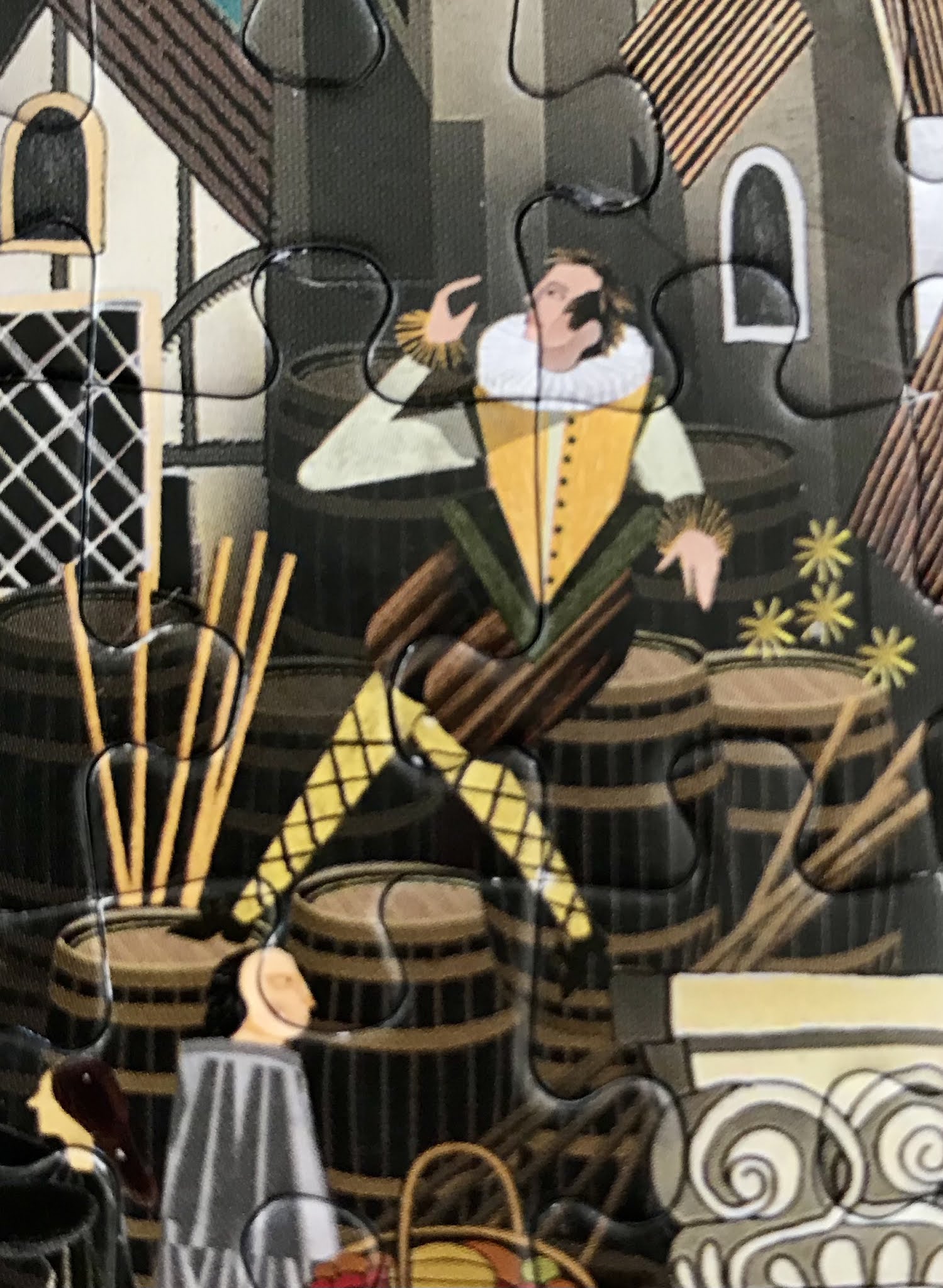
I have been posting updates on my blog about the puzzles I have been doing, but I feel that this one deserves a post of its own. This beautiful and rich image is by Adam Simpson; the puzzle is by Laurence King Publishing; and it was lent to me by Purple Lady.

There is an accompanying sheet (text by Neil Carter) that tells us all about the picture - it's superbly educational for younger folk interested in the bard, or those of any age starting out on their knowledge gathering, or those with experience who just want a bit of fun recognition. It states, "Shakespeare's London is alive with activity. The River Thames winds past the Globe Theatre on the South Bank, under London Bridge, and by the Tower of London in the east. Houses are tightly packed together in the city centre, but the outskirts quickly give way to open spaces and woodland nearby."

Naturally, when piecing the puzzle together, I did the river first, partly because the colour stood out, and partly because it is my river. I then did The Globe, because, well, it's the Globe.
 
The Globe
Henry V
The bear pit
Inside the Globe, there is a rehearsal for A Midsummer Night's Dream featuring the characters of Bottom, Titania and Oberon with an entourage of fairies and (my favourite thing) William Shakespeare with script and quill in hand overseeing the rehearsal. Outside "a man stands on a box addressing the crowd, wearing a crown and armed with sword and shield: this is Henry V delivering his rousing 'Once more into the breach, dear friends' speech." Nearby is the bear pit in which a bear has escaped its chains and is chasing its keeper, with a nod to the famous stage direction, ‘exit pursued by a bear’ from The Winter's Tale.

Macbeth
A Midsummer Night's Dream
Gravediggers on the edge
Next, I did the Macbeth scene, where the three witches are "engaging in nefarious practices", as Macbeth and Banquo ride up on their horses. At the edge of this scene are the pairings from A Midsummer Night's Dream (Demetrius; Lysander; Helena; Hermia) watched by Puck from the tree marvelling at 'what fools these mortals be'. In another section of the puzzle, the gravediggers from Macbeth lean on their spades for a break in their work. 

Hamlet
Romeo and Juliet
King Lear
Julius Caesar
Scenes from all the greatest hits are scattered throughout the picture. Let's start with the tragedies... Hamlet offers Yorick's skull to Ophelia in front of Gertrude and Claudius, while the ghost of Hamlet's father hovers above the scene. Romeo climbs up some steps to get to Juliet, who is hanging out of a tower, while Tybalt and Mercutio fight a deadly duel below. King Lear is flanked by his daughters Goneril and Regan, "desperately haranguing him on each side, while a third quieter and more beautiful daughter (Cordelia) watches from the sidelines." He is also accompanied by his fool and a mad beggar (Edgar).  

The Julius Caesar scene is interesting because, as a way of getting around the fact that it is totally anachronistic (even more so than the play itself), this is described as, "in a field a group of children playing dress-up in Roman costume are having a mock battle in the vein of Julius Caesar". Lurking on the edge of this vignette is an alchemist, trying to turn base metals into gold, "watched from the shadows by Ben Jonson frantically scribbling notes for his next play." This is not the only time Simpson places one of Shakespeare's contemporaries in the periphery.

A tavern featuring a scene from Othello in the foreground and Falstaff on the roof
Andrew Aguecheek and Sir Toby Belch from Twelfth Night
Malovolio from Twelfth Night
Outside one of the taverns, “Othello and Iago are watching another man, Cassio, talk to Desdemona. Iago is whispering poisonous lies into Othello’s ear.” I love the fact this occurs underneath a pub sign of Shakespeare. Behind this tavern, "some are settling debts with a moneylender (perhaps even Shylock from The Merchant of Venice).”

On the roof, “Falstaff is in full drunken flow, holding court and being extremely obnoxious, with his flagons of ale held aloft. The tavern is lively. Andrew Aguecheek and Sir Toby Belch (both of whom hail from Twelfth Night) debate loudly as they eat and drink their fill.” Meanwhile, “Malvolio sits forlornly at the side of the bridge in his cross-garnered yellow stockings, wondering where it all went wrong.”

Prospero and Miranda from The Tempest
Caliban from The Tempest
Dogberry and Verges from Much Ado About Nothing in the centre of the scene
The Tempest is alluded to by Prospero in the brow of a boat “with his staff in the air attempting to conjure up a storm while his daughter, Miranda, waits at his feet, slightly annoyed.” Looking back at the pair from on land, Caliban “can also be found lurking on the riverbank.” Okay, he looks more like the Jolly Green Giant than 'abhorred slave', 'hag-seed', 'monster of the isle', 'a most perfidious and drunken monster', 'moon-calf', 'a born devil on whose nature/ Nurture can never stick', and an 'abominable monster', but at least he gets in the picture. 

Between Caliban and the King Lear grouping on the path, we see that, “Two bumbling night watch constables totter along the riverbank (Dogberry and Verges from Much Ado About Nothing). They are being pursued by rats, which populate many areas of the city and cause recurring plague epidemics.”

The Tower of London
Richard III
The Comedy of Errors
The Tower of London is another fantastic setting which includes a number of references to Shakespeare's plays and contemporaries. As well as the previously mentioned Hamlet consortium, we have a scene in which, “Two young boys - could they be the Princes in the Tower? - are playing watched on by someone who looks suspiciously like Richard III.” Meanwhile, “in the tower’s inner courtyard two masters are discussing comically confusing orders for twin servants (referencing The Comedy of Errors).” 'Comically confusing' is an interesting description of that play, and I'm not sure all would agree. Incidentally, the figure leaning out of the window of the Tower above them is Walter Raleigh who "is being held prisoner: he gazes out on to the water longingly.”

Benedick and Beatrice from Much Ado About Nothing
QEI
Sir Francis Drake on the Golden Hind
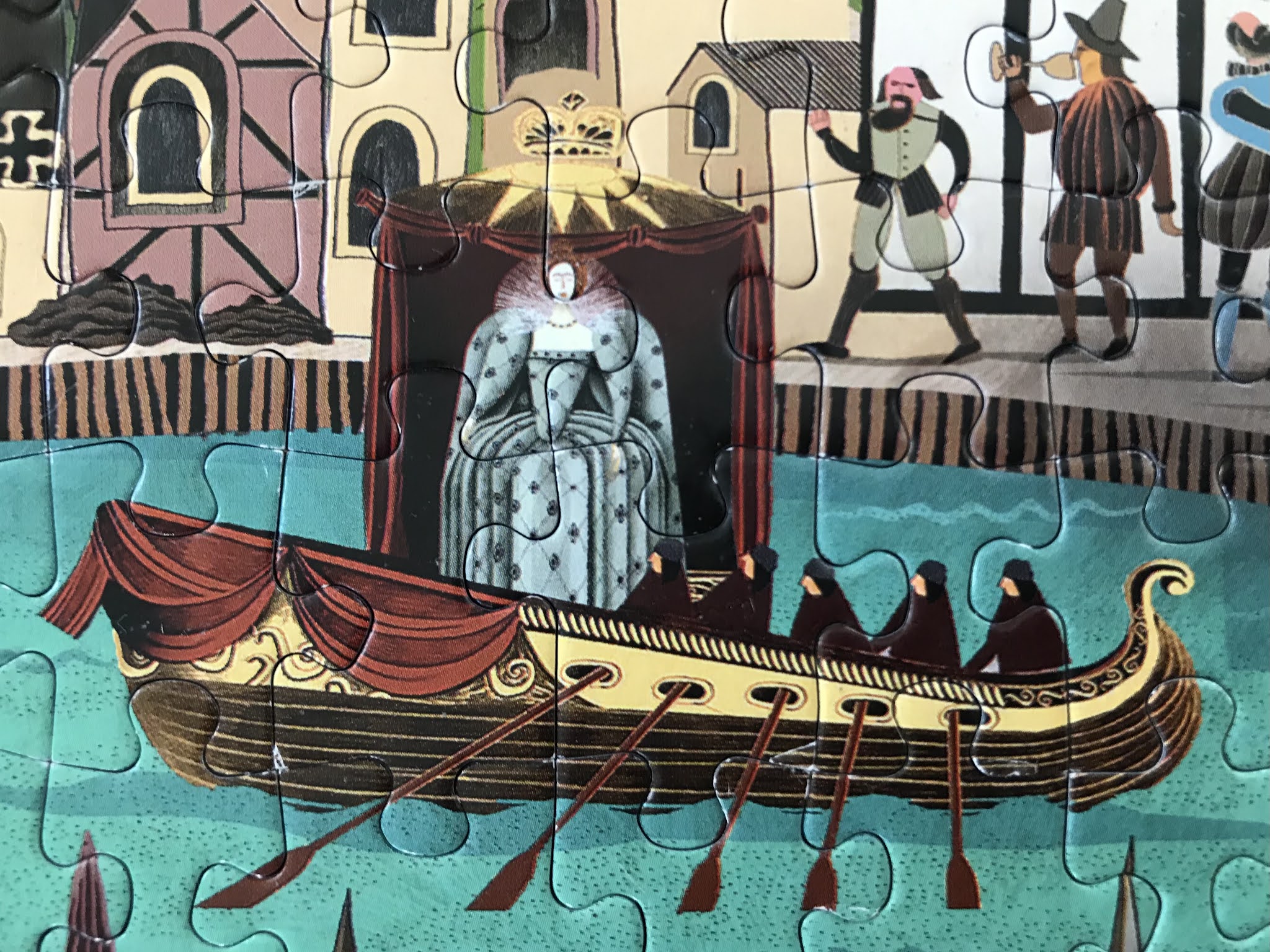
I wouldn't have guessed these characters, but apparently “Two small boats are quite close to each other and Benedick and Beatrice are quarrelling across the water.” There are other great figures upon the water too: at one side of the picture is Gloriana, Queen Elizabeth I herself, “on the deck of her royal barge, attended by various lords, making her way to the theatre” and at the other side, downriver, Sir Francis Drake buckles his swash on the deck of his famous ship, the Golden Hind.

Christopher Marlowe
John Donne
Christopher Marlowe is featured being stabbed, recalling the rumours of his death in a fight over a bill. It is described thus: “In a back alley behind the theatre a drunken brawl is taking place, and Christopher Marlowe is fighting a loosing battle with an assailant.” Another contemporary at the edge of the puzzle is John Donne. “In a room in the city’s northeastern outskirts John Donne is reluctantly waking up, light streaming through the window, which annoys him (referencing  his famous poem ‘The Sun Rising’).” Interestingly, the annoyance felt in this poem is because the poet would rather linger in bed with his lover, although in this sanitised version, he is alone. The makers would like this puzzle to be pieced together by children, and clearly violence and death is a lot more acceptable to show them than sex and healthy physical relationships. This bothers me on many levels, but this is not the place...

London Bridge
Heads on spikes
Speaking of the violence, there are heads on spikes at the end of London Bridge. The Old Medieval Bridge (1209-1830) was lined with buildings, shops, houses and churches. For over 600 years this bridge was the key crossing point of the Thames in London, ferrying people, goods and livestock across the river. It was an iconic feature of the City of London, not least due to those heads. (Digression alert.)

In a very informative blog, Paul Asling tells us all about it. The severed heads served as a warning to anyone thinking of challenging the Crown. The first head to be placed there is thought to be that of William Wallace in 1305 after the Scot was found guilty of leading a campaign against Edward I. Other celebrity dead heads included Jack Cade (who led a rebel army to overthrow the government), Thomas Moore (who refused to accept Henry VIII as the supreme head of the Church of England), Guy Fawkes (part of the Gunpowder Plot of 1605), and some of those who had signed the death warrant of Charles I (in 1660 when the monarchy was restored with Charles II). They ended the practice in 1678 when the heads of the most important traitors were displayed at Temple Bar instead.

The silent heads became a tourist attraction, drawing visitors from far and wide. To ensure longevity, the heads were parboiled and coated in pitch. Once put on the spike on one of the gates at the end of London Bridge, they were left to the elements to rot and eventually fell into the Thames; when the original bridge was pulled down, workers found skulls in the mud. The Keeper of the Heads had full managerial control over this section of the Bridge. I wonder if the power went to his head... (Digression over.)

May Day fete
I love the charmingly skewiff perspective. I love the little drawings of dogs and musicians popping up all over the place. And I love the inclusion of entertainments such as jugglers outside the Globe, and the merriment of the May Day fete. “The land between the South Bank and the city’s eastern edge (towards Bermondsey) is host to a May Day fete, with food and drink flowing freely, and displays of maypole dancing and archery.” 

This is an utterly charming puzzle and I am very grateful to Purple Lady for letting me borrow it. I shall now look out for others in their range, which include The World of Charles Dickens; The World of Jane Austen; The World of Frida Kahlo; Pop Art Puzzle; The Story of the History of Impressionism; The Dream of Surrealism (in 1,000 jigsaw pieces); The World of Sherlock Holmes; The Wonderful World of Oz; Inside the Chocolate Factory and The Mythical World, among others. 

Friday, 1 October 2021

Friday Five: ISO Puzzles

As part of the not being able to travel anywhere vibe, we are doing puzzles of places we can't currently visit. We've done this before, but puzzles become a little bit trickier when one has cats in the house. It turns out that many paws do not make light work. Who knew? 

5 Puzzles Completed:

  1. Rialto Bridge, Venice

  2. Seljalandsfoss, Iceland

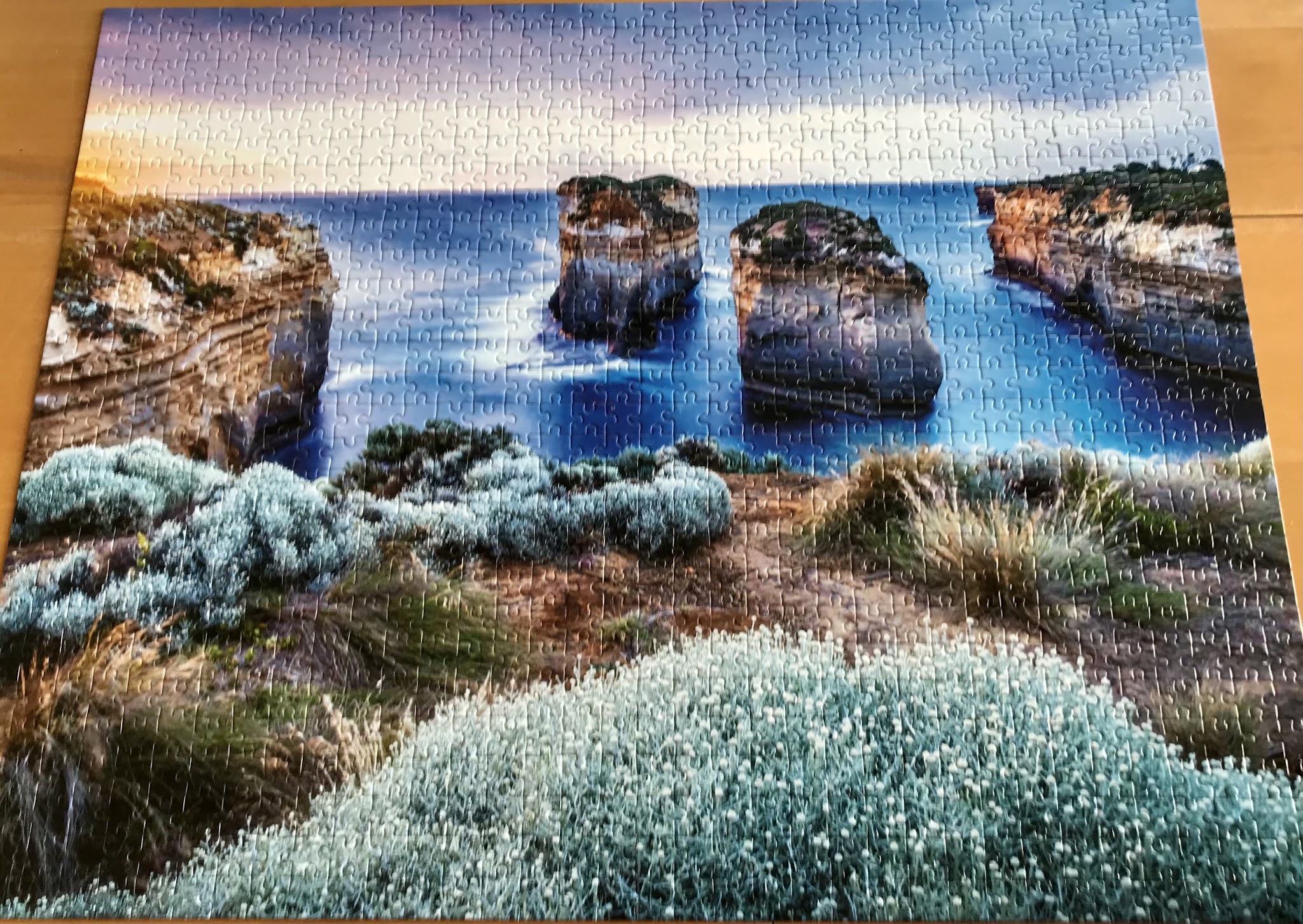
  3. Island Archway, Great Ocean Road, Australia
    This is the reason the above image is called the island archway. It used to be - now, due to erosion it has become two pillars instead.


  4. Biking in Tuscany
  5. This last is another from the whimsy collection lent to me by the good Dr Kay. I love Lowry so really enjoyed completing this puzzle. I'm now considering a Lowry cross-stitch... 
  6. Market Scene, Northern Town - L.S. Lowry

Tuesday, 28 September 2021

'God's Chosen People': Tanamera


Tanamera by Noel Barber
Corgi
Pp. 736

Tanamera (from the Malay meaning ‘red earth’) is the saga of the eponymous house and all who live in her, namely the Dexter family. It is a tale of a dynasty, narrated by John Dexter, and, by extension, a novel of Singapore. Of course it is a white colonialist’s view of Singapore and contains all the inherent classism, racism and sexism one would expect to find in a novel written in 1981. It claims to be both a witness to the change in the country before and after the Second World War, and a love story, but it is so partisan that it can barely be either, especially as the women are very poorly drawn caricatures.

The descriptions of Singapore are as viewed by an ex-pat; there are tennis clubs and gin and tonic on the veranda. And it is hot, and full of insects. The Dexter dynasty, and the house, was established by Grandpa Jack who made his money through rubber (Dunlop), railways, shares in tin mines, and setting up Raffles. The novel condenses the history of rubber and those who control the price and the export of it. The colonialist attitudes are jarring but not unusual: the casual racism and exploitation of the local people is hugely unpalatable but typical of the time. This attitude of superiority extends to gender and sexuality, as the narrator says of his brother, “even though Tim’s sickness manifested itself in his trousers, it was the head that needed attention.” He also refers to Tim, as “that fairy” and “a bugger boy”.


The narrator cannot write a credible female character. Julie, his love interest, is docile, compliant and beautiful, like an ex-pat’s colonial dream of an Asian woman. She is happy for him to take her virginity and does not mind that she is not allowed in his tennis club or at his parties, saying demurely, “I’ll always be yours if you want me.” Her looks and desirability to other men raise her value in his eyes and he admits to a “fierce feeling of possession and intimate knowledge of showing Julie off. Of course Johnnie marries and has children with someone else, while claiming to retain undying love for Julie. He tries to justify his actions as Julie forgives him for sleeping around and marrying someone else because there is licence to cheat during the war, apparently. She is light-hearted and never remonstrates with him but quotes poetry instead in a parody of the accommodating oriental mistress.

It is unlikely that he appreciates a woman’s ability to enjoy herself sexually; he has sex with a friend, Vicki, when they are both married to other people and she tells him, “Every married woman secretly dreams of being raped – by a friend of course.” Later, Julie repeats this nonsense, with the exact same words. This dangerous fantasy of his displays a complete lack of respect and understanding. Dramatic scenes later in the novel linger on the prurience of a gang-rape of his wife and sister, Natasha.

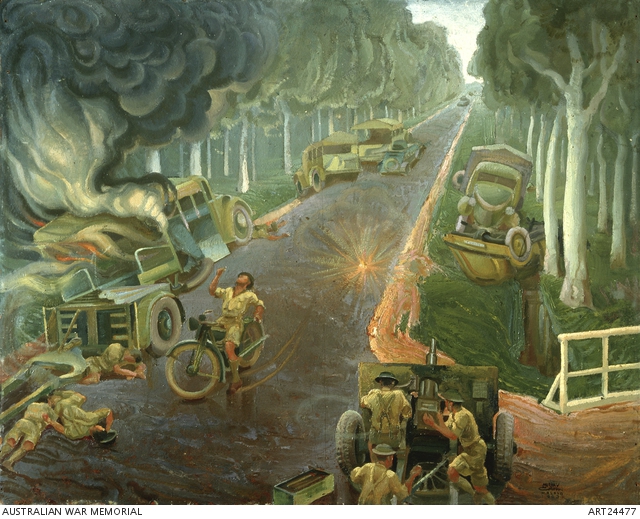
Action at Parit Sulong, January 1942 by Murray Griffin

There is some merit within the book, however, and it is in the description of war and how it affects Singapore (as seen through a colonialist’s eyes). There is a strong ‘end of an era’ atmosphere as can be expressed when viewing it in hindsight. War, when it comes, is initially just another reason for exploitation and profiteering, as it is seen from a distance as capitalists prepare for its approach. Eventually Singapore falls and the war comes directly to the Dexters, as John fights in the jungle, and there are detailed descriptions of making bamboo bombs and the sadistic torture methods and general savagery of the Japanese. As Barber’s reflections become more political and less personal, he includes footnotes to historians’ writing as if to back up his fiction with fact. He is better at understanding the big picture than individual motivations.

As a rambling novel of a family saga with Singapore as a backdrop, this is an ambitious work. One is reminded of James A Michener’s Tales of the South Pacific. He couldn’t write women either and approached the situation from a white male colonialist viewpoint, but it won him a Pulitzer Prize in 1948 when that was the only perspective that mattered. Hopefully times are changing.

Friday, 24 September 2021

COVID-19 Friday Five: More Podcasts

We're allowed two hours of exercise now. I walk. I listen. Sometimes I listen to the birds and sometimes I listen to podcasts. Here are some of the podcasts to which I listen.

5 Podcasts:
  1. David Tennant Does a Podcast With... (Somethin' Else and No Mystery) - The former Doctor Who star chats with his showbiz friends. It's very star-studded and a bit lovely-dahling, but it makes one realise how many great actors he has worked with, from Judi Dench, Olivia Colman, Elisabeth Moss, Billie Piper and Cush Jumbo to Ian McKellan, Neil Gaiman, Michal Sheen, John Hamm and Brian Cox. At this stage there is no Season 3 planned, but there are still 21 episodes to get to grips with at this stage.

  2. Eyes on Gilead (SBS) - As a companion podcast to The Handmaid's Tale, a group of intelligent and interested viewers (Fiona Williams; Haidee Ireland; Sanar Qadar; Natalie Hambly) discuss and dissect each episode after it has finished. More than just examining the plot, they suggest possibilities and refer to design and direction elements that highlight the intricacies of the show. There are also bonus interviews with actors (special love for Yvonne Strahovski - well, it is Australian), composers, make-up artists, costume designers, directors and the series creator. It's one for the fans. 

  3. Natalie Haynes Stands up for the Classics (BBC Radio 4) - a friend introduced me to this podcast after I read Natalie Haynes' A Thousand Ships, which re-tells the story of The Illiad from the perspective of the women involved (it's excellent - more on that later). In a sort-of spin-off from the original series, Natalie Haynes does a series within the podcast in which she 'sits down' for the myths. In a move that will surprise absolutley no one, the first one I listened to was on Penelope. There are also episodes on The Odyssey, Clytemnestra, Helen of Troy, Penthesilea and Medusa. Plus, there are the original episodes on Cicero, Plato, Sophocles, Virgil, Ovid, Aristotle, etc. It's told in a light, informative and entertaining manner. I remember most of it, and can happily go back a few weeks later to remind myself of the bits I missed first time around. 

  4. The Poet Laureate Has Gone to His Shed (BBC Radio 4) - I've got a bit of a thing for Simon Armitage. No, not like that (although I do love his voice). I've met him (twice) and I'm in his book, Gig (although not by name). He taught at the polytechnic where I studied (although not at the same time) and we know some of the same people, and have a shared interest in myth (The Odyssey; The Green Knight; King Arthur). He is busy writing haiku in his shed at the bottom of his garden (or so he would have us believe) and he interviews some iconic figures from my growing-up days. So far I have listened to the episodes featuring Jo Whiley, JK Rowling and Johnny Marr. I look forward to listening to the back catalogue including interviews with Maxine Peake, Antony Gormley and HRH Prince Charles.

  5. The Skewer (BBC Radio 4) - Described as the news retwisted as a comedy treat, it is a biting satire on politics and current events using the very effective sampling techniques that put words into other people's mouths. It's irreverent and devastating in 15-min chunks with dazzling wit and British pop-culture references that might stump some living outside the UK.

Wednesday, 15 September 2021

Hiding Her Light Under a Bustle: Agent Sonya


Agent Sonya: Lover, Mother, Soldier, Spy by Ben MacIntyre
Viking
Pp.328

Spies, especially female spies, capture the imagination. Ursula Kuczynski, codenamed Sonya, was a German Jew, a dedicated communist, a colonel in Russia’s Red Army, and a highly trained spy. From planning an assassination attempt on Hitler in Switzerland to spying on the Japanese in Manchuria and helping the Soviet Union build the atom bomb, Sonya conducted some of the most dangerous espionage operations of the twentieth century. Ursula Kuczynski married several times – she had many names, both real names and codenames. The novel is subtitled ‘Lover, Mother, Soldier, Spy’, and, although she had many lovers, none of her partners ever betrayed her. MacIntyre, meanwhile, is obsessed with her conflicting duties towards the party and her family, which he embodies by talking about making jam and baking cakes.

Ursula had a relatively comfortable and privileged background, and became a communist through ideology. She moved to Shanghai, where she was appalled by the discrepancy in conditions caused by wealth. Bored and sickened by her life in Shanghai, she was anxious to do something more meaningful. She was clearly passionately idealistic, but with sexism bordering on misogyny, MacIntyre is unable to believe that she supported the Communist cause for reasons of ideology alone and frequently espouses the theory that she was attracted to the glamour and the excitement of espionage. “Ursula was committed to communism, but also increasingly addicted to danger, the romance of risk, the addictive drug of secrecy.”

Throughout the book he clearly points us in a certain direction, editorialising in a blunt fashion as if he doesn’t trust the reader to make up their own mind, or perhaps he mistakes condescension for humour. He is also critical of other authors, which is spiteful and unprofessional, merely heightening the sense of smugness. There is a lot of repetition, suggesting the lack of a disciplined editor and, whereas this is a great story and would make a great film or novel, this biography has got both a muddled and didactic approach. He sets the scene very well, even if he does it multiple times, and he clearly enjoys the complicated details of the meetings between handlers and recruits in which two people walk towards each other “holding a green book in one hand and a tennis ball in the other, exactly as Sonya had instructed. At 4pm on the dot, a stocky man appeared, wearing a pair of gloves and holding a second pair in his left hand.”

In 1932 when Japanese forces attacked Shanghai, Ursula was “dispatched” to the war zone to discover if Japanese incursions into China presented a potential threat to the Soviet Union. Later she was sent to Mukden, a city in Manchuria in Inner Mongolia (invaded by the Japanese in 1931) “to liaise with the communist partisans, provide them with material assistance, and transmit military and other intelligence to Moscow by radio.” She built her own radios (which she had to bury in the fields) and assembled aerials on the roof (which she had to dismantle each night). She moved to Switzerland, where she ran a spy network, using the “peaceful land of cowbells and cuckoo clocks” as a base to launch operations into enemy territory. 

Threatened by possible exposure, she left Switzerland and took her family to England where she settled in Oxfordshire. When Ursula moved to Great Rollright, she cycled into the countryside to put messages in a hollow tree and receive drops with her instructions, but there were no communications and she began to worry. Basically, the GRU had got the wrong tree. After the war, Ursula continued to spy for the Communist Party, and in 1949, she went to Berlin where she continued her work in East Germany. She worked with many ‘famous’ spies, including Alexander Foote, a radio operator who spied for Russia and Britain, and Klaus Fuchs, who supplied information from the American, British and Canadian Manhattan Project to the Soviet Union during and shortly after WWII.

It seems incredible that Ursula was not caught. Her brother and father were already under surveillance by MI5 and the whole family were considered suspicious. She had been made a colonel in the Red Army – the only woman to rise so high in Soviet military intelligence. All of her previous husbands, lovers and many of her recruits were interrogated, but none betrayed her. Many men couldn’t comprehend that a woman could be a spy. MacIntyre writes, “Some in MI5 wondered how Ursula could possibly have time to spy since ‘her hands are fairly full with domestic duties.’”

She became dissatisfied with the Communist regime due to instances such as Stalin’s Great Purge, the crushing of the Hungarian revolt against Moscow in 1956, the building of the Berlin Wall in 1961, and the put down of the Prague Spring in 1968, but she still believed she was helping to make the world a safer place by stealing atomic secrets from one side and sharing them with the other. Her own children did not know anything about her life as a spy until she published an autobiography, Sonja’s Rapport in 1977, which would probably be a great read. MacInytre’s attempt to place her experiences into a domestic and female context is clearly done for dramatic effect, but somehow manages to undermine the commitment and consequences of this remarkable woman.

Friday, 10 September 2021

Friday Five: Spring Garden Flowers

While we are in lockdown I am thankful every day for my garden. We live in a beautiful part of the world and we are currently permitted two hours of exercise per day (recently increased from one hour) as long as we do not leave our area, which I appreciate. Even on the  days when I'm working from home and back-to-back meetings and emails mean I cannot leave the house for such periods of time, I can breathe in deeply as the onset of spring brings forth the blooms and blossom. I never thought I would be one of those people, but I truly love my garden space. Here are some reasons why.

Wednesday, 8 September 2021

Love's Labour's Knots: Ties That Tether

Ties That Tether by Jane Igharo
Jove
Pp. 306

Azere is a young woman of Nigerian descent, living in Canada, who is obsessed with her cultural identity and screen romance. The novel is written in a light, fluffy style, combining the predictable plots of all her favourite films, while hammering home some ethnic issues. Azere falls for a Canadian man of Spanish descent after a one-night stand but tries to do the right thing by her family, even after he shows up at her work (advertising) as the new marketing director. Her mother has another man in mind for her – one with whom she was in love as a young teen, who took her virginity on a camp and never spoke to her again until now. This has all the makings of a modern sassy rom-com with a younger sister and cultural sensitivity thrown in.

In the opening line Azere tells us, “Culture is important. Preserving it, even more important. It’s the reason I’ve always abided by one simple dating rule.” Due to a promise to her father on his death bed, Azere will only date Nigerian men in an attempt to preserve her culture, even after immigrating to Canada. Her mother and sister are aware of this promise, which rules her life. Let’s start with the culture, because that is what the author keeps banging on about with deafening repetition. She claims, “That’s what my mother has been doing since we moved to Canada – shoving my culture down my throat, so I don’t forget where I come from.” After the eighty-fifth reference, I know the feeling.

She explains the richness of her culture and it is clear, and understandable, that she doesn’t want to relinquish it. Her mother is clearly a powerful influence, although not all her cultural strength is positive, as in when she tells Azere, “If you want to be a feminist, fine. But please be a married feminist with at least three children. In our country, a woman’s honour is her husband and her children. A career means nothing.” Her father, before he died, was a commanding force, and she also has a cultural issue of needing to look after her younger sister. Occasionally in trying to explain how special her culture is, she denigrates that of other people. Her mother sees no difference between a white man and a Hispanic one; there are clearly shades of racism at play here.

Azere is motivated by romances and romantic comedies, and all the references are upbeat and contemporary, from Beyoncé to Sex in the City: it’s pure trash but it makes a change from the tired old Jane Austen template. She is self-aware about the narrative structure, pointing out the mechanics of the story including the lead character’s sidekick – “someone bold, witty, and capable of providing comedic relief and harsh truths the lead isn’t willing to face” – or the grand gesture, “one of the most pivotal scenes in romantic movies”, which is meant to prove one’s love, earn a lover’s forgiveness, or win back a lover’s affection. All of these tropes are deployed. Part of the romantic genre is to place an obstacle in the way of the couple; miscommunication of which threatens their relationship and only love can overcome. In this there is an ‘intrigue’ that goes on far too long about Rafael’s ex-partner, but it provides the definitive hurdle: it is forced, but it fits the romantic mould.

The chapters are told from alternating viewpoints – Azere’s and Rafael’s – although the voice is the same. Everyone cares about their wardrobe, hair and make-up and has “perfectly groomed eyebrows”. Rafael describes Azere’s “spaghetti-strap knee-length dress”; it seems incongruous that the male perspective would notice this detail. Of course the woman is petite and the man big and strong: Rafael epitomises the unsavoury aspects of the masculine hero, and when he tells Azere, “You’re mine now, and there’s no way in hell I’m ever giving you up” we are meant to view it as charmingly romantic rather than disturbingly possessive.

The novel is a simple love story which follows the predictable lines of a modern romance. It has an ethnic and cultural element which gives it slightly more depth, but some of the faux-profound asides are out of step and sound a wrong note. It is shallow entertainment and if it accepted itself as such, it would be a more rewarding novel.