Monday, 23 May 2016

Rise Up.


Now is the Time by Melvyn Bragg
(Sceptre)

Melvyn Bragg’s novel may ostensibly be about The Peasants’ Revolt (a dramatic six weeks in summer 1381), but it clearly has parallels to today’s socio-political situation where the rich tax the poor beyond reason and endurance.  

In the author’s note, Bragg writes that he studied history at university but that the Peasants’ Revolt – the greatest popular uprising in English history – was overlooked. He suggests that this may be because “it was too dangerous for establishment historians to dwell on, too radical, altogether un-English... Perhaps for some it was too disturbing. Perhaps it always will be.” He sets out to right this wrong with a work that took him 15 years to write.

The historical fiction focuses on the factual characters of preacher John Ball, activists Jack Straw and Walter (Wat) Tyler, his wife (Margaret), daughter (Joan), and follower and sometime-lover Johanna Ferres, the boy-king Richard II, his mother Joan, Princess of Wales and Maid of Kent, and his several advisers and councillors.

Money is the root of all this evil, particularly the unjust raising of taxes. Under the leadership of Wat Tyler, the people join forces and march on London to meet their King and to present their demands. These demands are not excessive, and the people who call themselves The True Commons, remain loyal to the King. Their issue is with his advisers and the wealthy merchants and priests who hoard their wealth to the detriment of the people. 

Inequality is rife as John Ball sees by the vast warehouses of the wool trade nestling beside great poverty, “like an illustration of the World As It Was and the World As It Could Be. Ball saw, yet again, here as all over England, the rich seeming to need to confine and cramp the poor. And the poor had agreed to endure it until now.”

Many use the anarchy on the streets to settle old scores; the prisons are opened and people ‘join’ for the mayhem, not the cause. “London feels as if a barrel of gunpowder has been thrown into the middle of it. Many people think they will never get out alive.” People adopt the cover of rebellion to settle old scores and redress grievances of envy, and there is soon indiscriminate bloodletting.

The novel begins with a quote from The Mirror of Man, a 1378 poem by John Gower in which he claims that there are three things capable of producing “merciless destruction when they get the upper hand”; water, fire, and “the common multitude”. The last words of the book, in the author’s note remind us that, “The poll tax was not imposed again for six hundred years. In the 1980s, Margaret Thatcher reintroduced it. It provoked violent riots and was quickly withdrawn.” 

This is almost a polemic; a call to arms. It is certainly a stark warning about what can happen to a society that allows the rift between rich and poor to plumb to such astronomic depths. The clue is the title.

Wednesday, 18 May 2016

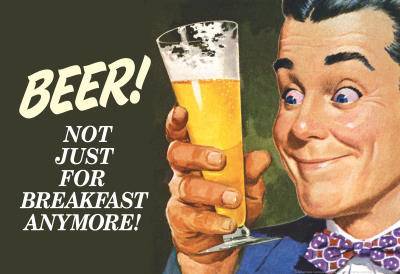
Quote for Today: Beer Elixir


"Beer was good, he thought. It did as it was asked. In the morning its tang braced his body for the day, sluiced around it, cleaned it out. Before battle it gave him an extra pip of courage. It could make lovemaking more loving, friendship friendlier and even, sometimes, smooth the sharp edges of an argument. And it could, as now, take him into a space where no cares could reach him, insulated as he was, by the God-sent drowse of ale." From Now is the Time by Melvyn Bragg

Sunday, 15 May 2016

Eurovision 2016: Jump(suit) to it


I watched both semi-finals, so that you don't have to, and the findings are that this year's offerings are as kitsch-tastic as ever, but the hosts are more impressive than usual. The crowds love Petra Mede, comedian, dancer, actress and TV presenter, despite the costume designer's best attempts to make her look like a potato. Mans Zelmerlow is a pop singer and presenter, and he seems to know what he's doing too, in a clean-cut Scandinavian sort of way.

We are reminded that the Eurovision Song Contest was created in 1956 to unify Europe after it was torn apart by war. It is suggested that the continent is facing tough times now, and this is an opportunity to put aside differences and 'come together', which is the theme this year. Apparently nothing says unity like leotards, jumpsuits, bare thighs and capes. 

And here are the songs in order:

Here come the Belgians!
  1. Belgium - Laura Tesoro - What's the Pressure: it's always tough to have to start, but Belgium burst on with bubblegum energy; this is a great dance number from everyone's favourite human glitter ball.
  2. Czech Republic - Gabriela Guncikova - I Stand: described as 'like a bride singing at her own wedding'. Someone needs to tell her that letting your hair down doesn't count as a clothing removal, but there is an all-white outfit and a wind machine, so she's having a stab.
  3. The Netherlands - Douwe Bob - Slow Down: Country music cheese probably has a place (Nashville and New Zealand, I believe), but it isn't at Eurovision. The opening line is 'I'm going nowhere and I'm going fast'. Enough said.
  4. Azerbaijan - Samra - Miracle: If I describe this as a karaoke cross between Cher and Shakira, and you get the image of jump suits, long hair, wind machines and reaching for unobtainable notes, then you've got the right idea. She sings, 'It's gonna take a miracle to save us now' and I'm not going to disagree.
  5. Hungary - Freddie - Pioneer: I actually like this song with its Shaolin drumming and Communist-style stomping and clapping from the backing whistlers. Freddie can't afford new jeans or a t-shirt, poor lamb; I feel sorry for him and his sensual eyes under heavy-duty brows.
  6. Italy - Francesca Michelin - No Degree of Separation: True hippy-dippydom with a long-haired centre parting, sparkly dungarees, and a proffered seed at the finish. She seems to believe in herself, which is good.
  7. Israel - Hovi Star - Made of Stars: This song features a giant star-studded hula hoop, containing dancers. Eurovision needs more over-sized pointless props.
  8. Bulgaria - Poli Genova - If Love was a Crime: One of my favourite songs, with the traditional verse, catchy chorus, dance break and sample lyric ' you and me against the world'. 
  9. Sweden - Frans - If I Were Sorry: The home crowd know the words, so they are giving as much support as they can to the bland modern ballad by Mumford's prodigal son.
  10. Germany - Jamie-Lee - Ghost: Great set and standard lyrics, 'Trying to figure out what we've missed?' Um... reality? The K-Pop inspired-songstress might be told that Korea isn't actually in Europe, but don't let that stop you, am I right, Australia? 
  11. France - Amir - J'ai Cherche: Singing the verses in French, the chorus in English, and the whole thing in a too-tight suit and a misplaced confidence in his own abilities, Amir is representing the spirit of Eurovision past.
  12. Poland - Michal Szpak - Colour of Your Life: Sergeant Pepper wants his coat back; the loafers with no socks combo is disturbing; and that hair is crying out for a wind machine. But you can tell it's dramatic because of the string instruments and the key changes (or are they merely modulations?).
  13. Australia - Dami Im - Sound of Silence: The song is fine if you like that sort of belted ballad that passes for music in the commercial conveyor belt of the current singing industry, but the presentation is somewhat lacking. Regardless, they shouldn't be here, so let's return to Europe
  14. Cyprus - Minus One - Alter Ego: Somebody told me that Cyrus are doing The Killers from within cages.
  15. Serbia - Zaa Sanja Vucic - Goodbye (Shelter): If The Spice Girls were leather-clad cyborgs they would sound like this. Songs about domestic violence may have a strong message, but they won't win Eurovision.
  16. Lithuania - Donny Montell - I've Been Waiting for this Night: Points for wearing trousers that actually fit. Yes, the bar is set that low. But he can do a back-flip.
  17. Croatia - Nina Kraljic - Lighthouse: Clothing removal and another all-white outfit; it's all about the dress, which is fortunate, because that song won't stand up by itself.
  18. Russia - Sergey Lazarev - You Are the Only One: The broody Gothic beginning builds to a staccato Kraftwerk-esque number. My silhouette dogs and rabbits look a bit shit now, to be honest. Thanks a lot, Russia! 'Thunder and lightning; it's getting exciting'. Why, yes, yes it is.
  19. Spain - Barei - Say Yay: Turning up straight from bed in a night-shirt and sparkly slippers, she is not so much P!nk as a blushing embarrassment. 
  20. Latvia - Justs - Heartbeat: Three words: dull; dull; dull. Almost interchangeable with Lithuania except his leather jacket is black rather than white.
  21. Ukraine - Jamala - 1944: You know when you go to A&E on a Saturday night and some crazy snaggle-toothed woman with wild hair staggers threateningly towards you shouting in some language that may or may not be English? That's the Ukraine.
  22. Malta - Ira Losco - Walk on Water: There's a creepy stalking bloke doing a tumbleweed impression on the stage - he looks like he may have just wandered in off the street. That poor singer is smiling and struggling on regardless despite the fear in her eyes. Security!
  23. Georgia - Nika Kocharov and Young Georgian Lolitaz - Midnight Gold: An energetic number full of psychedelic fabulosity. I'd go clubbing to that.
  24. Austria - Zoe - Loin d'Ici - That Austrian lass looks like she's sitting on a toilet roll, but she looks so happy and smiling about it. I would tell her that her song is saccharine-coated sh*t, but that would be like strangling a kitten, so I won't.
  25. U.K. - Joe & Jake - You're Not Alone: They look like a couple of lads from down the pub. As a friend mentioned last night, 'Eurovision is not about patriotism', but they were wearing Liverpool shirts in the video intro, so all is forgiven.
  26. Armenia - Ivetta Mukuchyan - Lovewave: With a bit of chat at the beginning, a leotard, lots of leg and hair, this seems to be something for the dads.
Great song Georgia
Once again, I am at odds with the 'judges' and the public. My top 5 were:
  1. Belgium
  2. Georgia
  3. Bulgaria
  4. Russia
  5. Hungary
It was criminal that Bulgaria didn't do better
Meanwhile, these were the 'actual' results (which included a massive discrepancy between the jury votes and tele-votes):
  1. Ukraine
  2. Australia
  3. Russia
  4. Bulgaria
  5. Sweden
Scary Ukrainian woman

Thursday, 12 May 2016

We Can Be Heroines


How to be a Heroine: Or, What I’ve Learned from Reading Too Much  by Samantha Ellis 

After an argument over which Brontë sister (Charlotte or Emily) wrote the best novels, Samantha Ellis decides to revisit all the novels she read in which she found the heroines from her younger days. Approaching them as an adult she asks who has the better heroines, and to what are they teaching girls to aspire? It transpires the answer is mainly marriage and motherhood. “All the heroines’ stories seemed to end in death or marriage.”

As a child she read fairytales, in which the heroines are usually passive princesses waiting to be rescued by a man. In these stories mothers are evil, jealous harridans, and mature women are bitter, ugly old crones. Angela Carter delightfully subverts these themes in her re-imagining of the tales in The Bloody Chamber, which Ellis read with glee.

She intersperses the literary critiques with anecdotes from her family history, outlining her feelings of displacement and her struggles to fit in. She notes that the stories from her childhood were no longer satisfactory as she grew up. Whereas she identified with the feisty heroines, many of whom were creative types, she was horrified to find that Anne of Green Gables and Jo March (Little Women) both give up their writing when they eventually get married to devote themselves to ‘family life’. Instead she found herself attracted to Shakespeare’s characters, who resisted their families and broke society’s rules.

Her undergraduate reading reintroduced the notion of female passivity and that suffering had value – all the heroines did it, and it ennobled them. From Clarissa by Samuel Richardson to Miss Julie by August Strindberg or Tess of the d’Urbervilles by Thomas Hardy, all these noble women suffered terribly for their dignity, and it doesn’t go unnoticed that all these beatific portraits are written by men. Once again she turned to theatre and its inherent vitality. She loved her theatrical heroines and their environment in which there was a lot of superficiality, but also “people who were open about their ambitions, ready to live with thin skins and open hearts”.

It seems that Ellis has fallen out of love with Cathy, and has changed her mind about her heroine. “Back then, I wanted my heroines to show me new ways to be, like heedless, selfish Cathy. I didn’t want heroines who mirrored my own anxieties too accurately. But maybe I’ve changed. Or at least: maybe I’m changing.” She concludes that our tastes change as we grow older, which is natural and perfectly acceptable. “I’m beginning to think all readings are provisional, and that maybe we read heroines for what we need from them at the time.”

Maybe we read to learn things; maybe we read to escape; maybe we read to find new characters and role models; maybe we just read. And if our reasons to do so, and the characters we admire change from time to time, that seems perfectly understandable too.

Tuesday, 10 May 2016

Shady Russian Dealings

Sonya(Yanina Clifton); Marina (Alice Ferguson); Vanya (Jerry Hearn); Yelena (Lainie Hart)

Uncle Vanya

Canberra Repertory TheatreTheatre 3

29 April – 14 May, 2016

Director Geoffrey Borny makes much in the programme about the humour in Chekov. He claims the dark view that the Russian’s plays are gloomy affairs is a radical misinterpretation. Choosing to work with David Mamet’s fresh translation, he brings out many shades of light and dark, and subtle nuances are a relief as the play zips along under his capable stewardship.

The laughs drawn from the audience are often at what might be considered to be the blackest moments, such as when Sonya (Yanina Clifton) agonises, “We are all desperately unhappy”, or when Vanya (Sam Hannan-Morrow) is driven so far to frustration that he attempts to shoot Serebryakov (twice) and misses (twice). We are amused, rather than touched by people feeling sorry for themselves and moaning about their plight instead of doing anything about it. Serebryakov (Jerry Hearn) in particular strikes several Eeyore-like poses, and, although he is a ghastly old grump, he is a comic one.

Sam Hannan-Morrow works hard to elicit our sympathies in the titular role. His self-pity is deliberately tedious, but he mines the pathos of his anger and his feelings of rejection. He falls in love with Yelena (Lainie Hart), the young wife of Serebryakov, who is his brother-in-law, having previously married Vanya’s sister. The image of Vanya as an unrequited suitor with a bunch of winter roses is quite heart-breaking, and his understated depression is genuinely affecting. The local doctor, Astrov (Jim Adamik) is also in love with Yelena, and so visits the house much more than his professional capacities should allow. Meanwhile, Sonya, Vanya’s niece and the daughter of Serebryakov, is in love with Astrov, but he doesn’t notice her because she is plain, although she has the proverbial “beautiful hair”.

Astrov attempts to seduce Yelena with his passion for the environment. When he explains the rampant deforestation and the effects it will have on future generations it echoes his own behaviour in acting rashly for immediate gratification with no thought to the consequences. This and his realisation that he has been a fool at the dénouement are Adamik’s best scenes, as his passion is much more convincing than his comedy.

Sonya understands his work, because she has hangs on his every word. Working on the land, she understands that all of nature is connected and that we are bound by our ecosystems, whereas the vapid Yelena has no interest in anything that requires thought or philosophy. The men don’t care for brains, however; they are all in thrall to youth and beauty. Although fresh-faced and dowdily dressed, Yanina Clifton glows on stage: she may be plain (without make-up) but her expressions are gorgeous and make her eminently watchable. Her calm strength and dignity are justly rewarded in the final scene as she delivers the climactic monologue with resolute conviction.

Yelena is described repeatedly as idle, languid and lazy, yet Lainie Hart flits across the stage with none of the indolence with which she is frequently credited. She is dashing and dramatic, flirtatious and restless, and we feel her pent-up dissatisfaction and irritation with her husband. When Sonya admits her love for Astrov to Yelena, the confession is more like a daughter to a mother than an understanding between friends. Similarly, Yelena’s meeting with Astrov, after being made aware of her step-daughter’s feelings comes across as spiteful rather than innocent. Youth and its passing is a major theme, so the miscasting of ages obscures the message. Similarly, Sam Hannan-Morrow is clearly not the 47 years that are mentioned at least three times in the play, and his constant references to stagnating in old age are not credible.

Times are changing and people don’t necessarily like change when it is forced upon them. Vanya and Sonya look after the estate, which belonged to Vanya’s sister until her death, when it passed to her husband, Serebryakov. When he suggests selling up and turning them out, his complete lack of comprehension at their distress is resonant with absentee landlords everywhere. Serebryakov stays up all night writing books that regurgitate other people’s opinions – Vanya tells him, “You know nothing of art because you have no soul.” To add to his anguish, Vanya’s mother (played with intelligence and restraint by Antonia Kitzel), adores Serebryakov, respects his pedantry, and herself writes pamphlets that nobody reads.  

The family lead dull and boring lives. They eat and drink and sleep, and follow a rigid routine of sandwiches and samovars, and are terrifically unsettled when this banal schedule is interrupted. The aesthetics of this life are beautiful from the set (Andrew Kay) to the costumes (Heather Spong), but empty. It is left to the servants to provide the depth, and the richest images are drawn from the land; when the men fight, the nanny, Marina, refers to them as a gaggle of cackling geese. Alice Ferguson imbues Marina with a warmth and assurance, which implies continuity; the delightfully simple Telegin (Neil McLeod) is happy when he sees a job done well, and even the workman, Yefim (Jonathan Pearson) has a solidly enduring presence.

Those who do the physical labour are the true heart of the country. Passing passions are fleeting, but solid foundations will endure. As a doctor and an activist, Chekov understood the importance of true substance over superficial artifice; as a director, Geoffrey Borny does too. The basic humanity of this production is without doubt; it may well be worthy, but it is also well worth seeing.

Monday, 4 January 2016

Body Art

More than a Body: Organic Perception
Fredrika Rose

Tuggeranong Arts Centre

This exhibition from last year features watercolours, sculpture and installation by Fredrika Rose, winner of the 2013 Emerging Arts Support Scheme (EASS) Award.


Her work explores biological aspects of our lives, such as a print which resembles a wallpaper design of imaginary bacteria as if seen through a microscope. The colours and intricacies drip bodily fluids and reveal natural features such as mountains, flowers and rainbows. The juxtaposition of the earth's grandeur with the minutiae of cellular activity draws parallels between botany and biology.


Some of the pieces explore the self-destructive capacity of the human body, such as these pieces incorporating silk, human hair and alpaca hair. The positioning of the three items recalls the ceramic flying ducks favoured of interior decor of certain demographics. Rather than being comforting and homely, however, the installation has connotations of hatching eggs and aggressive cancerous growths.


Fredrika likes to challenge the viewer by contrasting the weird and fantastic; matching dark humour and shocking spectacle. Dressing up animal skulls in pearls and feathers is a heightened memento mori reminding us that all beauty must die, but that organic adornment will transform into alternate energy. In other words decomposition is creation. It's an intriguing concept.

Other sculptures are made from medical accoutrements, such as colostomy bags and drips, coiled on themselves and arranged to resemble a bunch of flowers. The artificiality is pronounced and obvious, but the human mind likes to interpret inanimate objects naturally.


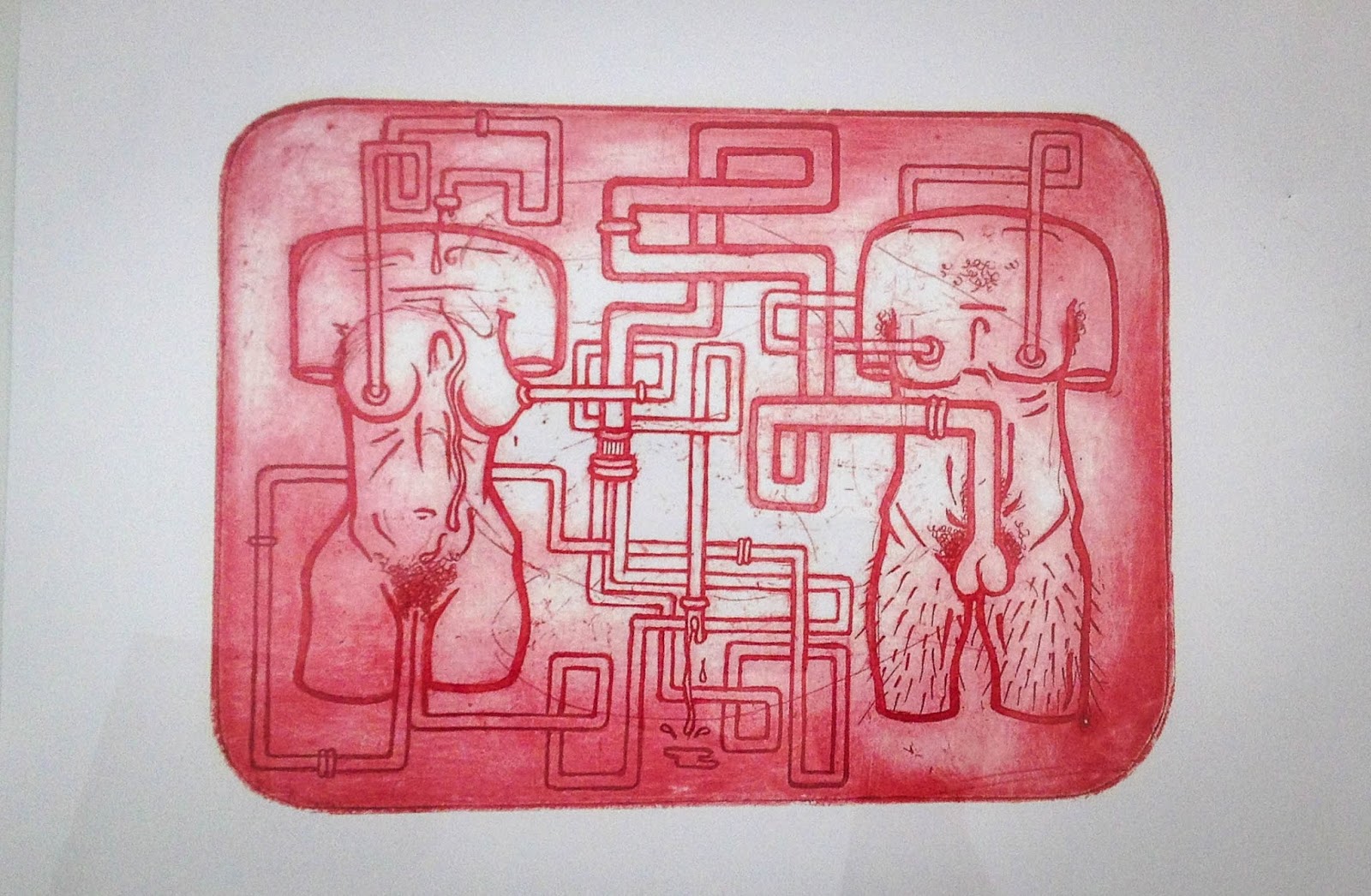
Other aspects of her work in this exhibition are blatantly physical, which both attract and appall. The surreal style is simultaneously playful and voyeuristic bringing curiosity to a corset-styled torso, or a technical design inspired blueprint for human plumbing.


Plumbing
Her artworks are often surrealist in style, but she can also draw Michelangelo- style anatomies when she wants. Even in these, however, her restless curiosity is apparent.

Friday, 1 January 2016

Friday Five (Six): Favourite Films of 2015

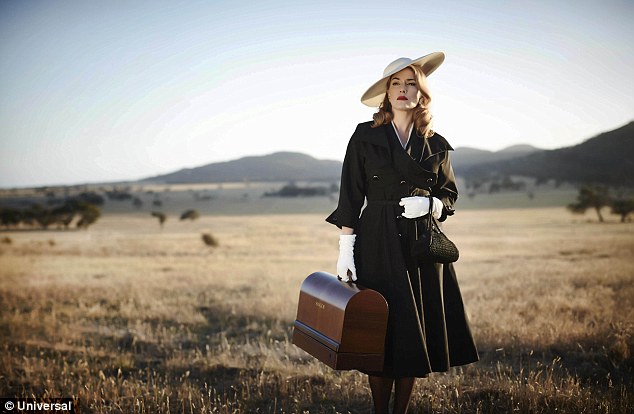
Kate Winslet in The Dressmaker
Obviously I have not seen everything that was released in 2015, but I totted up the number of this year's films I have seen and there are twenty on the list. So I have whittled it down to my favourites (in alphabetical order). And, yes, there are six, but as I've said before: my blog; my rules.

6 Favourite Films of 2015

  1. The Dressmaker – A glorious multi-genre Australian film directed by Jocelyn Moorhouse, with roots in fantasy, Western, black comedy and revenge drama, with the most outstanding costumes you’ll see this year. Kate Winslet is fabulous as the woman who returns to the town that spurned her as a child in a blend of Mary Poppins and Chocolat but without the songs or the saccharine.
  2. Mr Holmes – Ian McKellen is wonderful as the curmudgeonly retired detective with a passion for bee-keeping and a need to tell the truth about his last case, even if it doesn’t paint him in the most flattering light. His interactions with young Roger (Milo Parker) are heart-warming, and his oblivion to the feelings of Roger’s mother (Laura Linney) is equally affecting. Director Bill Condon has a great cast, and he makes the most of them in a reflective work.
  3. Selma – David Oyewolo portrays Dr Martin Luther King as flawed and conflicted despite his firm belief in civil rights. If you put your family in danger for your convictions, does that make you a hero or a martyr? Director Ava DuVernay poses this question as the film focuses on the specific 1965 incident of the Selma/Montgomery marches in Alabama. This cohesive narration avoids the potential of a rambling biopic, while the superb acting and direction make it a confident and assured work of cinema.
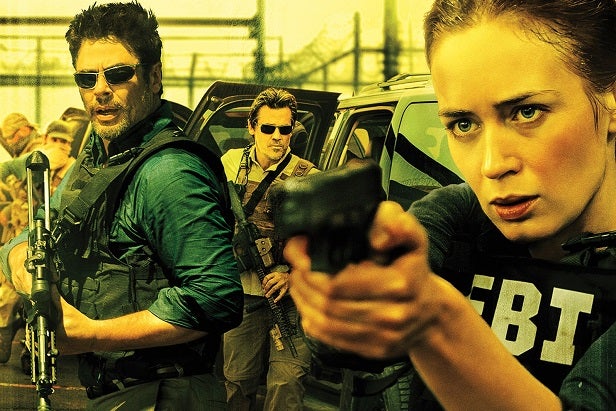
  4. Benicio del Toro, Josh Brolin and Emily Blunt in Sicario
  5. Sicario – Emily Blunt is the viewer’s Everywoman as she gets mired in an FBI operation to bring down the leader of a powerful and brutal Mexican drug cartel. She is unsure of who is in charge and the ethics of their actions, as is the viewer. Denis Villeneuve directs terrifically tight action sequences full of anxiety and tension. Benicio del Toro and Josh Brolin are also excellent in the frustrating thought-provoking drama.
  6. Testament of Youth – This is highly recommended quality film-making; one of the best adaptations of a book I’ve seen, and I loved the book! Alicia Vikander is excellent as Vera Brittain, who remains stoic at the heart of the dramatic narrative. Huge plaudits must be awarded to director to James Kent for handling this iconic memoir of WWI from a woman’s perspective with such subtle charm.
  7. Youth – Deliciously studied performances from Michael Caine, Harvey Keitel and Rachel Weisz at a luxury lodge in Switzerland also populated by Maradona, Miss Universe, an actor studying for a role (Paul Dano), and a couple that never speak, make this a marvel of cinema. Paolo Sorrentino directs with a masterful touch; the sound and the scenery, and the superb supporting cast all combine to make this simply sublime.
Michael Caine and Harvey Keitel in Youth