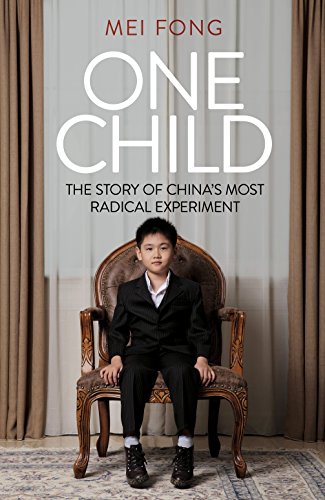
One
Child: Life, Love and Parenthood in Modern China
by Mei Fong
(Oneworld Publications), Pp. 236
Pulitzer Prize-winning journalist
Mei Fong has spent eight years documenting the effects of the one-child policy
across Chinese society. In this critically acclaimed account, she weaves
together personal stories and social politics to produce an evocative
investigation into how the policy has changed China and why the repercussions
will be felt across the world for decades to come.
The one-child
policy was introduced in 1979; it was ‘relaxed’ in 2013 and phased out in 2016.
Mei Fong argues that it was flawed from the initial concept when it was introduced
as a form of population control, and that population growth would have
decreased naturally without the need for such draconian measures. Even since
the abandonment of the one-child policy, the birth rate in China is not
increasing. Polls reveal that although couples would like to have two children,
many say “it’s unaffordable, too stressful, and will impinge on their personal
goals too much…by having one child, they can better concentrate their resources
and have a more successful child.”
As it was, the
policy led to many unforeseen issues, including the number of enforced
abortions and sterilisations. “In one year alone, 1983, China sterilised over
20 million people, more than the combined population of the three largest US
cities, New York, Los Angeles, and Chicago.”
During the
system of the one-child policy, the law was relaxed to allow people to pay to
have a second child. Naturally this benefitted the rich (and arguably led to a
more affluent, urban and spoiled population) while providing a source of income
for poorer counties where families were charged heavy compensation fees (shehui fuyangfei) for having more than
one child. As these fines were the only income that did not have to be handed
over to the central government/ national treasury ‘for redistribution’ they
were rigidly enforced.
In a society which is geared
towards marriage and family, this policy has long-reaching effects on cultural
attitudes, such as the creation of the Little Emperor phenomenon, and the
shocking treatment of elders. The author uncovered many harrowing instances of
elder abuse as the spoiled single offspring no longer see the necessity of
caring for their parent. “The one-child policy significantly reduced the number
of care-givers for China’s elderly, not just in quantity alone, but also in
quality. There are fewer women in China now – and by extension, fewer
daughters-in-law, and they’re the ones who really take care of the elderly.”
There are terrible stories of geriatrics being put in pigpens by their children
or shunted off to unsanitary nursing homes where they wait to die. If this
trend continues there will be insufficient young people to care for the current
population. According to academic predictions, “Somewhere in the decade between
2020 and 2030 China’s absolute population will hit is peak and start to
decline. By 2100, China’s population could have declined back to 1950 levels of
about 500 million.”
Perhaps to Western sensibilities,
one of the more obvious side effects is the treatment of women. “With the
current gender imbalance, women are certainly more valuable, but not
necessarily more valued. In addition to a rising anti-feminist backlash, the
female shortage has resulted in increasing commodification of women.
Prostitution and sex-trafficking in China have been on the rise for the past
decade.” Many women in neighbouring countries, such as Vietnam, Cambodia,
Myanmar and North Korea, are forced or tricked into being sold as wives for
Chinese men.
In the last two
decades 120,000 children from China have been adopted internationally. Naturally
this has “significantly shaped global attitudes toward race, family, and the
ethics of intercountry adoption” but is it all ethical? Mei Fong asks, “Is the
wave of Chinese adoptions, as many believe, an altruistic act that rescues
hundreds of unwanted, mostly female children from a life of penury and
institutionalization – or is it really baby buying on an international scale,
sanctioned and even facilitated by the Chinese government?” She discovers
multiple incidents of babies being stolen and sold to orphanages.
Ethical questions also arise
regarding fertility and consequent eugenics. With the ability to have only one
child, many people are using reproductive technologies to have the kind of
children they want “This usually means choosing the sex and the number – twins are
favoured – and screening out genetic diseases. In cases where an egg donor is
desired – and where genetic material is passed on – Chinese parents are also
trying to select traits like intelligence, height, looks, blood type, even
double eyelids.”