Showing posts with label politics. Show all posts

Thursday, 15 January 2026

My Newest Favourite Thing: Behind the Lines


While Cousin Rachael was visiting, we went to Old Parliament House, and while she walked around the Museum of Australian Democracy, I went to the Behind the Lines exhibition to see the political cartoons from 2025. Here are some of my favourites. I have added the exhibition's words in quotations.

Introduction by Matt Golding
"In this specially commissioned cartoon for Behind the Lines 2025, Political Cartoonist of the Year Matt Golding responds to this year's theme: Are We Rolling? The politicians running across the top of the film projector are (left to right) Donald Trump, Vladimir Putin, Xi Jinping, Benjamin Netanyehu, Allegra Spender, Larissa Waters, David Littleproud, Angus Taylor, Sussan Ley, Jim Chalmers, and Anthony Albanese."

Climate change remains a headline catastrophe, but cartoonists point out that people are less bothered by global concepts than personal finances.

The Cost-of-Not-Living Crisis by Matt Golding
"If we listen to the political dinosaurs, the cost of living is the most pressing issue affecting Australians. Climate change scientists might disagree, noting Australia's climate is already changing and calling for immediate action to reduce carbon emissions. Climate change is the 'asteroid in the room' that no one wants to acknowledge."

Responding to Our Wake-up Calls by Matt Golding
"The cost-of-living crisis was one of the biggest points of debate during the election campaign. In Matt Golding's cartoon, this is the issue that finally spurs the world into action - whereas climate change has the whole world repeatedly hitting the snooze button."

Priorities by Cathy Wilcox
"September saw the release of the National Climate Risk Assessment by the Australian Climate Service. The Department of Climate Change, Energy, the Environment and Water described it as 'Australia's first nationally comprehensive look at how climate change could affect the systems we rely on'. The report detailed sea-level rises, increased deaths from heatwaves and the impact of climate change on the Australian property market, which could see close to a million homes possibly uninsurable by 2050."

Join the Dots by Megan Herbert
"Mid-year a deadly algal bloom driven by marine heat waves had a devastating effect on the marine life around the coast of South Australia, with an unusually large number of dead marine creatures appearing washed up on the state's beaches. Between March and July, according to data collected on the citizen science site iNaturalist Australia, the bloom killed around 15,000 animals from over 450 marine species."

House of Cards by Harry Bruce
"As the cost of living rose and the housing crisis continued, Australians turned to their credit cards. Reserve Bank statistics released in February showed the national credit card debt sitting at $17.8 billion, a figure bolstered by Australians' record monthly spend of $28 billion in December 2024." 

There are, inevitably, cartoons specifically aimed at Australian politics. 

Nighthawks at the Sky After Dark Diner by Matt Golding
"In this work Matt Golding recreates one of America's most famous paintings, Edward Hopper's Nighthawks (1942). Peter Dutton approaches an intimate bar, the Sky After Dark Diner, where former Liberal leaders Malcolm Turnbull, Scott Morrison and Tony Abbott, seated next to Sky News host Peta Credlin, are being served by the channel's owner, Rupert Murdoch." 

The Liberals' Post-Election Complete Rebuild by Matt Golding
"This is one of two very clever re-creations of IKEA instruction booklets in the year's Behind the Lines. The challenge of rebuilding the Liberal party after the election could be remarkably simple - or very difficult - depending on your personal view of whether it is easy or hard to follow IKEA construction manuals."

Nuclear Neverland by Claire Harrison
"A major coalition policy during the election campaign was a plan to build seven nuclear power plants across New South Wales, Queensland, Victoria, South Australia and Western Australia. The coalition claimed this would provide a 'cheaper, cleaner, and more consistent alternative' to coal or renewables. Many did not share the Coalition's enthusiasm for the policy and were concerned about its many documented risks, such as the effects of radiation on humans and animals."

Podcasts vs Justice by Jess Harwood
"The mushroom murder trial of Erin Patterson spawned at least five dedicated podcasts and countless news reports. Around the same time there was a coronial inquest into the death of Kumanjayi Walker, a Warlpiri man who was shot and killed by police while resisting arrest in the remote Aboriginal community of Yuendumu, Northern Territory. The inquest found that Walker's death was 'avoidable' and should not have happened."

Farewell to Old England Forever by Mirranda Burton
"This rabbit X-ray refers to the pests that were brought to Australia on the First Fleet and which now number in their hundreds of millions. Recent favourable conditions have seen the population boom, leading to calls for federal support to fast-track the next rabbit biocontrol virus. Rabbits cost the Australian agricultral sector $200 million a year, twice as much as do foxes and mice. They also threaten double the number of native species compared to other introduced animals."

There is a strong contingent of American news and concerns. Of course, this makes me question whether American newspapers and cartoonists would be interested/ aware of anything taking place beyond their shores. 

Inflammation of a Nation by Matt Golding
"This cartoon appeared in June 2025, not long after the protests in the city of Los Angeles against ICE abductions and deportations of undocumented people. The protests lasted several days and in response President Donald Trump sent in 4,100 Califormia National Guard troops and 700 Marines, sparking widespread debate about the boundaries of presidential power."

Burning by Cathy Wilcox
"In January 2025 a series of 14 wildfires caused significant damage and loss of life in the Los Angeles metropolitan area and San Diego County in California, United States. Two of the fires were considered to have been the second and third most destructive ones in California's history. Reports said more than 18,000 homes were destroyed and up to 440 people were killed as a reslt of the fires."

The Wake-up Call? by Mark Knight
"American democracy has been put to the test in 2025, with nearly double the number of politically motivated attacks than for the same period in the previous year. In September conservative activist Charlie Kirk was killed while speaking on a Utah collage campus. This followed two assassination attempts on Donald Trump during his 2024 presidential election campaign. Politicians and national figures have been targeted throughout America's history; pictured here are Abraham Lincoln, John and Robert Kennedy and Martin Luther King Jr, all of whom were assassinated, and Ronald Regan, who survived the attempt on his life."

Global politics and events are also included, such as this gut-punching cartoon from Cathy Wilcox.

Exodus by Cathy Wilcox
"In September a UN Commisssion of Inquiry released a report stating that Israel was committing genocide in Gaza. It detailed the targeting of citizens, including children, in far larger numbers than in  previous conflicts; the blocking of medical aid, foood and water; and acts aimed at 'deliberately inflicting on the group conditions of life calculated to bring about its physcal destruction in whole or in part'. The Israeli government rejected the report, saying it relied 'entirely on Hamas falsehoods'.

A couple of the works feel quite personal as they address the individual and their relation to art. 

Overflow vs Flow by Megan Herbert
"Megan Herbert captures the dilemma of many creative people,  particularly freelancers, as they try to carve out a sustainable career in Australia. The federal government's five-year Revive policy, which has been in place for almost three years, has the 'Centrality of the Artist' as a key pillar, an acknowledgment of the need for career structure and fair remuneration. Living a creative life has always been a precarious position, even without the disruptive threat of  generative AI."

Put Things in Perspective by Scott Wrigg
"According to The Guardian, Gen Z is taking up 'cosy' hobbies in 2025 as a way to de-stress, find connection and create tangible objects in an increasingly digital world. From pottery classes to cooking clubs, arts and crafts are being used as a positive mood booster and a way to regain some perspective. Sometimes, though, art can do the opposite and give us too much perspective."

Antisocial Media by Megan Herbert
"Phones used to be simple devices that connected two voices separated by great distances. Now we have smartphones, incredibly sophisticated, multifaceted communication devices that can spread messages to millions in milliseconds. However, there's growing anxiety about people using them to fuel extremism and spread misinformation."

The Problems of the World by Rosie Murrell
"In this cartoon a crowd of people, seemingly disconnected from each other, are looking down at their phones, doomscrolling, consuming negative news online. As Rosie Murrell said when she posted the image to Instagram, they - and we - are 'wondering what we can possibly do to stop any of it. And the exhaustion of it.'"

Looking through all these political cartoons can actually get quite depressing as we see the state of the world with greed, war, famine, and basic inhumanity. So, I'll finish the post with a positive cartoon.

Horses for Courses by Fiona Katauskas
"The Four Horsemen of the Apocalypse from the New Testament's Book of Revelations symbolise conquest, war, famine and death and herald the 'end of days' that will precede the Last Judgment and the damnation or salvation of souls. Fiona Katauskas's horsemen, however, have decided enough is enough and have pivoted to harbingers of hope."

Wednesday, 7 August 2024

My Newest Favourite Thing: The Wharfies' Mural


One of the most iconic treasures in the Australian National Maritime Museum is the Wharfies’ Mural. It is a window into the cultural movements that occurred among workers on the waterfront during the 20th century, and a reminder of their significant role in broader Australian politics and society.

This mural, an iconic example of Australian working-class cultural expression, originally adorned the canteen walls of the Waterside Workers' Federation building in the busy waterfront of Darling Harbour. Painted in stages mainly between 1953 and 1965, it was a collective effort by nine artists, including waterside labourers, or 'wharfies'. 


Though vital to Australia, wharf labouring was hard, dangerous, low-status work. The maritime unions had long fought for improved wages and conditions, and they took a lead role in national campaigns for social justice, minority rights and anti-war activism. This mural celebrates and memorialises that history.

The Waterside Workers' Federation encouraged the cultural and artistic development of its members. With the support of union leader Tom Nelson, artist Rod Shaw and wharfie Sonny Glynn developed a design that could intertwine maritime and labour history. For years wharfies ate their lunch as the artists worked, debating the social and political struggles as they appeared on the wall.


Reflecting the social and political ideals of those involved, the mural for the Waterside Workers' Federation (WWF) canteen was a collective effort. By the 1950s murals were important to left-wing and working-class cultural expression, particularly in communist circles. Rather than elite activities, artistic creation and appreciation were seen as accessible to everyone. Realist art and so-called 'conscious propaganda' were a focus. Producing banners and placards for May Day marches set the creative groundwork for the mural's creation. Mural artist Evelyn Healy for example, first painted banners for May Day in 1938.


Conversations between the artists, union leaders and wharf labourers guided the struggles and victories that the mural depicted. With the help of wharfie Sonny Glynn, Rod Shaw projected the initial sketches onto the wall and then outlined them in chalk. He then painted over them in oil paint created with pigments from the printery where he worked. Shaw conceived the mural's structure as major themes painted in dark, sepia tones with spaces left for cameos, or small windows, that would be painted in full colour by different artists. He described the effect as 'like a tapestry'.


From those first lines on the wall, the mural eventually wrapped around multiple surfaces in the canteen. It was created in four phases. The first was from 1953 to around 1956 by Rod Shaw with Sonny Glynn, Evelyn Healy, Vi Collings, Harry McDonald and Pat Kelk Graham. The second phase between 1957 and 1960 was painted by Clem Millward and Harry Reade, assisted by Ralph Sawyer. The third phase in the early 1960s saw Sonny Glynn returning to work on the mural with Sawyer. During the final phase after the mural was relocated in several pieces to the new union building, Swayer filled the remaining blank cameo in 1993.
"The ideas for the mural were discussed with a lot of people. Many of us did preliminary sketches for the General Strike of 1917; that's where we started... We got a rough idea and finally Rod put some rough-outs up on the wall." - Artist Vi Collins, 1992

The harsh physical and economic realities of waterside labouring drove the creation of maritime unions in the 1800s - collective effort to ensure safer and more just working conditions. The struggles, aspirations and victories expressed in The Wharfies' Mural reveal a far-reaching trajectory with implications for workers in Australia today. What began as a localised fight on the docks in the 19th century led to ongoing organised agitation for social change. Union support for Aboriginal and Torres Strait Islander justice, women's economic equality, worker's rights, internation solidarity and global peace continues well into the 21st century.


Art and politics are often intertwined. The mural examplifies this convergence. Local artists, inspired by Socialist Realism and left-wing thought, formed groups such as the Studio of Realist Art, hoping to take art from a prerogative of a few to a concern of the many. Likewise, progressive film-making, theatre and visual arts in the 1950s sought to depict the seemingly invisible experiences of the working class and make them accessible to all. Created through communal effort and now preserved for future generations, the mural speaks to the wharfies' trials, triumphs and shared cause. 
"I believe it is... a very early example of a cooperative work of art. It involved time, a lot of thought, you know, a lot of everything - a lot of heart." - Artist, Clem Millward, 1992

Tuesday, 25 October 2022

Le Carre's Last Stand: Agent Running in the Field


Agent Running in the Field by John Le Carré
Viking
Pp. 281

The last book that John Le Carré wrote is, perhaps unsurprisingly, a fast-paced action with a clear story and credible characters. Themes of espionage, defection and loyalty may have seemed passé, but nationalism and protectionism are once again current: the old enemy is back, reinvented as the new enemy and we may need to defend our nation and concepts of freedom and democracy all over again from plutocrats like Putin. The novel is crammed full of code names and secret spy business, played out against a backdrop of Brexit, Trump and greedy oligarchs in a contemporary environment.

Nat is a forty-seven-year-old veteran of Britain’s Secret Intelligence Service who plays badminton and lives a pleasant and seemingly settled life in London with his wife, Prue, who does pro bono legal work for worthy causes. He is somehow manoeuvred into playing badminton at his exclusive private club against a young upstart, Edward Shannon, who has ideas, and he is not afraid to expound them. With an older mentor’s indulgent attitude, Nat finds himself looking forward to these meetings, although the book is written in retrospect as he reflects upon them.

The premise is that Trump has helped to engineer Brexit so that Britain has to rely on Russia for financial and political assistance, which is obviously going to be grubby, and be beholden to the USA once again. Tellingly, Trump does Putin’s dirty work for him: “pisses on European unity, pisses on human rights, pisses on NATO. Assures us that Crimea and Ukraine belong to the Holy Russian Empire, the Middle East belongs to the Jews and the Saudis, and to hell with the world order.”

There may possibly be “an Anglo-American covert operation already in the planning stage with the dual aim of undermining the social democratic institutions of the European Union and dismantling our international trading tariffs.” This operation will also “disseminate fake news on a large scale in order to aggravate existing differences between member states of the Union.” One former spy is horrified to think that he risked his life to see the Great British Empire, liberal conscience and Christian values replaced by “a cartload of hypocritical horseshit”. In present circumstances, division and in-fighting will not be difficult to engineer.

The language of spies follows form: a newspaper in which hand determines whether it is safe to talk or not; letters written suggest the opposite of what is declared. There is, however, a refreshing respect for women, which is often absent from male hard-boiled thrillers. The novel is elevated by its use of witty and decisive one-liners to describe characters and actions. For example, one high-ranking official has a “cheery port-and-pheasant voice”, while another “doesn’t do confrontation, which is something we both know. His life is a sideways advance between things he can’t face.”

At 281 pages the novel is shorter than many of Le Carré’s previous heavyweight thrillers, but it is engrossing and entertaining, packed with set pieces, old tropes and new angles. We live in a world of surveillance and, while anyone may express almost anything on the surface, there are people watching our utterances and manipulating our movements, biding their time until we can become useful to support a pet project. Gripping stuff.

Friday, 28 August 2020

Friday Five: More Podcasts

Back in May I wrote a blog post about the podcasts to which I was listening in COVID-19 times. Well, it's still going on, and I'm still listening. I just keep adding them to the list, and they roll around and keep me entertained alongside my regular favourites. Here are five more recently-listened-to podcasts.

5 Recent Podcasts:

  1. The Guilty Feminist (Patreon) - Deborah Frances-White hosts this podcast which ranges from stand-up comedy to interviews about hard-hitting topics such as domestic abuse and genital mutilation; recent episodes have covered Justice, Satire, Rebellion, Shame, Education and Credibility. Every episode kicks off with a round of  'I'm a Feminist, but...' as hosts and guests confess to 'shameful' double standards which we can all recognise. While mixing up the tone, the message remains firmly to fight for gender equality, and this is also the podcast that introduced me to the wonderful protest folk music of Grace Petrie. 
  2. The Anfield Wrap (TAW Player) - Yes, it's all about Liverpool F.C. and yes, it has over 28 million downloads worldwide. Neil Atkinson hosts a group of blokes (and it is nearly always blokes, unfortunately) who sit around discussing the highs (of which there are many lately) and lows of the club. There are a number of levels to which one can subscribe, but the free content is sufficient for me, covering transfers, signings, matches (both before and after), player interviews and a plethora of awards. Bonus 'cup of tea' episodes address current issues and how they affect the club from supporting foodbanks to LGBTQI rights and kicking racism out of football. 
  3. The lads of The Anfield Wrap with the manager of the Anfield team
  4. No Filter (Mamamia) - If interviews with interesting folk are your thing, then this Australian podcast hosted by Mia Freedman might be for you. With a fresh approach and a candid attitude she chats to well-known celebrities (Julia Gillard and Osher Gunsberg) and 'ordinary people' with incredible stories, such as a mother of a trans child or the bloke whose wedding sparked a COVID outbreak. 
  5. Have You Heard George's Podcast (BBC Sounds) - George Mpanga (aka George the Poet) delivers a highly individual take on societal issues through a mixture of music, poetry and storytelling. The first series, which came out in 2018, won four gold awards at the British Podcast Awards, plus two silvers and the podcast of the year.  His subjects included blaxploitation films, Reaganomics and why drug dealing and murder can seem the only options for black youth, whether in the 1970s and 80s US or contemporary UK.
  6. Newscast (BBC News) - I started listening to this when it was Brexitcast, then it became Newscast, then Coronaviruscast, and now I think we're back to Newscast. It might be tricky to keep up with the title but the premise is the same - intelligent, topical political and social issues introduced by Adam Fleming, and discussed 'with the BBC's best journalists and other people who know what they're talking about'. It's basically how I check in with what's going on back in Blighty; it's interesting informative and measured with lots of heft and a touch of levity.

Monday, 20 July 2020

Gently Hurling: After She Left


After She Left by Penelope Hanley
Impact Press
Pp. 337

This novel focusses on three generations of women and in particular the mother/ daughter relationship, but the characterisation is shadowy and they all blend into one. Penelope Hanley obviously has things that she wants to say about Irish immigrants, illegitimacy, art, Sydney, politics, and the Women’s Liberation Movement but the forced plot and the unnatural dialogue does her story a great disservice. The granddaughter, Keira, is trying to do a photo essay project on her grandmother (Deirdre Wild)’s art, but her mother, Maureen, resists saying much about her, creating a sense of mystery. It transpires she had an illegitimate child after an affair with a married man; this is not a scandal today and the consequences of it then aren’t covered well enough for it to merit the supposed shock.

There are ways of blending historical detail seamlessly into a novel, which Penelope Hanley ignores. She uses newspaper articles to fill in details, or clunky discussions about conscription and the Vietnam War; Whitlam’s speeches are transcribed. Neither does the author follow the advice given to every aspiring author of ‘show; don’t tell’. The description of Deirdre’s peripatetic lifestyle reads like a route map, and rather than trying to weave the effect of the artworks into the narrative, Hanley chooses to describe Deidre’s art in a mock newspaper review; a three-page long account of the paintings and the artistic style supposedly from the Sydney Morning Herald.

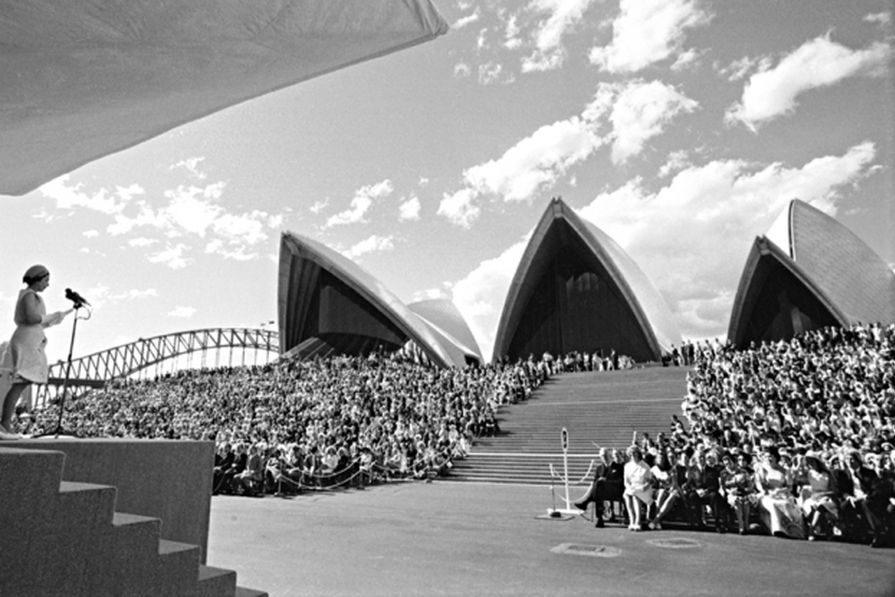
Queen Elizabeth II officially opening the Opera House on 20th October 1973
Characters discuss sexism in art, and the architecture and politics of the Opera House in a way which is simply unrealistic. Keira won’t go to the opening, because the author wants to shoehorn in her opposition to the monarchy. The frequent discussions about gender roles and how women do all of the “domestic stuff” even when they have a paid job too, are clearly important, but are presented as daughters and mothers lecturing each other with full speeches. It plays to the gallery so strongly I feel as though I’ve been hit over the head with a pop-up placard. Earnest debates about apathy and change read more like a social history textbook, and the writing is turgid as no noun is left with an adjective; no verb without an adverb. “When she let herself in, Lady, in a quick dash of woolly curls and wagging tail, hurled herself gently at Keira, barking ecstatically, her paws on Keira’s thighs.” – can a dash be anything but quick? Can one hurl gently?

Depth is implied through what the characters are reading, perhaps hoping their knowledge and ideas might be inferred; all books are mentioned from Iris Murdoch and Erica Jong to Germaine Greer and Simone de Beauvoir. Apparently constant mention of characters’ outfits is also a substitute for giving them any personality. This could have been an interesting tale but it is submerged in layers of overblown prose, excessive detail, stilted dialogue and indistinguishable characters.

Friday, 3 July 2020

Friday Five: Cross-Stitch on a Theme

Sometimes everything gets 'a bit much' and, in these times, I have found that working designs from Really Cross Stitch: For when You Just Want To Stab Something a Lot helps. Of course, I am not advocating violence, but I am hoping for progress, and there is a theme in my latest five patterns about who or what I would like to change. As previously, all the words are from Rayna Fahey, and all the complete lack of ironing is my own.

"Politicians and toddlers have a lot in common. They are both prone to tantrums and act unreasonably, especially when they don't get their own way. Every now and then - just like a toddler - you have to give them a good talking-to!"
"Contending for the misogynist comment of the millennium, a presidential candidate's suggestion that he was at liberty to grab female genitalia due to his privilege was dismissed as 'locker room talk'. Whilst this overheard vulgarity wasn't enough to kill an election campaign, it certainly put feminists on a war footing well before Trump took office.

This pattern attests to the fact that kitty has claws. The only pricks we will tolerate come from our cross stitch needle."
"Now it's really not nice to attack someone you don't like politically based on their appearance. But this time the temptation was too strong.

"For someone who is world-record-breakingly quick to insult someone, Trump's skin does appear to be diaphanously thin when it comes to people discussing the size of his hands. But in the scale of things, this is the guy that reinstated the Global Gag Rule and wants to ban the world's 1.6 billion Muslim people from America. So there's plenty of actual policy to organise around while you're doing this cross stitch."
"Cunts are deep, warm, and delightful; indeed the place from which the majority of us astoundingly enter this fragile world. Yet no single word creates as much division and carries as much power as this little number.

"One thing activists are super-good at is dissecting the meaning of language, until letters break down into pixels. Give us another decade and everyone will know that vagina is 16th century slang for a place to keep your sword. Ouch."
"Language can be used to persuade, amuse, insult, and mobilise action. Few formats can accomplish these goals as ably or succinctly as the protest sign.

"Of course, sometimes the words just won't come. Or there are too many of them to fit on one sign. Or you're just so tired of being angry and upset that you just want to go UGH; which is fine. 'Just, Ugh' conveys all the despair, rage and hopelessness in just seven easy letters, and of course, can be used for virtually any occasion as it works for anything. Plus, it's nice and easy to stitch."

Thursday, 18 June 2020

"A Little Bit of Politics': Number Ten


Number Ten by Sue Townsend

Penguin

Pp. 324

Satire is a problematic genre. From Jonathan Swift and Charles Dickens to Douglas Adams, J.K. Rowling and Paul Beatty, authors struggle to find the balance of serious points amidst the comedy in socio-politics. In Number Ten the Prime Minister, Edward Clare, fears that he is out of touch with country (he doesn’t know the price of milk; I think many men of a certain age don’t) so, accompanied by Jack Sprat, a policeman who normally stands outside the door of No 10, he sets out on a public relations odyssey.

Just as Shakespeare’s Henry V disguised himself as a commoner to move among his people, so Edward Clare disguises himself as a woman, borrowing his wife’s clothes, and calls himself Edwina. This is a little cringe-worthy and hovers dangerously around the Mrs Brown’s Boys/ Dick Emery/ Les Dawson/ man-in-drag-is-hilarious trope. Edward soon discovers that he likes dressing as a woman, even if he does resemble “a poor man’s Joan Collins” and there are further references to the film Some Like it Hot: the novel immediately aligns itself with a certain demographic.

The Labour Prime Minister’s formidably clever wife, Adele, is described as “an absolute cow”. He has a swarm of advisors, including Alexander McPherson, “political friend and colleague, his press officer”, and David Samuelson, the spin doctor, who wants to change the name of the party by taking ‘Labour’ out of the party’s name. “The word Labour has totally negative connotations; it’s associated with sweat and hard work, trade unionism and protracted and painful childbirth.” Added to the entourage is Chancellor of the Exchequer, Malcolm Black, who may have his own political designs. Obviously we are meant to draw parallels with Blair’s government with Gordon Brown waiting in the wings, but it also sits halfway between Yes, Prime Minister and The Thick of It.

Policeman, Jack Sprat, is the foil to the shenanigans; a sort of Everyman who becomes the Prime Minister’s conscious, arguing politics with him supported by information he has picked up on duty. For example, when Edward Clare is championing laissez faire politics, in which people can plough their own furrow, Jack counters, “They could plough a straighter furrow with a better plough and a healthier cart horse.” His mother, Norma, is afraid to leave the house due to media-hyped fear-mongering. She takes in a young man as a cleaner, and he abuses her trust and turns the place into a crack den, highlighting the issue of single elderly people being taken advantage of by disenchanted youth. When asked his opinion about what most concerns the people of this country, Jack replies, “It’s crime sir. There should be more policemen on the streets.”

Times and references change very quickly, and this is also a very British book; name drops such as Graham Norton, Adele, Ben Elton, Simon Armitage, Gary Lineker, and Ulrika Jonsson are very time-and-place specific. The novel touches on many current topics of concern, from sink-hole estates and battery farming to chaotic A&E departments and lack of common courtesy on public transport.

People feel under pressure to perform; success is difficult to manage and the reader may find themselves sympathising with Edward Clare as not altogether a bad person. He may be out of touch, but he has so much stress that he has a breakdown. The psychotherapist who questions him notes that he cannot name his favourite flower, rock band, or book. “He is pathologically unable to commit to an opinion for fear of displeasing the questioner, in this case me.” The Prime Minister has many people’s opinions to consider, and that is his job. How can he be expected to know everything? Is it his duty to take these worries from us? Or would we rather have ‘a man of the people’? Which people? Would we end up with something a lot worse?

In the midst of this angst, we have the character of Adele. There are enough Shakespearean references for the reader to surmise that she is intended as a parody of Lady Macbeth: she drives him onwards; he feels the guilt. She is not portrayed sympathetically but, although she is unpleasant (self-centred; pompous; oblivious to the misery of a member of staff whose son is about to lose a leg), she is also clearly unwell, and on medication. Her symptoms are ridiculed as a diversion, and the opportunity to show some empathy for mental illness is missed, as is the chance to portray a non-white character, Ali the Pakistani taxi-driver, as anything other than a shallow stereotype. These are the major failings in what is otherwise a passably amusing novel.

Thursday, 5 March 2020

Power to the people!

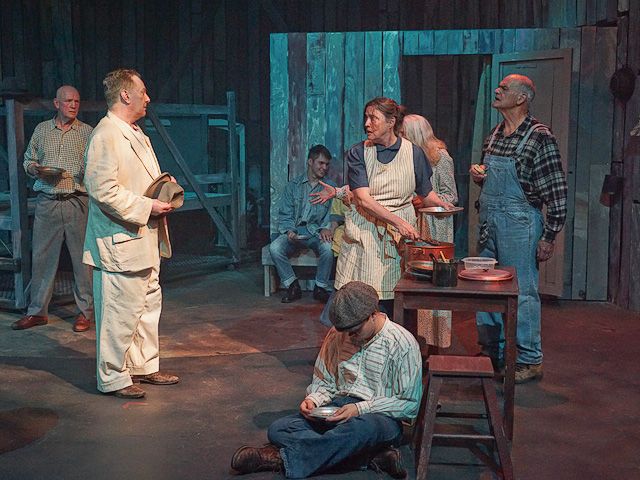
The Grapes of Wrath, Canberra Repertory Society
Theatre 3
13-29 February 2020


The Grapes of Wrath by John Steinbeck (published 1939) is one of those classic great American novels – it is taught in American high schools to the point that everybody knows it, even if they’ve only read the cheat notes or seen the 1940 film (directed by Tom Ford and starring Henry Fonda as Tom Joad) in order to pass the test. And it is a test. Full disclosure: I studied it at High School in New York (U.S.A), and I studied it for my university degree at Manchester (U.K.). It’s a tale that spans continents.

The 1988 play adapted by Frank Galati won the Tony Award for best play in 1990, and in the last thirty years has become a perennial favourite of high school productions. This is both a good and a bad thing, and a context with which to inform the Canberra Repertory production, directed by Chris Baldock.

The plot is fairly simple. During the Great Depression, the Joad family are driven off their land in Oklahoma due to a combination of drought, economic hardship, bank foreclosures and agricultural industry changes. They light out for the West (it is the American Dream, after all) in hopes of finding solid work and good fortune. It is not a spoiler to say things don’t turn out that way.

The set (designed by Chris Baldock; co-ordinated by Russell Brown) drew rounds of applause from the audience. It is a good set, made from pallets and angular constructions which variously represent houses, riverbanks and graves. The scene changes are complex and occasionally clunky, diverting attention from the dialogue or the emotion on stage to appreciation of the artifice.


The jalopy which the Joads load to travel to California is created on stage from flats and loaded up with bags and wheels, although it recalls The Wiggles more than the spirit of desperate adventure. At one point a rain curtain creates a deafening noise over which the actors cannot be heard, and soaks the stage although, strangely, not the actors. I refer to them as actors rather than characters, as this is another of those ‘stepping outside of the scene for the sake of the set’ moments.

The theme of family, friendship and community is one of the most powerful aspects of the story, and initially this is well handled as the multi-generational Joad family bustles about the stage doing chores and preparing a communal meal. It is also nicely contrasted with the isolation felt by Tom Joad (James McMahon) as he returns from a stretch in prison and encounters Jim Casey (Michael Sparks), the ex-preacher, who is struggling to come to terms with his new identity and the situation that has forced them away from all they have known.


As the family and a few extras embark on their journey this sense of community falls apart. Partly this is as members of the clan drop off by the wayside – Noah’s defection as played by John Whinfield is particularly affecting – but also because there is no sense of unity between the company. This should be an ensemble piece, but various actors proclaim and hold forth in a singular way without any perceivable warmth for their fellow cast. James McMahon and Amy Dunham (in a welcome return to the stage as Rose of Sharon) make overtures to the rest of the family, but they are almost rebuffed by a fearsome Ma (Karen Vickery), whose defensiveness is overplayed to the exclusion of the softer side of the matriarch.

Tom, Casey, and also Uncle John (played with hyper intensity by an almost unrecognisable Jerry Hearn), undergo personal, political and spiritual development with sensitivity and depth, dealing with hokey hillbilly dialogue – ‘There ain’t no sin and there ain’t no virtue. There’s just stuff people do’ – in a way that credits the acting and directing skills of all concerned. Considering this is a tale that led many to consider the implications of social economics, the differences between the socialist site and the capitalist camp are understated. Sure, the row of tents looks lovely, and the wire fence is an obvious allusion to camps closer to home, but the imminent threat is absent and the discussions about self-determination, unions, the rights of the worker, and responsibilities of the employer lack passion and are uninspiring.  


Essential qualities such as honour and resistance are given every chance to shine, and they do in solitary monologues but are lost in group moments: the dance and fight scenes are awkward, and the characters are not believable as the rough-and-ready types they represent. It is a stretch to believe in the resilience and perseverance of these average people whom circumstances have made extraordinary and it is not always clear that “We’re the people that live. They can’t wipe us out, they can’t lick us. We’ll go on forever, cos we’re the people.”

That’s not to say that there aren’t emotional scenes: the choices made in the face of starvation and the compassion shown by those suffering personal hurts are at times beautifully portrayed, not least by Dunham in the final scene. The lights fade on a touching tableau, highlighting human dignity; finally the motif of individual sacrifice to the greater good of the community is clear – and that is a wonderful way to finish. Power to the people.


Wednesday, 29 January 2020

Just right: A Universe of Sufficient Size


A Universe of Sufficient Size by Miriam Sved
Picador
Pp. 311

Spanning continents and three generations, this rich novel of mathematics, politics, friendship, family, sexuality and love, features numerous time and narrative shifts. Illy discovers a diary written by her mother, who has left it deliberately where she can find it, and reading it changes Illy’s perception of history and her self. It takes her back to 1930s Hungary, when Jews are barred from attending university, so a group of five friends and mathematicians (two couples – Ildiko and Levi; Eszter and Tibor; and Pail) meet beneath the statue of Anonymous in Budapest to expound upon their theories.

This desire for anonymity is unusual as nationalities fight to be the one to make mathematical breakthroughs that can be given military applications. Ildiko considers how one can know what future use will be made of the science, maths and physics they think they are discovering in isolation.

The friends cannot know that the Holocaust is coming, but they are aware that the future will be dangerous and that their group will dissolve. They can’t imagine marriage or children, because they live in such uncertain times. They all, particularly Eszter, want to protect Pail from the real world and shield his genius, worrying that he is not equipped to deal with the coming war and its consequences. While Pali remains entrenched in his theoretical problems, not all of the friends agree he needs extra attention. Ildiko tells Eszter, “Someone will always look after Pali, because he is brilliant and hopeless at the same time. I have noticed that people can’t resist the combination of brilliance and hopelessness in men.”

This world is echoed in the present when Josh, Illy’s son, attempts to find applications for his version of theoretical mathematics. He is aware of the work of Pali Kamar, but thinks the internet provides practical applications, which he explains to his grandmother, Nagymama, not knowing she was a friend of Kali’s. Josh is excited by finding order in chaos; to understand the universe; to feel less insignificant, which he (and Pali before him) demonstrates through Euclidean planes. Josh searches for order and predictability, trying to shape the situation to fit.

Everyone in the novel tries to find their own pattern and shape their own narrative, while accepting difference and factoring it into individual and societal equations. When Nagymama moves to America, “It still surprises her how everything in this ridiculous country seems brighter, bursting with its own youth; even the vegetables have a juvenile optimism.” Infinite possibilities provide exciting concepts, but is it necessary to try and define them when there are constant breakthroughs and alternate opinions which subvert preconceived notions about everything from sexuality and religion to mathematics and astrophysics?