We went to Sydney for 48 hours over Australia Day weekend and we packed a lot in. I shall write more about each of these activities, but these are the headlines.
1. Woolloomooloo Sculpture Walk - ARTPark Australia: This is a free public exhibition of outdoor large-scale sculptures made from materials such as stainless steel, bronze, concrete and wood. The sculptures sit along the Wharf Boardwalk and many contain allusions to environmental and sustainable themes.
2. Nick Cave and the Bad Seeds at The Domain: The reason we went to Sydney in the first place, Nick Cave excels again in the Wild God tour. Him Outdoors is a big fan of the Bad Seeds era (he likes The Birthday Party best but it is unlikely they will ever tour that material). We were more than happy to enjoy a two-and-a-half hour set, including new tunes and old favourites as the bats flew overhead in the night sky.
3. Art Gallery of New South Wales: We went to two exhibitions here. The first, Dangerously Modern: Australian Women Artists in Europe 1890-1940, featured celebrated and rediscovered paintings, prints, drawings, sculpture and ceramics. The more than 200 works represent the wave of women artists who prevailed against social constraints and left Australia to pursue international professional careers. Some returned bringing back new ideas - realism; impressionism; post-impressionism; cubism; abstraction - and playing an integral role in modernising Australia. Artists such as Nora Heysen, Grace Cossington Smith, Margaret Preston, Dorrit Black, Frances Hodgkins, Thea Proctor, and Hild Rix Nicholas are represented in all their explorations of colour, light, form and movement.
The second exhibition, The Patchwork Portal, is a newly-commissioned work by Raquel Caballero. Celebrating craft as a skilled art, she invites visitors to contribute to a collaborative patchwork installation. She takes inspiration from her favourite childhood book, L Frank Baum's The Patchwork Girl of Oz, and the psychadelic fabrics of the 1970s are highlighted throughout her works of sculpture and portraiture.
4. The Book of Mormon at Capitol Theatre, Sydney: I have wanted to see this musical for a while and, seeing it was on its last weekend in Sydney, I was delighted to secure reasonably-priced tickets for pretty good seats. The theatre itself is beautiful and the show was as irreverent and as entertaining as I could have hoped. Parodying everything from virtue signalling and whitewashing to organised religion and musical theatre itself, the production was high-energy and full-on camp with exceptionally tight vocals and choreography, and even a perfectly pitched musical-within-a-musical.
5. The Australian Museum: Again, we saw two exhibitions here, the first being Relics: A New World Rises in which vintage objects meet miniature Lego brick worlds. The concept is that in the future, the human race has disappeared leaving their detritus behind from fridges and typewriters to ATMs and jetskis. The Lego community has colonised them to make a cryogenic health centre, printing press, credit union and holiday resort. The exhibition aims at being both nostalgic and thought-provoking, but there are far too many children present, who have no concept of stepping back to let others see, and what with all the pushing and shoving, it is difficult to get near the displays.
The Australian Geographic Nature Photographer of the Year displays are always excellent and this is no exception (although it is next to the Lego exhibition and there is a spill-over of space-oblivious children). The works showcase the spectacular flora, fauna and landscapes found throughout Australia, New Zealand, Antarctica and New Guinea. "From murky ocean depths, to soaring mountain tops and fiery outback landscapes", they invite us to see nature "in a whole new light".
On a recent trip to Sydney, we went to the World Press Photo Exhibition 2023 at the State Library of New South Wales. The annual exhibition presents the results of the 2023 World Press Photo Contest - the best and most important photojournalism and documentary photography of the last year. The winners were chosen by an independent jury that reviewed more than 60,448 photographs entered by 3,752 photographers.
We all know that bad news sells - few people want to read good news stories - and so it is with the photos in this exhibition. There are harrowing images of war, floods, drought, poverty, incarceration, and ecological disasters, leading to a warning such as the one above, and the one below: the photo of the year.
Mariupol Maternity Hospital Airstrike by Evgeniy Malolekta
Iryna Kalinina (32), an injured pregnant woman, is carried from a maternity hospital that was damaged during a Russian airstrike in Mariupol, Ukraine, on 9 March 2022. Her baby, named Miron (after the word for 'peace') was stillborn, and half an hour later Iryna died as well. An OSCE report concluded the hospital was deliberately targeted by Russia, resulting in three deaths and some 17 injuries. The jury felt the photo depicted an attack on the future of Ukraine. Evgeniy Maloletka photographed the image on assignment for Associated Press.
The port of Mariupol on the Sea of Azov was the first city struck when Russia launched its full-scale invasion of Ukraine on 24 February 2022. Civilians were hit hard.
The strategically important port is one of the largest Russian-0speaking cities in Ukraine, a major industrial hub, and vital for the country's steel exports. The territory was also of symbolic value to invading forces as it represented a large step towards building a land bridge between the self-proclaimed Donetsk People's Republic (DNR) and Crimea, which Russia had illegally annexed in 2014.
Images from The Siege of Mariupol by Evgeniy Maloletka
Top: 06 March 2022 - Zhanna Goma (right) and her neighbours settle in a bomb shelter in Mariupol, Ukraine.
Middle left: 11 March 2022 - Serhiy Kralya, a civilian injured during shelling by Russian forces, rests after surgery at a hospital in Mariupol, Ukraine.
Middle right: 11 March 2022 - Russian army tanks move through a street on the outskirts of Mariupol. The Z marking is one of several symbols painted on Russian military vehicles in the early stages of the invasion.
Bottom left: 04 March 2022 - Marina Yatsko and her boyfriend Olesksandr Kulahin bring her 18-moth son Kirill, fatally wounded during shelling, to a hospital in Mariupol, Ukraine.
Bottom right: 09 March 2022 - People place dead bodies in a mass grave in an old cemetery in Mariupol. According to the BBC, on some days during periods of heavy Russian shelling, up to 150 people a day were buried in mass graves.
By early March, Russian forces had completely surrounded the city, restricting water, power and food supplies. Some 200,000 citizens were trapped in Mariupol, as attempts to evacuate them failed. Russian bombardment devastated the city, and included civilian targets such as a maternity hospital and a theatre where people were sheltering. Evgeniy Maloletka, who is Ukrainian, was one of very few photographers documenting events in Mariupol at that time.
Image from The Siege of Mariupol by Evgeniy Malolekta
On 21 April, President Vladimir Putin announced that Russian forces had taken Mariupol, but the city council said that 1,000 civilians alongside thousands of Ukrainian soldiers were holding out in the giant Azovstal steelworks. By 20 May, the soldiers defending the steelworks had surrendered, and the UN and Red Cross were able to evacuate the citizens. The UN Human Rights Office confirmed 1,348 civilian deaths during the siege of Mariupol, stating that the actual death toll was likely thousands higher: Ukraine says that figure is more than 25,000.
At the time of this exhibition in April 2023, Mariupol remained under Russian occupation. Russia has begun rebuilding the city and scrubbing it of its Ukrainian identity by renaming streets and changing school curriculums.
The exhibition includes a short history of World Press Photo: since 1955, World Press Photo has connected the world to the stories that matter. The non-profit organisation remains committed to press freedom and the power of visual journalism by providing platforms that present accurate, diverse, and trustworthy images.
1955 - A group of Dutch photographers organizes the first World Press Photo contest to introduce their work to a global audience
1967 -Although black-and-white pictures still dominate the submissions, and chromogenic printing remains expensive, the jury awards World Press Photo of the Year to a colour photograph for the first time
1972 - The annual exhibition featuring current winners of the World Press Photo contest begins to tour outside the Netherlands. Since then, the exhibition has travelled to 129 countries
1977 - Francoise Demulder becomes the first woman whose work is awarded World Press Photo of the Year
1990 Charlie Cole's photograph of a demonstrator in front of tanks in Tiananmen Square becomes a symbol of peaceful resistance. To this day, this picture remains banned in China
Tank Man, Tiananmen Square by Charlie Cole
2002 - Fourteen years after creation of the JPEG, digital entries surpass analogue entries for the first time in the history of the contest
2019 - John Moore's photograph of a child from Honduras at the US border, which wins World Press Photo of the Year, leads to the repeal of the 'Zero Tolerance' policy that permitted separating immigrant parents from their children when apprehended
2021- To better represent a plurality of perspectives and global voices, World Press Photo introduces a new regional strategy, changing the set-up of the annual contest, the categories, and the judging
2022 World Press Photo of the Year by Amber Bracken
2022 - With her photograph of a roadside memorial commemorating the deaths of indigenous children who attended the Kamloops Indian Residential School in Canada, Amber Bracken becomes the first person to win World Press Photo of the Year without depicting a human figure
Woman, Life, Freedom
This photo-based video project narrates one chaotic night in the life of an Iranian nurse as she saves the life of a young protestor called Reza. The footage offers a rare glimpse into the dangers faced by protestors on the streets of Iran today, situated in the context of an inciting incident: on 16 September 2022, Mahsa 'Jina' Amini, a 22-year-old Kurdish woman, died after she was arrested by the Islamic Republic's morality police for allegedly violation the country's strict rules restricting the dress and conduct of women. The ensuing protests quickly intensified, spreading across the country. The Islamic Republic responded by disrupting internet access and violently repressing uprisings. Because hospitals are controlled by the regime, anyone injured in the protests risks arrest and further abuse upon seeking medical attention.
Iranian photographer Hossein Fatemi encountered the nurse in the video while providing support to local Iranian photographers covering the protests. Images and video for this project were captured by local photojournalists, the nurse herself, and a photographer on assignment to cover her story. Journalists and photographers attempting to report on the protests face reprisals from the Iranian regime, ranging from intimidation to arrest and violent abuse. Due to these efforts, it is difficult to know what is really happening inside the country. Many of the photographers who captured the images seen here will remain anonymous for security reasons.
Images from The Price of Peace in Afghanistan by Mads Nissen
These two images are from a collection that won World Press Photo Story of the Year, which captures the daily life of people living across Afghanistan in 2022. The top image shows Khalil Ahmad (15), whose parents, unable to afford food for the family, decided to sell his kidney for US$3,500. After the operation, Khalil suffers chronic pain and no longer has the strength for football and cricket. The lack of jobs and the threat of starvation has led to a dramatic increase in the illegal organ trade.
The bottom image shows women and children begging for bread outside a bakery in central Kabul, Afghanistan. Bread is a staple in Afghanistan, but soaring prices have forced more and more people to rely entirely on the compassion of others.
In August 2021, the withdrawal of US and allied forces from Afghanistan marked the end of a 20-year long attempt at nation-building. Taliban forces, having sustained an insurgency across the country, returned to power shortly after the collapse of the Afghan state. Consequently, all international aid, which in 2019 accounted for an estimated 80 percent of the country's expenditures, was halted, and 7 to 9 billion dollars of assets belonging to the Afghan state were frozen. Without these two sources of government income, the already fragile Afghan economy effectively collapsed.
National gross domestic product of Afghanistan dropped to around 25 percent of its peak in early 2021. Estimates for 2022 suggest that 97 percent of the population lives below the poverty line and 95 percent of people do not have enough to eat. Nine million people are at risk of famine and, according to the UN, over a million children are severely malnourished. COVID-19, intense droughts, and the inability of aid organisations to bring relief to those in need have all exacerbated the crisis, which is only expected to worsen in 2023.
The Nomad's Final Journey by Jonathan Fontaine
This highly-commended image shows Samira (16) looking out onto Qolodo camp near Gode in the Somali Region, Ethiopia, on 16 May 2022. Her family owned 45 goats and 10 camels, all of which died during recent droughts.
Nomadic peoples of Ethiopia and Somalia depend on their livestock, migrating across their territory to pasture their animals. In recent years water scarcity has threatened these livestock. Exacerbated by the climate crisis, droughts have devastated the region which, according to the World Food Program, now endanger the food security of over 26 million people. With many families forced to seek aid in climate refugee camps, social structures are weakening, precipitating violence against women and a host of mental health crises.
As droughts persist annually, women, who are often responsible for finding water, bear an enormous share of the physical and mental toll exacted by the ongoing crisis.
The text in the image above reads: This map, generated by RSF (Reporters Sans Frontiers) represents the current state of press freedom in 180 countries and territories. To arrive at the results compiled and visualised here RSF conducted extensive research during the past calendar year. In addition to distributing questionnaires among journalists, RSF also employed a panel of experts who ranked press freedom around the world according to five equally-weighted criteria: political context, legal framework, economic context, sociocultural context and safety. Their rankings are coded by colour, with the highest level of press freedom classified as 'good situation'. As you can see, that's pretty much Scandinavia. And that's it.
Part of Me by Nadia Shira Cohen
Surrogate mothers Vin Win (right) and Ry Ly (left) were arrested during a raid to fight trafficking in 2018. They live near one another and their children from surrogacy, Korng (3, left) and Phavit (4, right) often play together. Vin Win is separated from her husband who resents the situation.
This series portrays Cambodian surrogate mothers who have been required to raise their surrogate children as their own ever since Cambodia began prosecuting surrogacy in 2016.
Surrogacy - the act of carrying and birthing a baby for another person or couple - was accepted in practice in Cambodia until 2016, when the government started prosecuting surrogate mothers under already existing human trafficking laws. In 2018, a raid on a house in Phnom Penh led to the arrest and imprisonment of 32 women who were acting as surrogates to predominantly Chinese parents. Nearly all gave birth in confinement and, after sentencing by the Cambodian Supreme Court, all were obliged to raise the babies themselves or face prison terms.
Many of the women sought surrogacy arrangements with Chinese family planning agencies in order to help their families escape impoverishment and, in some instances, indebtedness from microfinance loans. In recent years, Cambodian households have become some of the most indebted on Earth and a major contributing factor has been the poorly regulated microfinancing sector. The rising burden of financial debt has resulted in an increase in child labour and families forced to sell their homes and land. For many of the women portrayed in this series, surrogacy represented a way out of debt, but now with the court ruling against them, their lives have become more difficult. Despite financial, social, and personal challenges, many of the would-be surrogate mothers have formed a deep bond with their children even as they express sadness that their children will not be able to benefit from the economic advantages that their biological parents could provide.
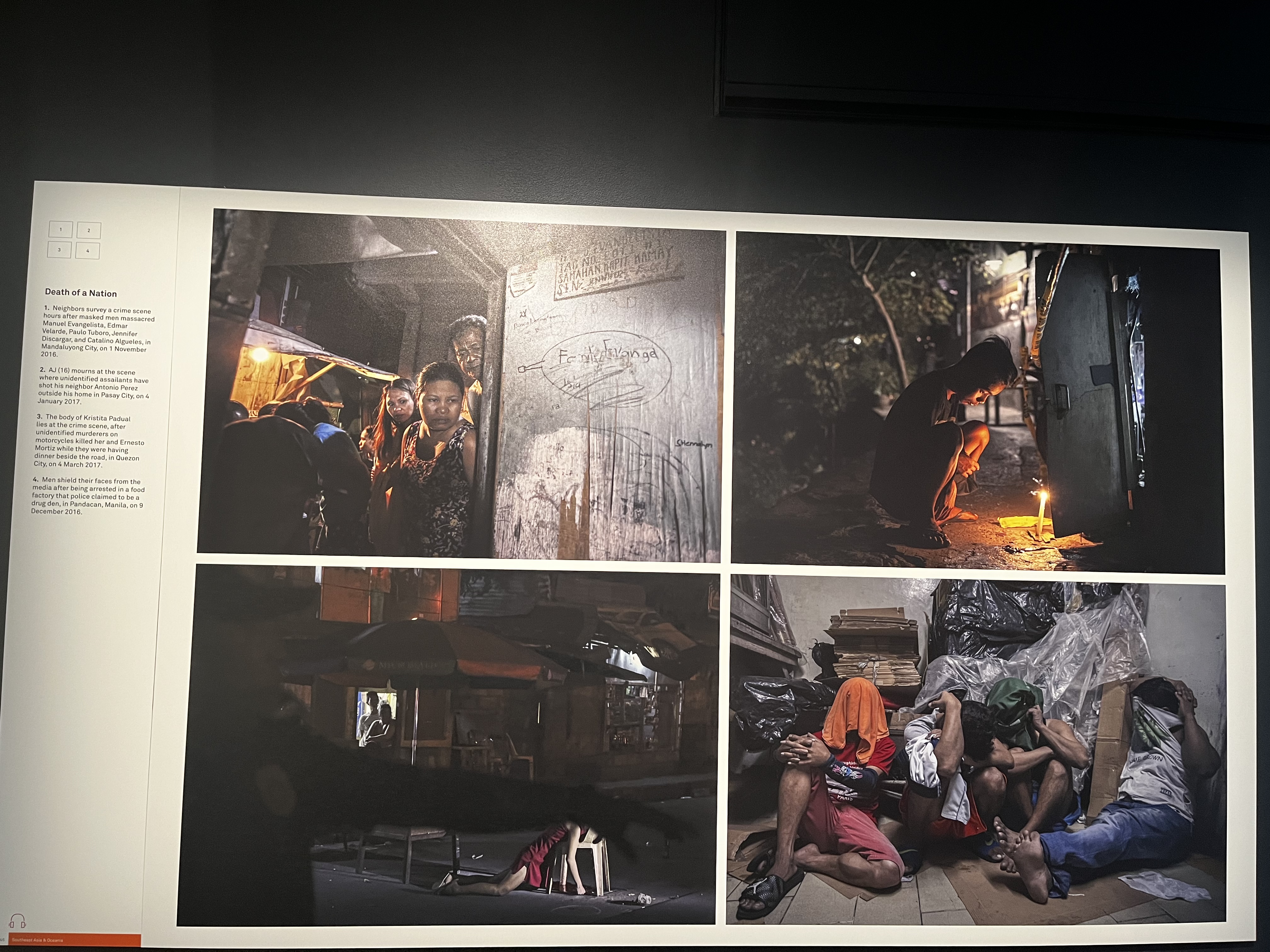
Death of a Nation by Kimberly dela Cruz
Winner of the long-term projects in the Southeast Asia and Oceania category, this project documents the Philippines' drugs offensive from its outset, capturing its broadening focus and the continued impact on families involved. The above photograph shows Jazmine Durana (15) cradling her month-old daughter Hazel on 2 February 2017, at the wake of her partner John 'Toto' Dela Cruz (16), who was shot by men wearing black masks a few days earlier.
Soon after taking office in June 2016, Philippine president Rodrigo Duterte began a concerted 'war on drugs', repeatedly ordering attacks against suspects. A surge of extrajudicial killings followed, perpetrated not only by police but also by masked vigilantes and other civilians. Amnesty International reports that executions mostly target low-income communities. The Philippine National Police admits to more than 6,000 such deaths to date; local human rights organisations put the figure at 30,000. The police appear to act with impunity, with only a handful of these killings being seriously investigated and almost no prosecutions.
Images from Death of a Nation
Top left: November 01, 2016 - Neighbours survey the crime scene hours after masked men massacred Manuel Evangelista, Admar Velarde, Paulo Tuboro, Jennifer Discargar, and Catalino Algueles, in Mandaluyong, the Philippines.
Top Right: 04 January 2017 - AJ (16) mourns at the scene where unidentified assailants have shot his neighbour Antonio Perez outside his home in Pasay City, the Philippines.
Bottom left: March 04, 2017 - the body of Kristita Padual lies at the crime scene, after unidentified murderers killed her and Ernesto Moritz while they were having dinner beside the road, in Quezon City, the Philippines.
Bottom right: December 09, 2016 - Men shield their faces from the media after being arrested in a food factory that the police claimed to be a drug den, in Pandacan, Manila, the Philippines.
According to the United Nations Office on Drugs and Crime, the Philippines has a low prevalence of drug use compared to the global average. Human rights organisations such as the World Organisation Against Torture (OMCT) and Amnesty International say killings often target political opponents, activists or marginalised groups. A Human Rights Watch report found that many of the killings that police attributed to drug gangs to be a veneer to shield themselves from culpability for executions carried out without legal process - an accusation the police refute, claiming self-defense.
Images from Death of a Nation
Top left: 08 September 2019 - Nestor and Alma watch the evening news, in Quezon City, the Philippines. Exactly three years earlier, their son Richard was killed during a police operation - an event that was reported on the news at the time.
Top right: 21 February 2022 - The family of Rovelyn and Richard Cham receive the urns containing their ashes in Tayuman, Manila, the Philippines. Unknown gunmen killed the couple at home in 2016.
Bottom left: 22 November 2019 - Mothers and widows of war-on-drugs victims rehearse for a theatre performance in Tondo, Manilla, the Philippines. Sarah Celiz (centre) lost two of her sons in 2016 and 2017 and was left to care for her 12 grandchildren. The performance was organised by Paghilom (Healing), a program started in 2016 by former drug user Father Flaviano Villanueva for the families of victims of the war on drugs, providing them with support and counseling.
Bottom right: 14 February 2022 - Mary Anne Domingo stands outside a courthouse after giving testimony, in Caloocan, the Philippines. She brought a case against the police after her husband and son were killed in a raid in 2016. The trial commenced in 2021.
In 2020, Fatou Bensouda, then the prosecutor of the International Criminal Court, said there was a 'reasonable basis to believe' that crimes against humanity had been committed in the Philippines in connection with President Duterte's drugs offensive. In July 2022, Duterte's successor President Ferdinand Marcos Jr. announced a refocus of the anti-drug offensive onto rehabilitation, however, killings continue and reforms have not yet been made to rehabilitation programs, according to Human Rights Watch.
The photographer has been documenting the war on drugs since its outset, and the jury commended her ability to capture the continued impact on families involved.
The Dying River by Jonas Kako (winner of the North and Central America, Singles category)
Alfredo, Ubaldo, and Jose tend beehives near Wenden in the Arizona desert, United States. A substantial decrease in rainfall in the area means that the men must now provide water for the bees in troughs. Heat and drought weakens bees, making them more susceptible to pathogens and parasites, and impacts the pants from which they feed. Between 2019 and 2020, colonies of managed honey-bees declined by 43.7% across the US. Bees are vital for pollinating many crops, and so play an important role in food security for humans.
This image is part of a broader project on how the climate crisis and increasing water demand are affecting the Colorado River, which flows nearby. Annual flow in the Colorado River has shrunk 20 percent in the past 30 years, according to a river program manager. The Colorado relies on snow melt from the Rocky Mountains and precipitation in upstream forests that collects in lakes and natural reservoirs. Drought and global heating have accelerated evaporation from reservoirs, and melted snowpack faster, so that rivers run dry earlier in the season. Hot, dry conditions have also parched the soil, which soaks up precipitation before it even reaches the river.
Water diverted for agriculture accounts for up to 80 percent of consumption in the Colorado River Basin, and a series of dams along the course of the river - providing drinking water to more than 40 million people and hydroelectric power to meet the needs of some seven million - further shrinks the flow.
In late 2022, the US government implemented severe restrictions on river-water use in states along the course of the Colorado River, cutting Arizona's annual allocation by 21 percent.
Jury comment: This portrait of beekeepers is visually clean and sparks interest and curiosity to understand the issue at hand. The image is subtle and understated, and the jury was impressed by the composition of bees across all thirds. While the topic resonates at ag global level, the image itself encourages us to sit with these particular people and consider how they might be impacted by the ongoing environmental crisis.
Oil Spill in Lima by Musuk Nolte
On 15 January, nearly 12,000 barrels of crude oil spilled into the sea while a tanker was unloading at Repsol's La Pampilla refinery. Repsol, the Peruvian government, and the Italian tanker company each disputed the cause of the spillage, trading accusations of negligence, inadequacy of equipment, and mismanagement.
The spill extended over 7.13 square kilometres, polluting beaches, killing wildlife, and impacting livelihoods in what the Peruvian government termed the country's worst ecological disaster in recent memory.
The oil reached three marine protected areas: Lomas de Ancon, the Pescadores Islets, and Punta Salina. The plankton-rich Peruvian Pacific waters sustain a chain of marine life, from anchovies to dolphins and seabirds. Marine mammals and birds are especially vulnerable, as the oil affects their eyes, nasal tissue and their insulating capacity, potentially leading to suffocation and hypothermia. Commercial fisheries, people relying on tourism, and local communities dependent on seafood for their diets also suffered. UN experts believe the effects of the spill will last up to ten years.
Alpaqueros by Alessandro Cinque
Vital to the livelihoods of many people in the Peruvian Andes, alpacas face new challenges due to the climate crisis. Part of the camelid family, alpacas can endure the high altitudes of the Andes and are a critical source of income for farmers in an environment where few or no crops can be cultivated. They are primarily bred for their fine fibre (wool) which is highly prized for knitwear and woven cloth. Tens of thousands of Andean families depend on raising alpacas or dealing in their fibre for subsistence. Among local Indigenous communities such as the Quechia, alpacas are also embedded in cultural and ritual life.
The climate crisis is putting alpacas and the communities they sustain at risk. Shorter rainy seasons and more intense, longer periods of drought are shrinking natural pastures and reducing the quality of the grass on which alpacas feed. In addition, meltwater from Peru's glaciers, which supports high meadows during the long dry season, is declining rapidly. Peruvian glaciers retreated by 53 percent between 1962 and 2016.
These challenges threaten not only the alpacas, but the loss of high-Andean cultural identity, as alpaquero (alpaca-farmer) communities are forced to move to even greater altitudes, or to abandon their lifestyles entirely and seek work in low-lying cities. Scientists hope to help address the problem using biotechnology to create alpaca breeds more resistant to extremes in temperature. This would help the animals to survive harsh nights at higher altitudes, as well as thrive at lower elevations, since alpacas also suffer in warmer temperatures, from illnesses not present in highland areas.
It's fair to say that the images and the situations depicted are extremely grim. A brief summary of the Year in Review attempts to explain 'What Happened in 2022?' "Photojournalists working in 2022 brought stories of the war in Ukraine and life under Taliban rule in Afghanistan, of use and abuse of river water in Central Asia and the United States, flooding in Australia, oil spillage in Peru, and people with dementia in Ghana. But a tough judging process and the limitations of how to visualise certain stories means that some major stories discussed by the jury did not make it through to the final selection:
Anti-LGBTQI+ Violence - April 2022, Kenya - Sheila Adhiambo Lumumba, a non-binary lesbian, is found raped murdered in Karatina, Kenya. Human rights organisations call attention to institutionalised homophobia in Kenya and other nations across the continent including Ghana, Nigeria and Uganda.
Uvalde School Shooting - May 2022, Uvalde, Texas, United States - On 24 May and 18-year-old gunman kills 19 children and two teachers at Robb Elementary School in Uvalde, in the deadliest school shooting in the US in a decade.
Abortion Law Overturned - June 2022, United States - The US Supreme Court overturns Roc v Wade, the legislation that made access to an abortion a federal right in the United States. The move leads to nationwide protests.
Sri Lankan President Resigns - July 2022, Sri Lanka - President Gotabaya Rajapaksa flees the country and resigns, after months of protest against the country's economic crisis had culminated in popular occupation of the presidential palace.
Death of Mahsa Amini - September 2022, Iran - The death of Mahsa Amini after being arrested by Iran's 'morality police' for allegedly not wearing the hijab in accordance with regulations sparked some of the largest demonstrations in Iran in years.
Kanjuruhan Stadium Disaster - October 2022, Jawa Timur, Indonesia - More than 130 football fans die in a crush apparently sparked by police firing tear gas as a crowd-control measure, while leaving the Kanjuruhan Stadium after a match, in one of the world's worst stadium disasters.
'Lula' Wins Brazilian Presidential Elections - October/ November 2022, Brazil - Luiz Lula da Silva wins a majority in the Brazilian presidential elections. Former president Jair Bolsonaro does not initially concede defeat, but President Lula da Silva is inaugurates in January 2023.
Ethiopia and TPLF Declare Truce - November 2022, Ethiopia - Ethiopia's federal government and the Tigray People's Liberation Front (TPLF), which controlled much of Tigray province, agree to stop fighting after a two-year conflict that has caused a dire humanitarian crisis.
White Paper Protests - November/ December 2022, China - Protests spread through cities across China, as demonstrators held up blank sheets of paper to oppose on-going government COVID-19 restrictions. In January 2023 China revoked its Zero-COVID policy.
An image from Net-Zero Transition by Simone Tramonte
In the above image (13 July 2021), people swim at Amager Strand, Denmark, near a wind farm which is co-owned by 8,552 electricity consumers, and serves more than 40,000 Copenhagen households. Upwards of 15,000 Danish families are members of similar wind turbine co-operatives.
Winner of the Europe, Long-term projects category, this sequence is a rare positive view of the world around us, which is why I felt the need to include it in this post. The project documents different technologies that offer possible routes of transition to a net-zero economy. The photographer visited innovative facilities across Europe, from Iceland to Italy, from 2020 to 2022.
Human-induced climate change is the largest, most pervasive threat to the natural environment and society that the world has ever experienced, according to the UN Human Rights Office, OHCHR. This prompted the European Union to establish targets to cut greenhouse emissions by at least 55 percent by 2030. European companies seeking ways to achieve these goals are exploring renewable energies, new technologies for food production, and the circular economy as potential ways forward.
Image from the series World Champions by Tomàs Francisco Cuesta
I wanted to finish this on a positive note, which is why I have placed this image last. It is a scene of jubilation as Argentinians revel in their country's return to World Cup dominance, Buenos Aires, Argentina, 18 December 2022. An estimated five million people took to the streets to participate in the parade and join the national team members in one of the greatest public demonstrations in Argentina's history. For striker and star player Lionel Messi the win cements his legacy as one of the greatest footballers of all time. Argentinian photographer Tomàs Francisco Cuesta said about taking these photographs,
"You really just feel good looking at those images, and those are ones that may resonate. It's just the beauty of sports. And it's the beauty of imagery, the beauty of pictures. Soccer in Argentina is so much more than a sport. It's more important than Christmas, more important than the New Years. For many people, it's more important than their jobs. That's why you saw five million people crowding the streets of Buenos Aires. It was the first time that I saw such a union in the streets without any discrimination. People were really united to celebrate and to let the players know that they were supporting them."
Bernabe Mendez from the State of Guerrero works as a professional window cleaner in New York. He sends 500 dollars a month.
What constitutes a hero these days? Yes, I know you were wondering too. According to Bonnie Tyler, he's must be strong, fast, sure, 'fresh from the fight' and 'larger than life', whereas Hollywood would have us believe it is a man (only occasionally a woman) in skin-tight spandex, a cape and a dodgy face mask, with superhuman powers like flight, X-ray vision and ridiculous flexibility. Photographic artist Dulce Pinzon has a slightly different take on the term. In her exhibition The Real Story of the Superheroes, she argues the notion of the 'hero' began to rear its head in the public consciousness more and more frequently after September 11th, as people celebrate the 'ordinary' firefighters, policeman, builders and street-sweepers who made a dramatic difference that day.
Minerva Valencia from Puebla works as a nanny in New York. She sends 400 dollars a week.
Born in Mexico City, she moved to New York aged 21 and is fascinated by the Mexican immigrant worker in NYC. Many of these unnoticed labourers work extraordinary hours in extreme conditions for low wages which they send home. Mexico relies on the money remitted by Hispanic workers just as the United States relies on their labour. Two nations depend on this manual militia of cooks, food servers, truck loaders, policemen, window cleaners, and construction workers.
Superman Noe Reyes from the State of Puebla works as a delivery boy in Brooklyn, N.Y. He sends 500 dollars a week.
Pinzon has photographed Latino immigrants in their work environment but dressed in the costume of an American or Mexican superhero. A short text includes the worker's name, hometown and amount of money they send home each week. The accumulation of these seemingly insignificant details gives them dignity and relevance and demands that values be questioned. Is a hero really someone who beats up the bad guys, or is it someone who cares for their family and seeks to create a harmonious environment, quietly getting on with their daily tasks and supporting the future of two countries. It's definitely worth a thought. Now pass me my cape; I've got some crusading to do.
Juventino Rosas from the State of Mexico works in a fish market in New York. He sends 400 dollars a week.
I took a sneak peak at the pictures that were coming up on my calendars for the next month. I love calendars and I've got five of them around the house in various rooms. These are going to be my pictorial companions for the next 31 days.
Laus Veneris by Sir Edward Coley Burne-Jones
5 March Images:
Laus Veneris by Edward Burne-Jones (Art of the Pre-Raphaelites)
Pendle Hill and Barley from Heys Lane by Keith Melling (Pendleside Calendar paintings by Keith Melling)
Bisti Landscape, New Mexico by Joe Cornish (Landscape Light: Points from the compass)
Church Street, Old Amersham by Colin Tuffrey (The Chilterns in watercolour)
Mt Kosciuszko and Main Range Circuit (photography by me)
Remember Me: The Lost Diggers of Vignacourt National War Memorial November 2012 - July 2013 Apparently a picture is worth a thousand words, and actions speak louder than them, but the small, sentimental exhibit at the National War Memorial references words, pictures and deeds. For much of the First World War Vignacourt was just behind the front lines; a staging point, casualty clearing station and recreation area for troops of all nationalities moving up to and then back from the battlefields on the Somme. Passing military traffic came from the British, American, Chinese, Indian, Scottish, Nepalese and French as well as Australian diggers. An enterprising French couple, Louis and Antoinette Thuillier, established a business taking portrait photos. They took the photos in their stables and turned them into postcards so the soldiers could send them home, and maintain a fragile link with family and loved ones back home in Australia.
“Enough of war, we are now resting in a peaceful little village and it is lovely to lay in the sweet grass under the apple trees and forget the trials of war and think of home sweet home. Bill, Ern and myself had our photos taken today and I will send you one when I get them.” – Horace Arnold Parton, 5th Battalion, 1916
The negatives of these photos were discovered years later in the attic of a dilapidated farmhouse by a relative of the photographers, who generously donated many of them to the Australian War Memorial. There were over 4,000 pictorial records of soldiers on leave, tired and battle weary but having fun with their mates. AWM World War I expert, Peter Burness, says that two-thirds of these men would go on to be killed or wounded. “The losses were appalling. In all likelihood these images are the last photographs taken of many of these young men before they died.”
“By Jove! Australians! Those clean-shaven, sun-tanned, dust-covered men, who had come out of the hell of the Dardanelles and the burning drought of the Egyptian sands, looked wonderfully fresh in France. Youth, keen as steel, with a flash in the eyes, with an utter carelessness of any peril ahead, came riding down the street.” – Peter Gibbs, British War Correspondent, 1916
Members of a television news programme reprinted these pictures in a dark room, using traditional techniques on fibre-based paper. They saw the soldiers emerge from the darkness, and cleaned and silvered the images with selenium toning to create the silver gelatine photographs. This exhibition features 74 of these prints and 800 digital negatives, fleshed out with written diaries and letters as part of the museum’s collection. Many excerpts are from letters written to sisters, mums or sweethearts, asking for photo-mementos and news from home. It’s noticeable and slightly sad that there are so few letters written to dads.
Although the photographers did not record the names of these men, several researches have attempted to identify them through their uniforms. Other clues to their identity can be found in their epaulettes, colour patches, badges, rank insignia on uniforms, medal bars, ribbons and wound stripes worn on uniforms, and any kit or equipment they may be carrying. In many cases the battalion is known, as men for a battalion posed together, even though they knew their battalion would be disbanded.
British censorship on the Western Front meant that few such informal photographs exist outside the official record. Australia did not have its own official war photographer until 1917 and soldiers were not able (as they ewer in the Gallipoli campaign in the Dardanelles) to sneak their personal cameras into the war zone. The Thuillier collection fills a hole in the historical record. It covers many of the significant aspects of Australian involvement on the Western Front, from military life to the friendships and bonds formed between the soldiers and civilians.
“The brightest memory of the lot is that I have known real men. Men with the cover off. Men with their wonderful nobility of character, of mateship, revealed. It’s a glorious memory to have. To have known men as men... My mates! Memories of men! Memories of mates!” – Edward P. Francis Lynch, 45th Battalion, commenting after the war
Some men were members of the newly formed (1916) cyclist battalion who traded horses for bikes and pose proudly with their metal steeds. Perhaps there might be special sympathy for them from the riders of the Paris-Roubaix or Tour of Flanders as they clatter over the greasy cobbles? There are pictures of bands playing instruments and some delightful images of people shyly celebrating the armistice. A few of the photos have snowfall as a backdrop – between 3rd and 13th January 1917 heavy snowfalls hit the region. The Commander of British unit in Vignacourt issued an order to his men: “No snowballs are to be thrown at the drivers of passing vehicles.” That they could consider such amusements is evidence that they are really still just lads. It makes it all the more poignant to consider, “It is a poor land rich with crosses. A troubled land where brave men rest forever.”
“Many things perforce remain unrecorded. The friendships, strong and clean as new steel, forged in the desert sand or the Somme mud that will savour life for us to the very end.” – Albert William Keown, 5th Battalion, commenting after the war
I know it is hugely controversial to suggest this, but excessive data surveillance may not be an entirely bad thing. Having realised that our Kiwi passports run out early in the New Year, we were very pleased to discover that we could renew them on-line. This is probably due to the fact that the New Zealand Immigration Department can find out anything they need to about us, from the fact that we pay our taxes to the books we check out of the library. Really, this doesn’t bother me. I am not ashamed to read young adult fiction or to vote for Libby Trickett on Dancing with the Stars.
Most happily of all, however, is the fact that one can now take one’s own photo – or rather, get one’s partner to do it in the kitchen – I’m not part of the selfie generation. Incidentally, is it just me (I know it isn’t) or does the word ‘selfie’ conjure up unwanted images of onanism? (I would recommend looking that up in an old-fashioned dictionary rather than googling it.) As long as it is the right size, you’ve got your eyes open and no encroaching shadows or blurriness, it should be accepted. You no longer have to go to those ‘special places’ (post offices or photo booths) and get them done, then take them to a judge or a veterinary surgeon who you have known since birth so that they can swear that it is a genuine likeness of you and all that.
Except, it is unlikely to be a genuine likeness, because you are still not allowed to smile. Now, admittedly, when I come off a long haul flight during which some demon spawn has been howling and battering the back of my seat for the past 36 hours, I’m not generally laughing and joking and distributing bonhomie to all and sundry. But smiling, at least a little, is my general default setting – especially when meeting new people, even if they are customs officers. When I am not permitted to smile (i.e. in passport photos) Him Outdoors says I look like Myra Hindley, which is somewhat unfair, and also, I suspect, not conducive to ease of entry at passport control. I think I, like almost everyone, look better when smiling and animated. Some people look good in pictures, and these are people who are considered to be photogenic. Let’s take this to mean that they are bland and two-dimensional in real life. Some of the most beautiful contemporary women – Kate Winslett; Toni Colette; Meryl Streep; Natalie Portman; Catherine, Duchess of Cambridge – can look almost ugly in photographs. I believe this is because they are known for their animation, warmth and fun-loving personalities. Sitting still and posing isn’t their forte, and neither should it be. The more lively, energetic and vibrant you are, the more likely you are to be unphotogenic. Once you think you are unphotogenic, it is doubtful that you are going to relax when anyone is around with a camera. You will probably have a lot of pictures of you gurning, looking away or holding your arms in awkward positions as you try to block the shot. None of these are going to be pretty, and that can only make the situation worse. Some of my favourite pictures of me are from my wedding when I was having such a great day and was so happy that I didn’t really care what I looked like. I relaxed. Also, we had a fabulous photographer (Dennis Orchard) who was twice UK wedding photographer of the year. My other favourite photo of me, which I use for head shots at theatrical enterprises, was taken by a friend and professional photographer (Dan Childs) who has a wonderful manner and delightful way of putting camera-shy people at their ease. And this is a major point – cameras these days are ubiquitous, and they are often really good quality. But just because everyone has a camera on their phone, it doesn’t make them a photographer. Photographers understand light, angles, focus, composition and settings. And they also understand people and their feelings and anxieties. So often people are ready to blame themselves for being a bad subject, but they rarely blame the person on the other side of the lens – it takes two to photo! Research I have read on these matters claims that symmetrical features make beautiful people who make good images. This means that no one who plays ball sports or fell out of a tree as a child is apt to look their best in photographs. I’m not really saying that every photogenic person is plain in real life, but I am saying that most exuberant, expressive, and adventurous types are probably going to be unphotogenic. This includes most of my friends, and I love you all. Here’s to falling out of trees and laughing about it, even if it means the camera is unkind!
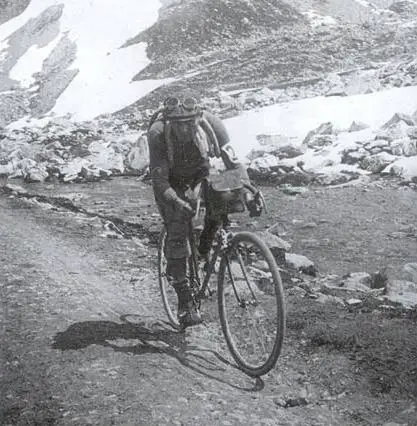
Eugene Christophe, who rode his first TdF in 1906 and his last in 1925, when he was aged 40.
The other day while I was waiting to meet Him Outdoors in a cafe, I picked up a book of photos released to commemorate the 100th Tour de France. Of course, it may be the hundredth race this year, but it is not 100 years since the first one: Le Tour did not take place between 1915-1920 and 1940-45. It seems that only war can stop the tour. It was very saddening to read that so many young men of phenomenal athletic ability who had ridden this incredible race, including winners Lucien Petit-Breton, Francois Faber and Octave Lapize, were killed in the wars.
As I flicked through the photos, I was struck by many differences both great and incidental: every spectator in the early shots is wearing a hat, whereas none of the riders are wearing helmets. Some of the roads are now sealed as opposed to the gravel, and the towns have grown, but the mountains remain the same. And although the bikes are now made of carbon fibre and state-of-the-art gearing, they are still just a frame on wheels. The bike is an amazing invention, and France is a fabulous country through which to ride.
5 Tour Trivia Tidbits:
The winner of the very first Tour de France (in 1903) was disqualified for taking the train - now that's blatant!
Le Tour has finished in Bordeaux more than in any other city, other than Paris
The first death at Le Tour occured in 1910 when Adolphe Heliere was stung by a jellyfish while bathing off the cost of Nice on a rest day
Originally cyclists were allowed no outside assistance (pictures show them carrying their own spare tyres slung across their chests). In 1913 the forks of Eugene Christophe's bike broke in the Pyrenees. He carried his bike 14km to the nearest village to repair them at a forge. Unfortunately the lad operating the bellows was judged to have been helping and Christophe was given a four-hour time penalty. That 326km stage took him 17 hours and 44 minutes to complete. (The Swiss rider Celidonio Morini took 21 hours and 24 minutes)
The starts were between midnight and 6am to allow the riders to finish in daylight hours.


/cloudfront-us-east-1.images.arcpublishing.com/tgam/2BYB7TMOVJOQHEYNRQ6NE3JSGY.JPG)




.jpg)