Friday, 16 April 2021

Friday Five: More TV

Here is a sample of some more TV series I've been watching - some are better than others, but they have all kept my interest up to a point. I've been keeping a list over the past year or so, so not all of these are bang up-to-the minute, but they are all on free-to-air services.

The women of The Split
5 Recent TV Shows I've Watched
  1. Cardinal (SBS On Demand) - There are four seasons of this Canadian series (each of six episodes) which are thoroughly enjoyable in a classic crime-drama fashion. The series adapts the novels of crime writer Giles Blunt, focusing on police detective John Cardinal (Billy Campbell) and his partner, Lise Delorme (Karine Vanassa). They investigate crimes in the fictional city of Algonquin Bay, involving corruption, drug dealers, serial killers, politics, suspicious deaths of family members and all the usual tropes. It is the pace and the setting that make this stand out; it is cold and so everyone is careful and needs to plan ahead, while the lead actors are thorough and understated rather than displaying any of the histrionics and hyperbole one would expect from a US equivalent.
  2. Cobra (BBC First) - I'll watch almost anything starring Robert Carlyle (*cough* Once Upon a Time *cough*), and so I was automatically drawn to this political drama. It's tonally a bit odd at the beginning when the UK's power is wiped out by a solar storm causing planes to fall from the sky and we're not sure if it's a thriller or a disaster series. Carlyle is the relatively new Prime Minister, Robert Sutherland, who has to deal with this crisis, as criminals and rioters take advantage of the situation and his daughter becomes embroiled in a drug scandal. Instead of working together, there are factions in the cabinet (mainly between Victoria Hamilton as Downing Street Chief of Staff and David Haig as Home Secretary) that attempt to score points rather than save community. Sound familiar?

  3. Last Tango in Halifax (ABC iview) - It is a joy to see great actors (Sarah Lancashire; Nicola Walker; Anne Reid; Derek Jacobi) playing great characters with well-written, humorous dialogue in credible and entertaining situations (series created and written by Sally Wainwright). Set in the beautiful but bleak Yorkshire and Lancashire country and towns, it could probably be described as following the fortunes or otherwise of a blended family. The central couple (both widowed and in their seventies) reunite and act upon their past youthful affection for each other, and the series was praised by critics and endorsed by the charity, Age UK as, 'a triumph against TV's ageism'.
  4. The Split, Season 2 (ABC iview) - This was a welcome return after Season One a couple of years ago - I was happy to see Nicola Walker back in her family of divorce lawyers and misfits. Supporting cast members of Stephen Mangan, Deborah Findlay, Annabel Scholey, Fiona Button, Meera Syal, and Anthony Head,  bring kudos to the series. The writing is still excellent (as one would expect from Abi Morgan), and it's refreshing to see a female-led series, but the will-she-won't-she storyline started to drag a little, and I would have liked to see more of the client drama - as apparently the legal focus is to protect women and ensure they get what they deserve from their divorces.
  5. Wild Bill (7 Plus) - Rob Lowe is similar to Robert Carlyle in the 'must watch' stakes to me, so I gave this series a chance, which is more than ITV did (they pulled it after one series). Lowe is an archetypal American who arrives as chief constable in Boston, Lincs, tasked with cleaning up crime, which he sets about doing through statistics and a whiteboard. No one really likes the arrogant Yank except salt-of-earth farming type, Muriel (played by Bronwyn James, last seen by me in Harlots). There is some understated British humour and sarcasm, which grates against the American schmaltzy daddy daughter relationship scenes, indicating the potential difficulty in pitching this to the right audience.

Tuesday, 13 April 2021

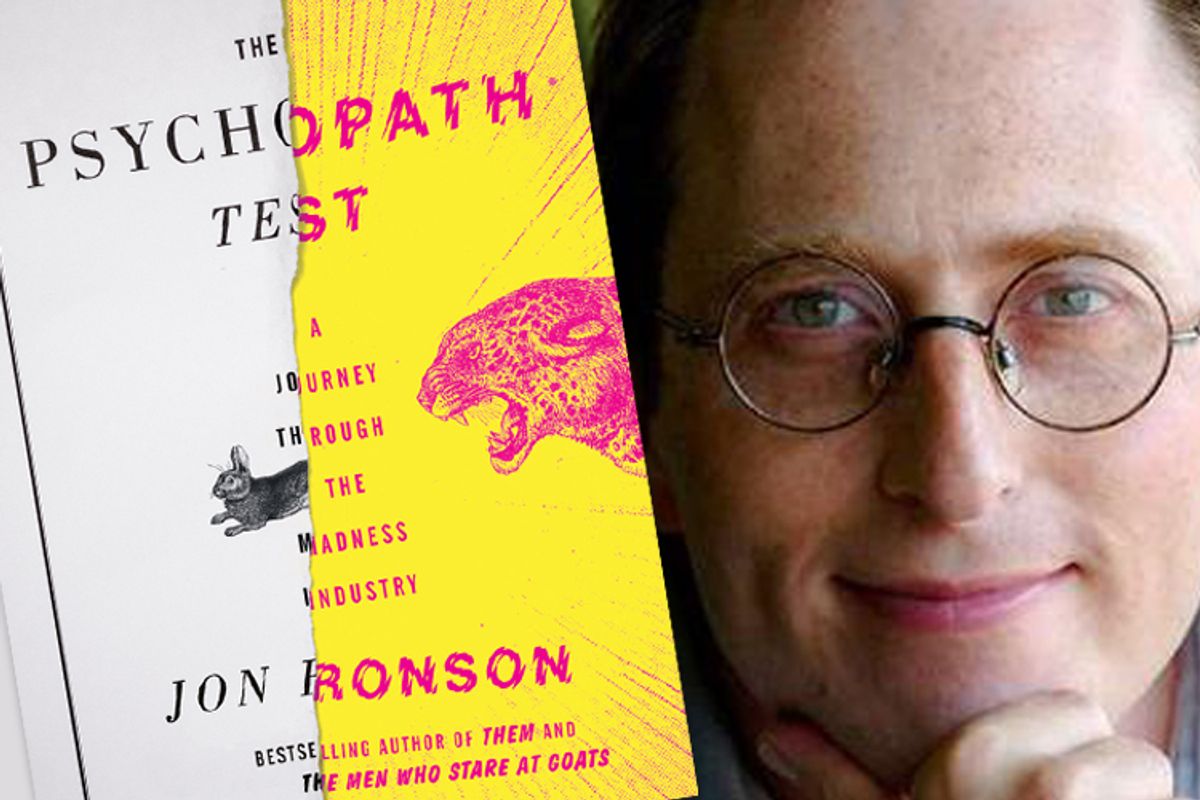
There's Method in It: The Psychopath Test


The Psychopath Test: A Journey Through the Madness Industry by Jon Ronson 
Riverhead Books
Pp. 272

We have a lot of examples in popular culture of what it looks like to be ‘mad’. The mental health industry has become increasingly prevalent and topical. Journalist Jon Ronson explored this phenomenon through a series of interviews and other research methods to publish this highly accessible study in 2011. While many people now self-diagnose, due to the availability of tests and checklists, others exhibit psychopathic behaviour almost undetected, and often end up running companies or countries.

He begins with the premise that it can be harder to persuade people you are ‘sane’ than it is to convince them you are ‘mad’. Ronson is allowed access to one of the most notorious psychopaths, incarcerated in Broadmoor Clinical Lunatic Asylum, Tony, who is allowed to read his own medical files and pass them on to Ronson. Tony claims that he faked madness and now no one believes he is sane when he tries to deny it. “Tony said faking madness was the easy part, especially when you’re seventeen and you take drugs and watch a lot of scary movies. You don’t need to know how authentically crazy people behave. You just plagiarize the character Dennis Hopper played in the movie Blue Velvet.”

Often psychopaths can present as totally charming, which makes it difficult to detect. Ronson says, “The moment I’d first seen Tony, he had strolled purposefully across the Broadmoor Wellness Centre in a pin-striped suit, like someone from The Apprentice, his arm outstretched.” (That particular TV reference is unintentionally relevant). Dressing smartly and being personable (“Glibness/ Superficial Charm”) is the first indication on the most available test; the twenty-point Hare Checklist, devised by Canadian psychologist Bob Hare, “the gold standard for diagnosing psychopaths.” The checklist is included in the book , so that readers can take it for themselves. Find it here: http://www.clintools.com/victims/resources/assessment/personality/psychopathy_checklist.html

It is common to redefine the psychopathic traits on the checklist as Leadership Qualities and the crossover can be a very fine line. In examining ‘lack of remorse or guilt’ and ‘callous/ lack of empathy’, Ronson highlights CEO Al Dunlap, formerly of Sunbeam. It is evident that if this book had been published ten years later, Donald Trump and Jeff Bezos would have been prime case studies. Ronson wonders whether highly driven and successful people are actually insane, and if what makes psychopaths so scary – no fear, filter, no conscience – also makes them good executives. Hedge funds, pension funds and investment banks advise their clients which companies to invest in, and they rejoice in job cuts and applaud as research facilities, tech areas and training centres get destroyed. Psychopathic behaviour is on prominent display on Wall Street.

Mental health disorders are listed in the DSM (Diagnostic and Statistical Manual of Mental Disorders), which lists mental disorders. It is used by clinicians, researchers, psychiatric drug regulation agencies, health insurance companies, pharmaceutical companies, the legal system and policymakers. Robert Spitzer, who worked on DSM-III explained that the idea was to list potential new mental disorders and a checklist of their overt characteristics. “It seemed a foolproof plan. He would eradicate from psychiatry all that crass sleuthing around the unconscious. There’d be no more silly polemicizing… Instead it would be like science. Any psychiatrist could pick up the manual they were creating – DSM-III – and if the patient’s overt symptoms tallied with the checklist, they’d get the diagnosis.”

DSM-III sold more than a million copies, mainly to civilians rather than professional psychiatrists. “All over the western world people began using the checklists to diagnose themselves. For many of them it was a godsend. Something was categorically wrong with them and finally their suffering had a name. It was truly a revolution in psychiatry, and a gold rush for drug companies, who suddenly had hundreds of new disorders they could invent medications for, millions of new patients they could treat.” As one psychiatrist Ronson interviewed confirmed, “A surfeit of checklists, coupled with unscrupulous drug reps is a dreadful combination.”

Ronson can’t help but test himself and starts to worry that, as a journalist, he might meet some of the criteria. One of his interview subjects tells him, “Finding patterns is how intelligence works. It’s how research works. It’s how journalism works. The search for patterns.” He also considers that in the very act of researching and writing this book, he might be contributing to the way that madness is packaged and presented for entertainment. “I was writing a book about the madness industry and only just realizing that I was a part of the industry.” He probably doesn’t think about the paradox too deeply. After all, that way madness lies.

Friday, 9 April 2021

Friday Five: Food and Drink in the Blue Mountains


1. It should be no surprise to anyone that we couldn't visit the Blue Mountains without dropping by the brewery there. DJ and Harriet McCready have opened Mountain Culture in a former newspaper office in Katoomba. The architecture is apparently 'inter-war free classical', with high ceilings, open beams, secret staircases, rooms of various sizes and an outdoor are to catch the mountain sun. But it's the beer we're here for, and it is definitely very fine. 

I particularly enjoyed the Status Quo New England Pale Ale (very hoppy, bitter and tropical with 'massive late and dry hop additions'), the VHS & Chill Retro IPA (orange rind, fresh grapefruit and dank pine), the Double Red IPA (the Holy Grail of beer), and the Big Richard Imperial Stout (big, boozy dark dried fruit and chocolate).

Big Richard Imperial Stout at Mountain Culture

2. Also new to us is Cafe 92 at the Conservation Hut. We had planned to do the National Pass Walk, but sections of the route are closed due to rockfalls and other hazards. Instead we did the Undercliff Overcliff Walk (yes, the wombling free song was sung), and found this cafe at the top of the aforementioned cliffs. The meals looked excellent, but we had eaten a hearty breakfast, unaware that we might encounter such a delight, so we made do with coffee and cake, and spectacular views from the verandah. The artwork inside is also very impressive - it is by Reinis Zusters, a Latvian-born artist who had a studio at nearby Wentworth Falls until his death in 1999.


3. The Carrington is one of our favourite places in The Blue Mountains and we always visit whenever we are here, although attempts to book accommodation have been unsuccessful as it is always so popular! We have been to a wine festival in the dining room; we have sat in the lounge on a rainy day and taken tea and scones when my parents came to visit; we have drunk full-bodied red wine while sitting in armchairs by the fire as it poured with rain outside; we have hung out in the bar with a couple of beers... 

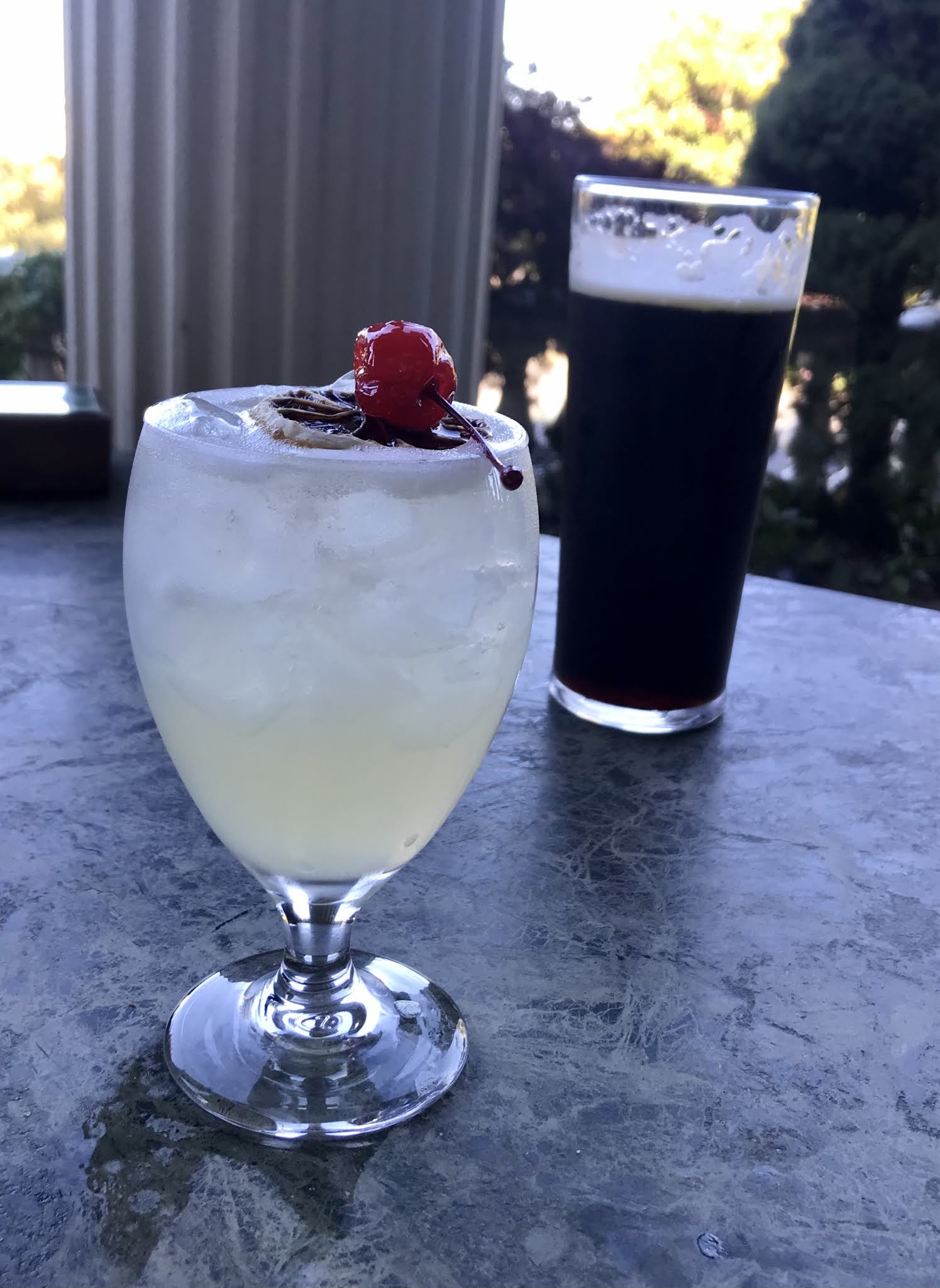
This time we sat out on the verandah and enjoyed a cocktail in the late afternoon sun. I had a St Germain (elderflower liqueur; gin; prosecco over crushed ice served with a slice of bitter lemon and a maraschino cherry). It was very tasty and refreshing after a long day of walking.


4. For dinner one evening we walked to Arjuna, an Indian restaurant on the outskirts of Katoomba. It doesn't look too salubrious from the exterior - although the adjacent water tower is painted with a rather attractive shark motif. 


It was Easter weekend and very busy; diners were booked into two sittings to keep the chef from getting two overwhelmed. We attended the earlier sitting, which means we caught the most amazing sunset views from the verandah. 


We weren't aware that the venue wasn't licensed so we hadn't brought a drink with us, although we spotted almost very other group arriving clutching bottles of wine - that's a top tip to remember for next time. The food was fabulous, though so I didn't feel as though we were lacking in anything. I had a Chicken Xacuti (Goan style chicken cooked with roasted coconut), which was melt in the mouth chunks of chicken in a rich and creamy sauce, while Him Outdoors went for Balti Gosht, which was served in one of those Balti buckets of spicy tomato and onion sauce. It was delicious, and we needed the walk of several kilometres back to our lodgings to work off some of the calories!


5. We were struggling to get a booking for dinner, because we had not been organised and had left everything too late, but we managed to book in to Avalon for Sunday lunch, and what a wonderful spot that was. The blurb on the website reads, 'set in the dress circle od the historic Savoy picture theatre, Avalon Restaurant and cocktail Bar at Katoomba combines playful art-deco charm with hearty food, friendly service and specular Blue Mountains views'. All of this is true.

The entrance leads us through the foyer of the 1930s cinema, past the ticket booth and up the stairs. It's all leadlight glass, geometric influences, upside down lampshades, kooky prints and vibrant colours. We began with cocktails, as it seemed wrong not to - he had a rhubarb and ginger martini and I had an 'Avalon', which was similar to the drink I had the other night featuring gin, elderflower liqueur, limoncello, Aperol, cranberry, peach bitters and mint. These were fabulous and a great start to the meal. 


For starters I had paprika prawns and tumeric scallops, served on pineapple and peach salsa, with caviar dip. The shellfish were melting with fishy goodness, and the salsa was popping with colour and flavour. I also inveigled a bite of the starter that Him Outdoors chose which was as delicious as it looked. He had grilled figs stuffed with blue cheese topped with a walnut and parmesan crust and wrapped in crispy prosciutto. This was rich and fruity with a bite from the blue cheese and savoury hints from the prosciutto - it was a perfect blend of texture as well. 


The quality of the starters set us up with high expectations for our mains, which were expertly met. Him Outdoors had the seared duck breast with carrot and ginger puree and orange liqueur reduction, served with rosemary potatoes and seasonal vegetables. I think he chose it partly because he loves duck - it's his go-to dish at a restaurant - but mainly because the description didn't mention 'jus' (a word he just despises for some reason; "why can't they just call it gravy?").  The waitress told him that it would be served pink and was he okay with this? He was, but I also like the way they explain this, not as an option, but as a directive - you don't have to have it if you don't like it!


It's Easter Sunday so I couldn't go past the lamb, and I do feel as though I have may have slightly won in the plate envy stakes. I had slow-roasted lamb wrapped in bacon, garlic, thyme, with a red wine and lime glaze, served with creamy mash and seasonal vegetables. The lamb was so tender and juicy; it practically fell apart and the comfort of the fat in the meat was well-matched with the crispness of the mangetout peas and the zing of the glaze. 


We accompanied the meal with a bottle of Robert Stein Shiraz Viognier (from Mudgee), which we lingered over at the end of the meal, unable to fit in any dessert. I was trying to think of an elegant word to tell the waitress I had had sufficient to eat, she supplied 'stonkered', which made me laugh as it is indeed a great word, but not particularly sophisticated. She also told us that the restaurant has been going for thirty years, and that last night (Easter Saturday) was their busiest night ever - people are obviously desperate to go on holiday and, as they can't currently go overseas, they are flocking to their own back yard. 

I also note that their menu says, 'along with our daily specials of new dishes to try, our main menu is well established, and so loved by our guests that we've hardly changed it in thirty years... we wouldn't dare!' It's good to know it should still be there serving fine fayre when we return.

Tuesday, 23 March 2021

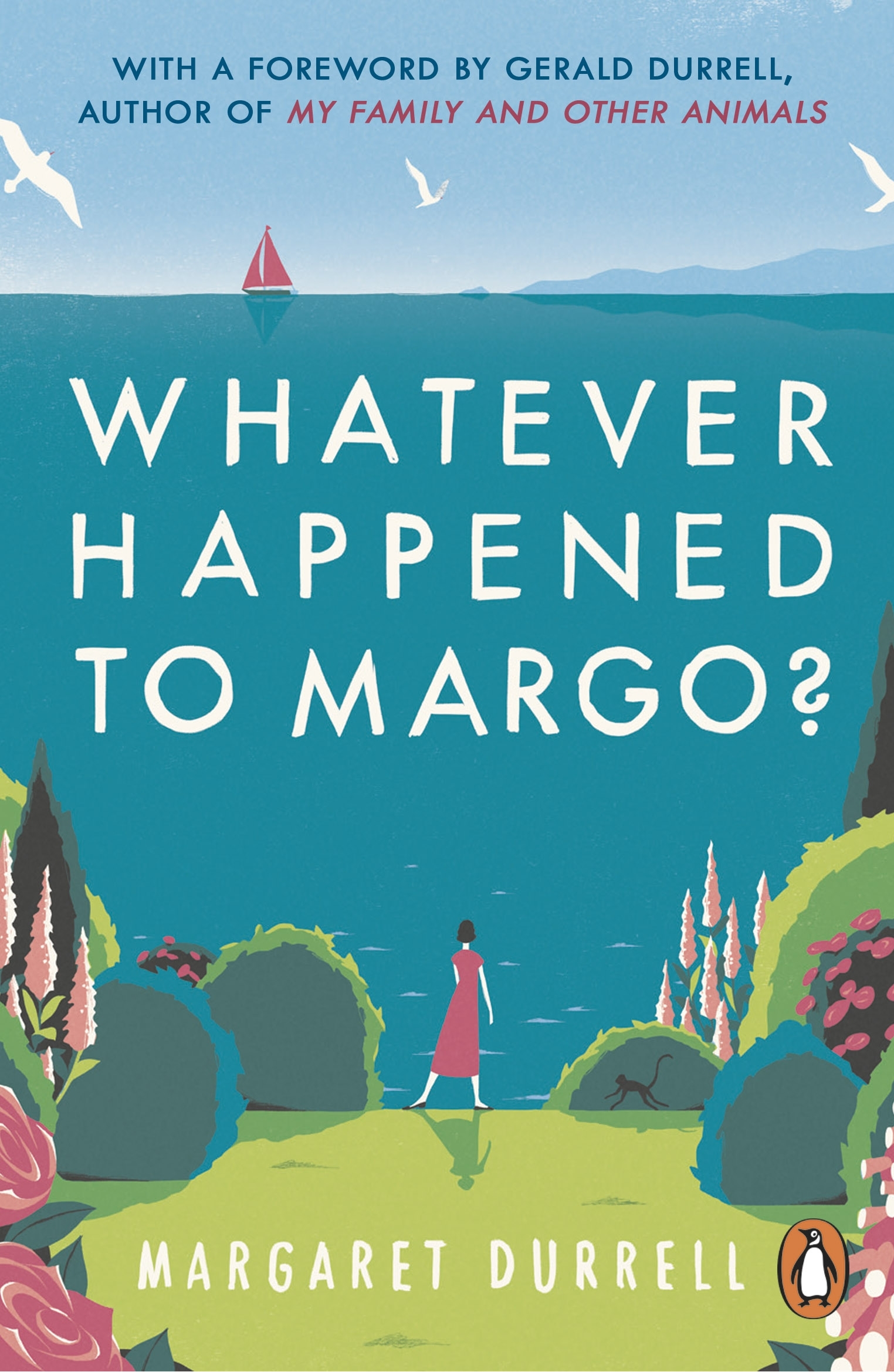
Bigotry in Bournemoth: Whatever Happened to Margo?


Whatever Happened to Margo? by Margaret Durrell 
Penguin
Pp. 259

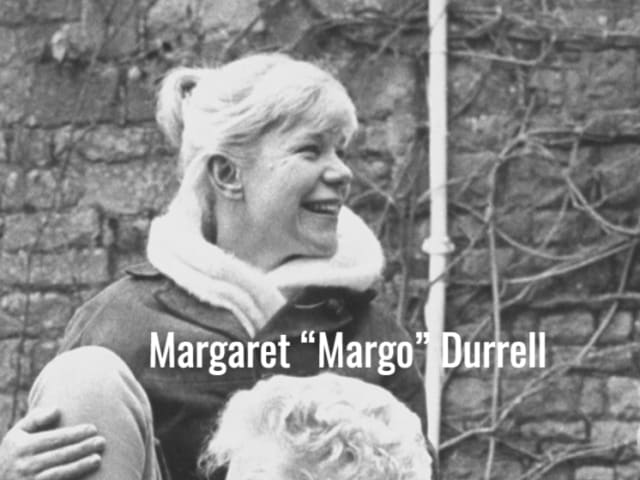
Those who read Gerald Durrell’s Corfu Trilogy about the escapades of the Durrell family on the Greek island in the 1930s, will be familiar with the character of Margo, and may indeed be interested in discovering what became of her. Fortunately for them, she has written a book about her subsequent life as a landlady in a Bournemouth boarding house. Unfortunately, she is not as entertaining a writer as her brother, and, whereas his anthropological remarks on animals were amusing and informative, hers on people are snobbish and dated.

After prompting from an aunt, Margo decides to buy a property across the street from her mother’s house, with money which was “a legacy from my father – dwindled somewhat”. She is ‘respectable’ and ‘middle-class’ with a divorce and two male children to her name, but there is no evidence of actual work. Her plan to take in a series of lodgers is a decent one especially since (one suspects) she has no employable talents.

It is 1947 and attitudes were different then, but the language and assumptions about her lodgers are quite ugly when related to modern readers. Edward Feather is a flamboyant red-bearded painter, leading to words like ‘nonce’ and ‘pansy’ being bandied about and smirks about men who wear tight trousers. Harriet is an eccentric old lady who accuses others of stealing her belongings while removing all the lightbulbs in the public spaces; when the residents gather over psychology books to decide what is wrong with her, at first they think she is “on the change”, a theory they quickly discount as “she’s too old for such capers”. Nelson is an obnoxious Billy Bunter type schoolboy (whom we are supposed to like for some inexplicable reason) and his harassed mother, who have fallen on hard times as their father/husband is in prison serving time for assault of her mother; he broke a plate over her head and she had to have twenty stitches.

Other residents include a man who abuses his wife – no one does anything until they dislike the noise – There is also Jane, a spinster, who is mercilessly ridiculed for being unattractive; a man who comes into money, which makes him a catch; a pair of musicians, one of whom Margo falls in love with; two glamorous nurses; and a bloke trying to get a job and a partner with equally limited success – he has a relationship with an Eastern European woman whom Margo, when she discovers she is transgender, reports to the police and a psychiatrist. All the women are in competition for men’s attentions, and the men are all expected to drool over attractive young females, while making fools of older ones. “It was surprising what a compliment from another man could do, lifting the drabbest of married women almost to prettiness.”

In a nod to her brother’s writings on animals, there are some in the house, including a dog (a present from her brother, Leslie) that cocks a leg over anything it chooses, including the baby’s pram. Gerald himself brings a python and a troop of monkeys for her to look after, and of course they escape with hilarious consequences. Meanwhile, the insufferable Nelson breeds mice to sell, causing Margo to display one of her many peculiar views as she remarks that there are “white mice breeding in the back lavatory like Communist China”.

The descriptions of her mother as an uptight suburbanite are a long way from the courageous woman who took her children to a Mediterranean island in search of a better life, and mingled with a cast of colourful characters in Gerald’s books. Here she is judgmental and small-minded, referring to a lovelorn woman as “walking barefoot like some male aborigine with twigs in her hair”. Margo packs her own children off to their father and takes Nelson on a trip to the seaside. She seems more interested in him than in her own offspring, and one wonders whether they will in time write their own account of these days in a never-ending family spiral. If they do, let’s hope it is in the style of their uncle rather than their mother.

Friday, 19 March 2021

Friday Five/ My Newest Favourite Thing: Belly Dancing


This is a cross-over post (of both Friday Five and My Newest Favourite Thing), as for the past six weeks I have been trying something new: namely bellydancing. Let me begin by saying I will never be a bellydancer. I haven't got the grace or the coordination, or the want/ need to shake my bits in front of an audience of strangers (in other words; I've got the belly but not the dancing bit down pat) but I have very much enjoyed my brief introduction to the art.

Our instructor, Brooke Thomas, is amazing. She is talented and professional (and has a proper dance troupe - Quake Bellydance) with warmth and humour to accompany her style. While she teaches serious and capable dancers, she is equally adept at dealing with incompetent, uncoordinated people with two left feet (i.e. me). She gives us moves to develop into a routine and introduces us to fun techniques, with plenty of warm up and cool down stretching, and some technical and historical background for those interested in the art. 

5 Favourite Things about Bellydancing
  1. Camaraderie/ body acceptance - bellydancers come in all shapes and sizes and they are meant to jiggle. The body is an amazing thing and this type of dance celebrates that. Shimmies and hip movements isolate and highlight groups of muscles, and arm placement draws further attention to parts of the body and indicates their vibrancy and versatility. You don't have to be a supermodel to bellydance; you just have to learn to embrace your curves and enjoy the way your body feels when it moves.
  2. Work-out/ flexibility/ stretching - Isolating muscle groups provides a great workout - it can be as high impact as you want to make it, and you really get to move, stretch and tone. The names of the moves are descriptive and evocative: there are hip drops, lifts, flicks, bumps, and rotations, snake arms, ribcage slides and circles, Maya, butterfly catch, envelope, Roman flame. The feeling afterwards is of a contented glow (much like you might experience with yoga or Pilates), and the week after we concentrated on snake arms, I really knew about it!
  3. Music/ Rhythm - I love music and dancing for fun, even if I'll never be any good at it. Brooke makes the choreography fit beautifully to the beats and the ambiance of the music. We listened to some great Turkish songs and compositions, which were uplifting and fulfilling. I will admit to not being a fan of Shakira, although I now have Whenever, Wherever as an uninvited ear worm lodged in my brain.
  4. Costumes - Brooke makes all her own costumes and she looks spectacular (did I mention she is ridiculously talented?). We danced in shorts or leggings and exercise tops. We did, however, get to play with the coin belts and veils. Coin belts are great fun: they jingle as we jiggle and we are literally present with bells on, but they are also tell-tale alarms for when the lower body is meant to be still as the upper body is meant to be directing the action. Veils are just great fun to drape, twirl and float about with. 
  5. Learning new things - it's good for mental as well as physical health. I have a whole new appreciation of the artform. And, most importantly, I had a lot of fun!
Graceful shape framed by a veil

Wednesday, 24 February 2021

Here I Am: Art by Great Women

Last week I was at an event at Kambri at ANU, and reached it by walking through this exhibition. Inspired by Know My Name and in cultural partnership with the National Gallery of Australia, HERE I AM: Art by Great Women is a showcase of Indigenous and non-Indigenous artists from multi-disciplinary backgrounds including street art, fine art, photography, illustration, digital, sculpture, film and more.

As I wrote on my other blog, I really like outdoor exhibitions, bringing art into public spaces, and it's interesting to see people interacting with the works with a fresh focus in a less forced environment than the usual gallery setting. This exhibition made a brisk walk into a thoughtful diversion.

The Fruits of My Labour Taste Sweet, But They Are Not For You To Eat by Jess Cochrane

I like the colours of this image - I like the way it is both specific and abstract, as the paint runs down the woman's body and she is both proud and defensive of her naked form, which in turn supports her and nourishes other life. Having recently had breast surgery, I am particularly drawn to the way in which the lines are blurred, suggesting a malleable and evolving form. Artist Jess Cochrane writes,
This artwork is a portrait of Verity Babbs. Verity is an Oxford graduate and one of the top up-and-coming arts writers in London. An abundance of oddly shaped, flat peaches are gently cradled in her arms against her bare skin. An imperfectly shaped peach serves as a metaphor for the physical body, in protest to all of the years of harmful stereotypes that have been marketed to us as women. As imperfectly shaped as the peaches are, they are still an absolute delight to enjoy, as are all women in their diverse range of existence.
Pass de Deux III by Kaff-eine
Once again I am drawn to the inherent imperfections in the way the image is presented and in the image itself. To be naked is to be vulnerable, and to be naked in public before strangers is outstanding. Perhaps the only thing worse than being looked at in this situation is not to be looked at, which might explain why there is a mask of a dead animal (also a victim of vulnerability) being worn. There is a suggestion that 'if I can't see you; you can't see me' which is both childish and deeply philosophical. We choose what we see, and also what (and who) we ignore. The artist, Kaff-eine believes,
Posing nude for a painting is an intimate, vulnerable act, requiring the model to muster significant confidence, and conquer past experiences and trauma. In late 2018, I invited the public to model nude for my paintings of 'deerhunters'; my signature characters with animal skull heads and hooved limbs. I prioritised people underrepresented in discourse about beauty and desirability. The resulting portraits reflect my interest in outback queer Australia, the LGBTQI+ community, the gothic, and the potential of hyper real portraiture to convey the interections of these themes. Darkness and light, animal and human, living and dead, softness and strength; lines were blurred and contradictions celebrated.
Mt Tomaree by Helen Proctor
Very reminiscent of David Hockney's ipad pictures, this image blends the beauty and simplicity of nature with the artifice and complexity of digitisation. The blocks of colour and the suggestion of shade and movement are oblique as they cannot capture the connection that we instinctively feel towards landscape. This work speaks out as either a collision or a compromise between culture; the way the viewer responds can be abstract or specific, which is a true reflection of our current relationship with places we physically cannot reach.
'Mt Tomaree' is an artwork that depicts the Worimi country along the New South Wales coastline. Although the artwork abstractly depicts a certain place, I wanted it to connect both in colours and shapes to the essence of the Australian coastline and the emotional connection that people feel with it. - Helen Proctor
Cook ain't no timelord by Aretha Brown
The juxtaposition of modern iconography (cars and factories) depicted in a monochromatic naïve style leaps out in bold confrontation. It is no accident that black counters white and vice versa, and it feels as though there are echoes of Dick Frizzell. There is something of a woodcut image in its clear lines, while it also recalls block type face and comic strip panels - is this news; or is it treated as incidental? These are clearly the issues that artist, Aretha Brown faces.
This work is about my need to constantly reiterate just how recent white history is here in Australia. It's been 232 years since Cook rocked up, that's so painfully recent. To think about how much destruction has happened, in such a small amount of time, towards First Nations histories and cultures is heartbreaking. But that said, Captain Cook isn't a time lord; he didn't bring light and time to this continent. We have always been here - not just living but thriving as the oldest living culture on the planet. My grandma couldn't even vote in her lifetime because she's black. So much for Australian democracy!
Queen of Strategy by Jodee Knowles
This one of my favourite works in this exhibition. As a child learning the rules of chess, I was always disappointed by the fact that we had to defend the king, who was so useless he couldn't do it himself. The king could only move one square at a time (apart from when he scuttled off to the corner to be barricaded behind his castle) while the queen raced around the board organising everything; discussing tactics with the sidling diagonal bishops and the leaping courageous knights. Even pawns could become queens, but the king had no hope but to rely on everyone else to do his bidding. It always seemed unfair. I'm glad modern artists are looking at redressing this (im)balance.
Chess is a game of strategy. The King has to be protected but the Queen is the most powerful piece. The history of art has predominantly been depicted through the eyes of males, thus diminishing the power of the female artist for centuries. The female suppression has placed us in the shadows of obscurity for too long. My aim is to enhance the understanding of women's contribution to Australia's cultural life. In this work I've attempted to represent the liberation of equality and the necessary benefits it holds for our future storytelling and history, to be told by ALL equally; to gauge the closest reality to the truth of our human existence. - Jodee Knowles
The Canberra Spider Orchid by George Rose
Technique and colour are powerful in this image - it looks pretty, like a repeating pattern one might use as a wallpaper, but it is more reminiscent of militant Morris & Co than inoffensive Ikea. It is as striking and claustrophobic as it is sensual and calming.
I've created a work that reflects upon the use of botanicals as a symbol of femininity and identity. I often utilise the depiction of botanical emblems as a way to connect my art to communities and culture. Here I've depicted an orchid, often regarded as a symbol of femininity. The Canberra spider orchid only grows in the ACT, is found in just three locations, and with less than [sic] 600 plants known to botanists it is considered endangered. I painted the small delicate flowers in bold, bright colours, paired with strong line work, to juxtapose the image of something regarded as frail being powerful instead. - George Rose
Holly and Chrysanthemums by Faith Kerehona
In an example of seeing something everywhere once you've noticed it somewhere, I refer to Faith Kerehona. I'd not heard of her until a couple of weeks ago, when I blogged about an amazing mural by her and Bohie Palecek (see below) at the Dickson Shops called In Our Hands. I have since seen that she is the designer and painter of the new mural at the Cook shops that I was admiring yesterday (and which will be featured in an upcoming post). I like her unashamed use of colour and the female form to frame her ideas and celebrate her connections.
This artwork is of my friend, Holly, a beautiful young woman who is capable, independent, and fierce. Her wisdom, humour and compassion uplift everyone she meets. I wanted to capture some of the radiating warmth and clarity I see in her. It's a cathartic process to paint somebody you love. I try to take as many moments as I can to celebrate the beautiful women in my life. - Faith Kerehona
Peony 2 by Nicole Reed
While this image is used as the advertising poster for this exhibition, it is, for me, one of those artworks that requires words to bring out the art behind the science - it is an image of flowers on fire, yes, but there is nothing in the execution or the background to inspire or explain. Maybe this clinical approach is deliberate, but it is not one that appeals to me.
Meaning and symbolism has been attributed to flowers for thousands of years. Floriography (the language of flowers) is like a secret means of communication through the arrangement or use of flowers. As legend has it, peonies are assigned the meaning of 'shame' or 'bashfulness' because of the playful nymphs that were said to hide in their petals. I wanted to make subtle commentary on the stereotypes that associate being mischievous with shame. For me, mischief is about taking calculated risks to make life a little more fun. Plus, I just like the challenge of setting plastic things on fire! - Nicole Reed
When our voices are censored, our spirits make noise by Maddie Gibbs
A personal interpretation of indigenous artwork designs, this is a striking and powerful piece. The swirling, halo, nimbus effect is interspersed with symbols of flora and fauna in a specific landscape highlighting connections to the land through palette and image. It demands to be seen and questioned. 
Aboriginal female spirits. Our spirits survive and thrive. Our connection cannot be broken - we fight, we stand, we connect. Authority won't suppress our spirits. Political systems will not categorise us. Governing bodies will try to muffle our voices but our spirits will roar. Spirit they will never have, spirit they can never control. - Maddie Gibbs
Onna Bugeisha by Nanami Cowdroy
I like the playful nature of the modern and traditional in this work - the cultural touchstones of East and West reflected in every aspect from the dress and hairstyle to the depiction of animal iconography. The spray can contrasts with the traditional tools of the artist in the brushes and pencils; the stylised fish trapped in the bubble forming bubbles of its own; the skateboard with the impression of a skull beneath; symbols of the elements; badges of flags and rock bands... this picture invites contemplation and offers multiple discoveries.
This is my interpretation of Neoclassicism - playing with traditional Japanese Ukiyo-E subjects and styles, combined with contemporary objects, elements and themes. Being lucky to be born and raised in a free country like Australia - where the concept of 'female empowerment' is the cultural norm - occasionally led to tensions when I was trying to relate to my okassan (mother) and her old-school, traditional Japanese views and behavioural expectations of how I, as a female, should 'be'. This piece reflects a rebellion over some of those cultural expectations which so many Japanese women still face. It's a playful reflection on what it means to be 'female'. - Nanami Cowdroy
The Future is Bright by Bohie Palecek
Bohie Palecek was mentioned above in partnership with Faith Kerehona. They both seem to deal in broad sweeps of paint to create meaningful interactions - this delightful piece of work expresses wonder and tenderness, with a beautiful nurturing relationship based on care and comfort through instinct rather than performance.
After a long drought, a catastrophic fire season, floods and a global pandemic, I find solace in moments of quiet reflection. This portrait is of the three-year-old daughter of one of my closest friends; out in the wild and braving the darkness in a field of purple Kunzea, which hugs the shores of the Shoalhaven River. This young girl is not asking for permission, or validation, or assistance. She's courageously immersed in the moment. My artwork invites the viewer to pause - to witness the magic of the wild and allow your heart to connect to and be moved by it. - Bohie Palecek
She/ Her by Gemma O'Brien
I've saved one of the best until last (or first, if you approach the avenue from the other direction). The bright vibrant text stands out from a busy and brilliant background shouting identity with pride. She makes no apologies for what being what she is.
'She/ Her' is a large two-panel painting of my pronouns. I wanted to share this through my art, as a way to remind myself that asking and using someone's preferred pronouns is a way of showing openness and respect, and disrupting any gender associations I may have. Although my pronouns are familiar, like he/ him, some people prefer to use gender-neutral or gender-inclusive pronounces such as they/ them/ theirs and ze/ hir/ hir, or perhaps by their name. So without further ado, pleased to meet you, my name is Gemma and I go by she/her pronouns. How should I refer to you? - Gemma O'Brien

Friday, 19 February 2021

Friday Five: Autological Words

Drawing Hands by Maurits Cornelis Escher

Here's a question I like to ask in a pub conversation: What's your favourite autological word? If I were ever single, I would ask it of prospective partners (possibly assuring that I would remain single). The way one answers is revealing. To not have a favourite might imply indecision or inclusion: it might imply lack of knowledge of the subject, which is fine, but how one responds to lack of knowledge is telling. I'm curious about things - I like to learn. I hate to be lectured; so it would depend how the information is imparted as to whether or not I would be interested.

An autological word is one that describes itself. 

Five Favourite Autological Words:
  1. Word - it is what it says it is (as is noun)
  2. Unhyphenated - can't argue with that
  3. Pentasyllabic - pentasyllabic is a five-syllable word; it is itself pentasyllabic and, therefore, autological
  4. English - indeed it is
  5. Obfuscatory - it's not exactly straightforward