Saturday, 21 March 2020

COVID-19: Make Sure You're Connected

A lonely vapour trail
This morning I received a message from a friend in the UK - inviting me to drinks in their mum's kitchen, due to the fact that the country was closing all pubs and clubs, disrupting usual Friday night plans. It was a Zoom invitation, and I joined in. Due to the wonders of technology I could see friends on the other side of the world and I shared a drink with them (tea for me as it was 8am, my time). They had a beer or a wine and we all shared stories and a laugh while checking in on one another, with lots of support, and a healthy dose of ridicule; we're all originally British after, all. There were ten of us on-line, and it felt like old times.  

But these are modern times. As we cannot make physical contact with others, it is still really important to connect and chat - naturally there will be conversations about the virus, but there should also be talk of family events, books read, scents smelled... we need reality in our virtual lives. There are of course, many platforms we can use to stay connected, but many of us have been using Zoom for work meetings and conferences for some time; this step is just the natural progression for more casual communication. 

According to the New York Times, last week 600,000 people downloaded the app, its biggest day ever. While the stock market crashes, Zoom shares have soared this year, valuing the company at $29 billion. That's more than airline companies, even before they were grounded. We had planned a holiday to the UK and France in July - it certainly doesn't look like that will be happening now, as international travel is cancelled until further notice. 

I am sad, because I was looking forward to seeing my family and friends. I still can. Obviously it's not the same as having them in the room, but technology is very powerful if we use it for good. We are fortunate to live in these times. There is a silver lining. Let's stay connected. 
"If you make sure you're connected
The writing's on the wall
But if your mind's neglected,
Stumble you might fall." - Stereo MCs

Thursday, 19 March 2020

COVID-19 - What a Wonderful World!

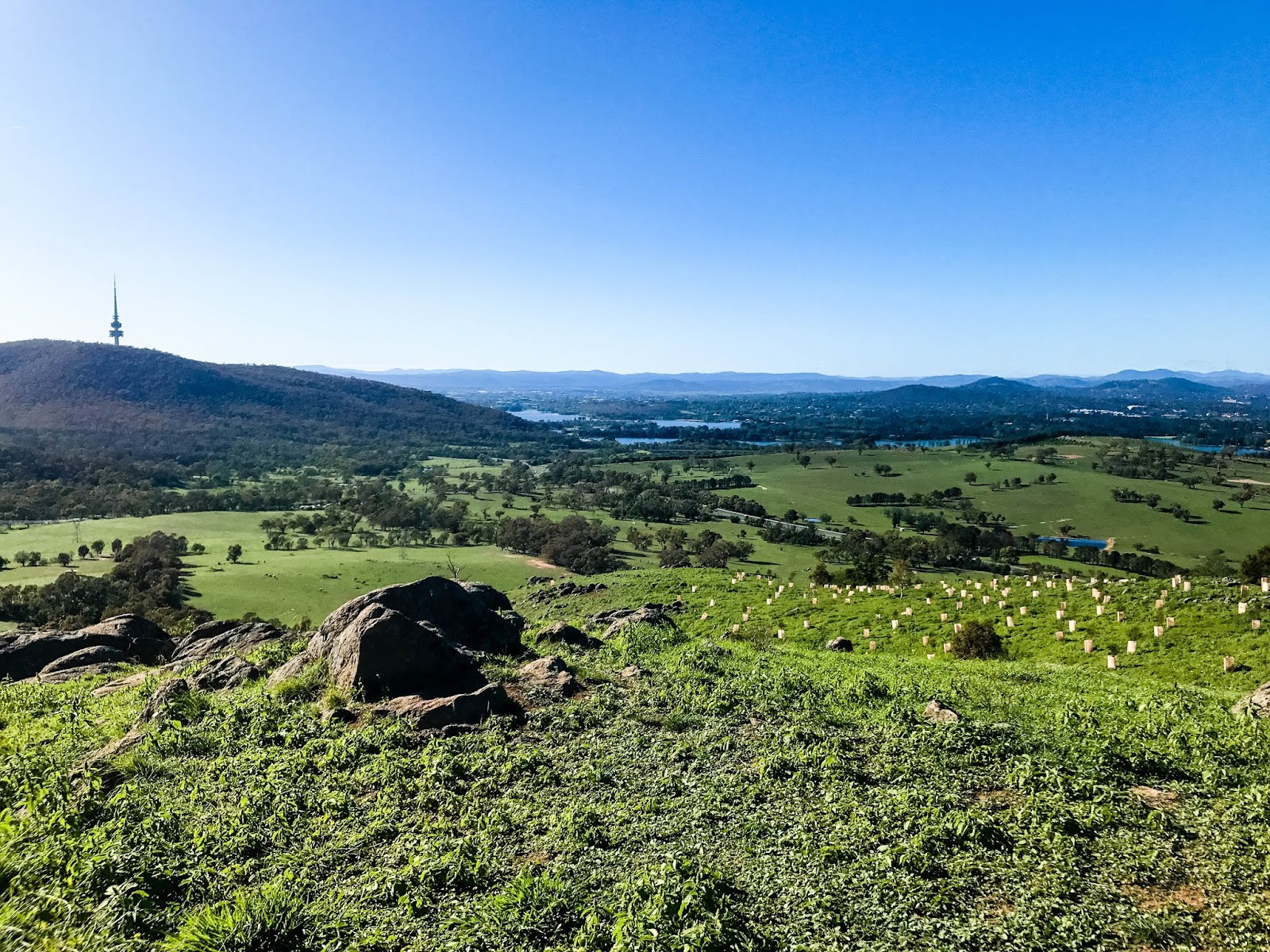
The view from Mt Painter
It's hard to make sense of things right now. A week ago we were joking about toilet paper, dried pasta, and how incredible it was that grown adults needed instruction on how to wash their hands. Now, the world has changed. 

I am working from home. My job, which involves putting educational programs into schools and communities to ensure that all children have equal opportunities to aid their learning development and engagement, is in limbo. Schools are still open, but they are not allowing any incursions or excursions; hence all our programs are suspended until further notice. 

I have read a lot of information. I have answered a lot of emails. I have cleaned up my digital files. I don't know if my job will continue to exist. This is a time of great uncertainty. We need to support ourselves and the vulnerable members of our community. But how? The Australian government seems to be doing very little compared with other governments - this is a global crisis and, as a citizen of three countries with family in all of them, I am watching things closely.  Our family is connecting and checking on each other regularly. 

I am avoiding gatherings where I might spread any infection to others - I don't think I've contracted it, but how would I know? I think the best thing to do is to avoid others. I don't know. Governments in different countries are telling people to do different things: stay in; go out; get exercise; abandon sport; support local business; avoid cafes and pubs 'like the plague' (even the cliches are relevant). 

I'm jotting my thoughts down here like some kind of diary - I don't know what's going to happen; no one does. But I need to record things because it's all so weird. In every version of apocalyptic scenarios I've seen, the world does not look like this. After months of not being able to go outside, due to fires, smoke and hazardous air quality, the sun is shining, the sky is blue, the fields are green and the roses are blooming. It is a world full of wonder; if not a wonderful world. 

A rose in our garden

Tuesday, 17 March 2020

Second Person Singular: You


You by Caroline Kepnes
Simon & Schuster
Pp. 422

Joe Goldberg narrates this erotic thriller in a way which is intended to be claustrophobic and creepy, but just results in being tired and formulaic. Maybe it is because Gone Girl ruined everything and there have been so many imitations of the toxic controlling relationship and the unreliable narrator that we are no longer shocked by the horrible things people do to each other in the name of their warped ‘love’. Perhaps the advent of the Fifty Shades phenomenon leads us to an expectation of more dominant sexual content in contemporary novels. Whatever the reason, this novel does not surprise, titivate, nor really even register interest.

The USP of the novel is that it is narrated not only in the first person, but that it is addressed to the second, so the ‘you’ of the title is both a character in the novel, and also potentially the reader. Joe Goldberg is the owner of a bookshop, into which walks his obvious love interest, Guinevere Beck (who prefers to be called Beck, as you would). The interaction between them is what is known in the movies as the ‘meet-cute’, and it is meant to recall scenes from rom-coms such as You’ve Got Mail.

Because it is a first-person narration, the reader is drawn into his world and perspective, but alarm bells ring straightaway. Stalkers are not sexy. Joe likes to observe people without them being aware they are being watched, which is uncomfortable when he preys on Beck, stealing her phone, hacking her emails and stalking her on Twitter, analysing every message and tweet that she sends, trying to fathom hidden meanings and monitor her behaviour under the guise of being her protector. He also stalks her physically, following her home and watching her through the windows – she doesn’t close her curtains – perhaps she does know and her behaviour is intentionally that of an exhibitionist.

Joe likes to play games, but it seems that Beck does too. She leads him on and then turns away, which infuriates him, but is she really teasing him or is that just his interpretation? Beck is not an attractive character either; she seems narcissistic and self-obsessed, but is that his portrayal of her? Beck is studying for an MFA in creative writing, and thinks of herself as a writer inventing scenarios, although feedback from her fellow students suggests her short stories are thinly-disguised diary entries. Joe’s record of the relationship makes his reasoning sound acceptable, until his violence and depraved actions surface. Is it interesting or depressing to be inside the mind of a privileged, entitled predator?

Joe uses many popular culture references of disturbed minds to drop clues that all is not rosy in his world. The allusions begin innocuously enough although they rapidly get darker as elements of fantasy, delusion and mental illness creep in to the descriptions. People with mental conditions are often aware of them in others but blind to them in themselves. In mentioning American Psycho he deliberately draws attention to the artifice and the twisted imagination of certain people. We are cautioned that this may not be real (there is a cage in the basement of the bookshop; few other characters with whom he interacts etc.), but the characters are so dislikeable, and the novel appears to be derivative and playing on all the popular tropes of the recent erotic thriller glut, making it impossible to care.

Thursday, 5 March 2020

Power to the people!

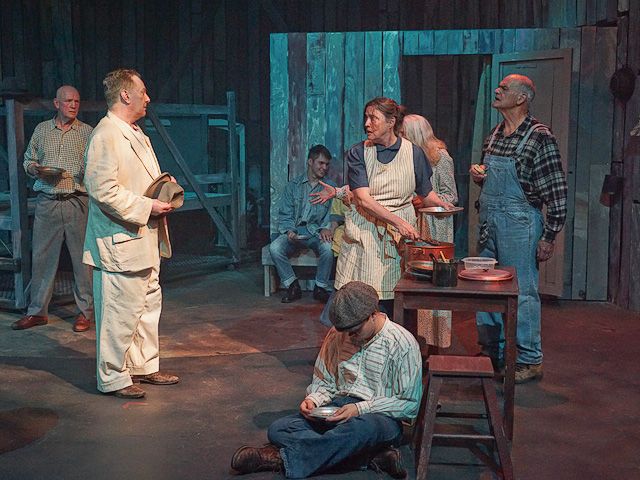
The Grapes of Wrath, Canberra Repertory Society
Theatre 3
13-29 February 2020


The Grapes of Wrath by John Steinbeck (published 1939) is one of those classic great American novels – it is taught in American high schools to the point that everybody knows it, even if they’ve only read the cheat notes or seen the 1940 film (directed by Tom Ford and starring Henry Fonda as Tom Joad) in order to pass the test. And it is a test. Full disclosure: I studied it at High School in New York (U.S.A), and I studied it for my university degree at Manchester (U.K.). It’s a tale that spans continents.

The 1988 play adapted by Frank Galati won the Tony Award for best play in 1990, and in the last thirty years has become a perennial favourite of high school productions. This is both a good and a bad thing, and a context with which to inform the Canberra Repertory production, directed by Chris Baldock.

The plot is fairly simple. During the Great Depression, the Joad family are driven off their land in Oklahoma due to a combination of drought, economic hardship, bank foreclosures and agricultural industry changes. They light out for the West (it is the American Dream, after all) in hopes of finding solid work and good fortune. It is not a spoiler to say things don’t turn out that way.

The set (designed by Chris Baldock; co-ordinated by Russell Brown) drew rounds of applause from the audience. It is a good set, made from pallets and angular constructions which variously represent houses, riverbanks and graves. The scene changes are complex and occasionally clunky, diverting attention from the dialogue or the emotion on stage to appreciation of the artifice.


The jalopy which the Joads load to travel to California is created on stage from flats and loaded up with bags and wheels, although it recalls The Wiggles more than the spirit of desperate adventure. At one point a rain curtain creates a deafening noise over which the actors cannot be heard, and soaks the stage although, strangely, not the actors. I refer to them as actors rather than characters, as this is another of those ‘stepping outside of the scene for the sake of the set’ moments.

The theme of family, friendship and community is one of the most powerful aspects of the story, and initially this is well handled as the multi-generational Joad family bustles about the stage doing chores and preparing a communal meal. It is also nicely contrasted with the isolation felt by Tom Joad (James McMahon) as he returns from a stretch in prison and encounters Jim Casey (Michael Sparks), the ex-preacher, who is struggling to come to terms with his new identity and the situation that has forced them away from all they have known.


As the family and a few extras embark on their journey this sense of community falls apart. Partly this is as members of the clan drop off by the wayside – Noah’s defection as played by John Whinfield is particularly affecting – but also because there is no sense of unity between the company. This should be an ensemble piece, but various actors proclaim and hold forth in a singular way without any perceivable warmth for their fellow cast. James McMahon and Amy Dunham (in a welcome return to the stage as Rose of Sharon) make overtures to the rest of the family, but they are almost rebuffed by a fearsome Ma (Karen Vickery), whose defensiveness is overplayed to the exclusion of the softer side of the matriarch.

Tom, Casey, and also Uncle John (played with hyper intensity by an almost unrecognisable Jerry Hearn), undergo personal, political and spiritual development with sensitivity and depth, dealing with hokey hillbilly dialogue – ‘There ain’t no sin and there ain’t no virtue. There’s just stuff people do’ – in a way that credits the acting and directing skills of all concerned. Considering this is a tale that led many to consider the implications of social economics, the differences between the socialist site and the capitalist camp are understated. Sure, the row of tents looks lovely, and the wire fence is an obvious allusion to camps closer to home, but the imminent threat is absent and the discussions about self-determination, unions, the rights of the worker, and responsibilities of the employer lack passion and are uninspiring.  


Essential qualities such as honour and resistance are given every chance to shine, and they do in solitary monologues but are lost in group moments: the dance and fight scenes are awkward, and the characters are not believable as the rough-and-ready types they represent. It is a stretch to believe in the resilience and perseverance of these average people whom circumstances have made extraordinary and it is not always clear that “We’re the people that live. They can’t wipe us out, they can’t lick us. We’ll go on forever, cos we’re the people.”

That’s not to say that there aren’t emotional scenes: the choices made in the face of starvation and the compassion shown by those suffering personal hurts are at times beautifully portrayed, not least by Dunham in the final scene. The lights fade on a touching tableau, highlighting human dignity; finally the motif of individual sacrifice to the greater good of the community is clear – and that is a wonderful way to finish. Power to the people.


Tuesday, 4 February 2020

Bedside Book Pile Update

At the beginning of 2019 I took a photo of the pile of books by my bed, with the hope that I would have an entirely different stack by the end of the year. At the beginning of 2020 I took another picture. Readers, I did it!


I've peaked too early, with the conclusion - it's like turning to the last page before continuing with the story (people who do that blow my mind) - but for those who would like to play along with the moves of the game, they began in this post, and they follow below:

Bedside book pile July 2019
In July I only read one book from the book pile, and it was Kerry Young's Gloria, which I admit I chose because of the cover and the plaudits - from The Guardian ('a vivid portrayal... heartfelt, sparky and affecting), Independent on Sunday ('A punchy tale of pungent characters and impassioned entanglements'), and The Observer ('A blindingly good read'). The author was born in Jamaica and has mixed Chinese and African heritage; she is hailed as 'stand-alone talent in the new emerging generation of writers from the Caribbean region'.

This is Kerry Young's second novel; the first was shortlisted for the Costa First Novel Award, and apparently many of the characters are the same - I haven't read it but it would appear to be almost the same story told from a different viewpoint. There is violence, prostitution, illegitimacy, class conflict, prejudice and redemption. I enjoyed it up to about half-way through, and then I began to get bored - it had nothing fresh or original to say and the pidgin English style became tiresome. Many others disagree, so maybe I should try another of her novels, but I'm not really in any hurry to do so.

Other books I read in July that were not on the list were The Bus on Thursday by Shirley Barrett (easy-to-read part thriller; part supernatural; part comedy novel about a primary school teacher's issues with mental illness in a rural NSW town), Ghost Milk by Iain Sinclair (a damning critique of grand projects; from urban developments and shopping malls to the structures involved in the London Olympics), and Rocky Road by Robert Wainwright (subtitled 'The Incredible True Story of the Fractured Family Behind the Darrel Lea Chocolate Empire', it covers the 'experiment' of a woman adopting children to be playmates for her 'natural' children and the consequences thereof).

Books read from pile: 17/25

Bedside book pile August 2019
In August I read two books from the pile and two not. John Irving's Last Night in Twisted River covers much of his usual ground - bears; large-breasted women with largely undefined personalities; wrestling; writers; running and being attacked by dogs. It is brightly written with an eye for detail (the logging industry is well represented) and a fair bit of fourth wall breaking.

I also read Today I Am A Book by xTx, because my peculiar reading scheme dictated that I needed to read a book by an author beginning with X. All of the short, poetic segments (it feels wrong to call them stories, and, besides, they have the tart juiciness of an orange) in this collection are introduced with the words ‘Today I am a…’ It is a great creative writing exercise, and a way to express thoughts and feelings, but a lot of them are complicated and negative.
 
Bonus reading (books not on the list) were the graphic novel adaptation of The Graveyard Book by Neil Gaiman (each chapter illustrated by a different illustrator gives it a sort of disjointed feel) and The Book of the Heathen by Robert Edric, which has a heart-of-darkness feel to the nineteenth century Congo explorations undertaken by a European mapmaker and anthropologist companion.
 
Books read from pile: 19/27

Bedside book pile September 2019
In my rules, it counts if you add a book to the pile and read it in the same month. Hence Someone Like Me by M.R. Carey counts. It has a good, creepy cover, and the novel has overtones of Stephen King, rooted in reality with strong doses of popular culture, and the central theme of split or multiple personalities. 

I also read Boys Will Be Boys by Clementine Ford, which is excellent. While it has less of the explosive passion of Fight Like a Girl, it features more cohesive arguments and channels the rage of gender injustice in a more constructive flow.

Not on the list, but I read it anyway, was a new version of The House f Bernarda Alba by Federico Garcia Lorca, this time adapted by Rona Munro. It was suggested to me by a friend that I might like to direct it, but I am not keen, as the story still basically just features a bunch of women sitting around waiting to get married and hating each other because they are not the chosen one. The modern translation may try to bring out the injustice of the situation, but it is still a gender nightmare. 


I also added An Orchestra of Minorities by Chigozie Obioma, because it was shortlisted for the 2019 Booker prize. It may be dressed up with classical mythology and Igbo traditions, but it is basically a patriarchal tale of a man behaving badly when he doesn’t get what he wants from a woman.


Books read from pile: 21/29

Bedside book pile October 2019
October was a great month for reading for me, with Harvest by Jim Crace, shortlisted for the 2013 Booker Prize, being one of the highlights of the year. It is glorious, beginning in a bucolic vein (like Hardy’s pastoral interludes) but rapidly becoming much darker and more claustrophobic. Set against the movement from common land to enclosures; wheat crops and cattle to sheep it asks questions about private ownership of public land, when there are changing masters who is in charge of themselves, and how easy it is to blame women as witches to provide easy scapegoats.

Ali Smith’s seasonal quartet began with Autumn, published last year, and continues here with Winter. The subject is quite different but many of the themes are familiar. It is written in a continuous fluid style, but with short sentences and without irksome stream-of-consciousness. The novel embroiders snatches of literature and legend into a rich tapestry: a retelling of Dickens’ A Christmas Carol for our times. This is a novel of stories and interpretations. We are given tales of fertility; the Green Man, Sir Gawain and the Green Knight, and defenders of past rituals and natural bounty. Smith combines the richness of the past with the frustrations of the present and a glimmer of hope for the future, believing that communities and compassion can overcome division and isolation.

Mum gave me a copy of The Salt Path by Raynor Wynn, which I read and left with Scarey Sis, who I thought would enjoy it as much as I did. The author loses her home for financial reasons, and her husband is diagnosed with a terminal illness. With no ties to bind them, and very little money to support themselves, they set off to walk the South West Path. The tale is as much about the 630-mile trek as it is about homelessness, compassion and the state of the nation.

Books read from pile: 24/31

Bedside book pile November 2019
I practically devoured The Testaments by Margaret Atwood; a thinly-veiled polemic against totalitarianism. In her acknowledgments at the end of the 2019 Booker-Prize-winning novel, Margaret Atwood thanks “the readers of The Handmaid’s Tale; their interest and curiosity has been inspiring.” If my desire to know what happened after The Handmaid’s Tale is in any part responsible for the writing of this book, 35 years after its predecessor, you’re welcome. It’s been a long time coming, but it is certainly worth it, and after all this time, it still has a clear directive: “We must continue to remind ourselves of the wrong turnings taken in the past so we do not repeat them.”

For something completely different, I read The Cat who Sniffed Glue by Lilian Jackson Braun - it was on my bookshelf so why not? It's a light-hearted mystery featuring an eligible bachelor, and two Siamese cats. It positions itself firmly in the category of 'cosy mysteries', subsection; if you know what to expect from this genre; you won't be disappointed. 

A friend recommended that I read Brothers by Yu Hua. It is a sprawling and picaresque epic focussing on step-brothers Baldly Li and Song Gang. The first half of the novel concentrates on their childhood and adolescence during the Cultural Revolution, and the second half features their adulthood, successes and otherwise during the early period of China's Opening-Up. It is wry, ribald and Rabelaisian with plenty of sex and violence delivered as farce and satire.

Books read from pile: 25/34

Bedside book pile December 2019
I was quite busy reading in December; one of my favourite pastimes so no complaints here! I also polished off four books that were on he list, and one that wasn't. Starting with the one that wasn't,  A Universe of Sufficient Size by Mirian Sved was a recommendation from a friend. Spanning continents and three generations, this rich novel of mathematics, politics, friendship, family, sexuality and love, features numerous time and narrative shifts. And I loved it.

Girls Burn Brighter by Shobha Rao also details an incredible friendship, also across continents and decades. But the persecution in this one derives from sexism rather than fascism and the women in this novel (Savitha and Poornima) are variously raped, abused, starved and mutilated because they are female and they are poor. It becomes a touch stereotypical, which is a shame, because it could have a lot to say beneath the layers of cliche.


The Girl Before by JP Delaney is supposedly an erotic thriller, but it feels a little predictable and formulaic. It's not about a girl, before, after or present; it is about a house and a man’s viewpoint of manipulation and control. It is an entertaining read, but it is not earth-shattering. Shock value isn’t everything, and its veneer wears off very quickly - maybe it's time to give this style of book (girl in the title = unreliable narrator) a rest.


If it is not already apparent, let me state that I love books and books about books, so Ex Libris by Ross King, which purported to be about a whole library, should have really stocked my shelves. But it felt flat, partly due to the confusing plot, which was all over the place (and not in a good way), and partly due to an over-indulgence in historical research - I know it's set in the 1600s and the author is very knowledgeable about the period, but I didn't feel as though he needed to shoehorn those facts in at every available and inopportune gap in the narrative. 


Where I was overwhelmed with insight and anecdote was Anthony Holden's biography, Olivier. He was a theatrical colossus and he made as many right as wrong choices of production and partner, but he remained dedicated to a craft that changed rapidly from stage to screen. It's also fascinating because it was written 40 years after Olivier's acting heyday and 40 years before today's judgmental generation. Holden, therefore, manages to review Olivier's towering performance of Othello without once mentioning the awkward issue of blackface. Those were different times indeed.


Books read from pile: 29/35


Bedside book pile January 2020
And so I begin again...

Wednesday, 29 January 2020

Just right: A Universe of Sufficient Size


A Universe of Sufficient Size by Miriam Sved
Picador
Pp. 311

Spanning continents and three generations, this rich novel of mathematics, politics, friendship, family, sexuality and love, features numerous time and narrative shifts. Illy discovers a diary written by her mother, who has left it deliberately where she can find it, and reading it changes Illy’s perception of history and her self. It takes her back to 1930s Hungary, when Jews are barred from attending university, so a group of five friends and mathematicians (two couples – Ildiko and Levi; Eszter and Tibor; and Pail) meet beneath the statue of Anonymous in Budapest to expound upon their theories.

This desire for anonymity is unusual as nationalities fight to be the one to make mathematical breakthroughs that can be given military applications. Ildiko considers how one can know what future use will be made of the science, maths and physics they think they are discovering in isolation.

The friends cannot know that the Holocaust is coming, but they are aware that the future will be dangerous and that their group will dissolve. They can’t imagine marriage or children, because they live in such uncertain times. They all, particularly Eszter, want to protect Pail from the real world and shield his genius, worrying that he is not equipped to deal with the coming war and its consequences. While Pali remains entrenched in his theoretical problems, not all of the friends agree he needs extra attention. Ildiko tells Eszter, “Someone will always look after Pali, because he is brilliant and hopeless at the same time. I have noticed that people can’t resist the combination of brilliance and hopelessness in men.”

This world is echoed in the present when Josh, Illy’s son, attempts to find applications for his version of theoretical mathematics. He is aware of the work of Pali Kamar, but thinks the internet provides practical applications, which he explains to his grandmother, Nagymama, not knowing she was a friend of Kali’s. Josh is excited by finding order in chaos; to understand the universe; to feel less insignificant, which he (and Pali before him) demonstrates through Euclidean planes. Josh searches for order and predictability, trying to shape the situation to fit.

Everyone in the novel tries to find their own pattern and shape their own narrative, while accepting difference and factoring it into individual and societal equations. When Nagymama moves to America, “It still surprises her how everything in this ridiculous country seems brighter, bursting with its own youth; even the vegetables have a juvenile optimism.” Infinite possibilities provide exciting concepts, but is it necessary to try and define them when there are constant breakthroughs and alternate opinions which subvert preconceived notions about everything from sexuality and religion to mathematics and astrophysics?

Friday, 24 January 2020

Friday Five: Old News

Yesterday's news
While unpacking boxes (yes, still), I found a pile of newspapers that I had put aside, obviously because I thought there might be some articles that I would like to read 'later'. The thing is with news; it very quickly goes stale. Back in the days when people would get fined for trading on bank holidays in the U.K., there was an argument that newsagents could open because they sold 'perishable goods'; not packets of prawn cocktail crisps and cans of Tizer, but newspapers. The expression, quoted in Elvis Costello's 1981 tune, Fish and Chip Paper, suggests that 'Yesterday's news is tomorrow's fish and chip paper', and we all know how quick we are to move on from the headlines. 

But what about the 'supplementary news': the stories in the magazine-type section of the paper? They might be reviews for films and books, thought-pieces about cultural events, or interviews with iconic personalities. These are often interesting many years later, as this sample from Panorama (the supplement to The Canberra Times) of 20 July 2013 indicates. 

5 Old (News) Stories from the Paper:
  1. Taking Charge: Hollywood has developed an appetite for science-fiction tales starring young women in empowered roles by Nicole Sperling (including stories from The Hunger Games, Divergent, Mortal Instuments and Ender's Game, in which she finds it encouraging that 'young women have more role models on the page and on screen - heroes as physically adept as their male counterparts but admired more for their internal strength than their fighting skills').
  2. Playing the name game: As J.K. Rowling has found, a nom de plume can be a writer's best friend by Anna Maxted (in which she examines the reasons writers hide behind pseudonyms from the Bronte sisters to the famous Harry Potter author).
  3. From Bond girl to bar brawler: Rosamund Pike may have broken onto the big screen with 007 but she has still had to fight for her career by Benjamin Secher
  4. Movie posters a design of the times: Vintage film imagery can stand the artistic test of time by Charlotte Cripps
  5. Great Pie Drive: our adventurer journeys from Canberra to coast to sauce the best of our baker's products by Tim the Yowie Man (for the record he listed the East Lynne Store as the premium pie purveyor).