Friday, 5 January 2018

May Your Days Be Merry... Advent Beer Calendar 2017 Part One

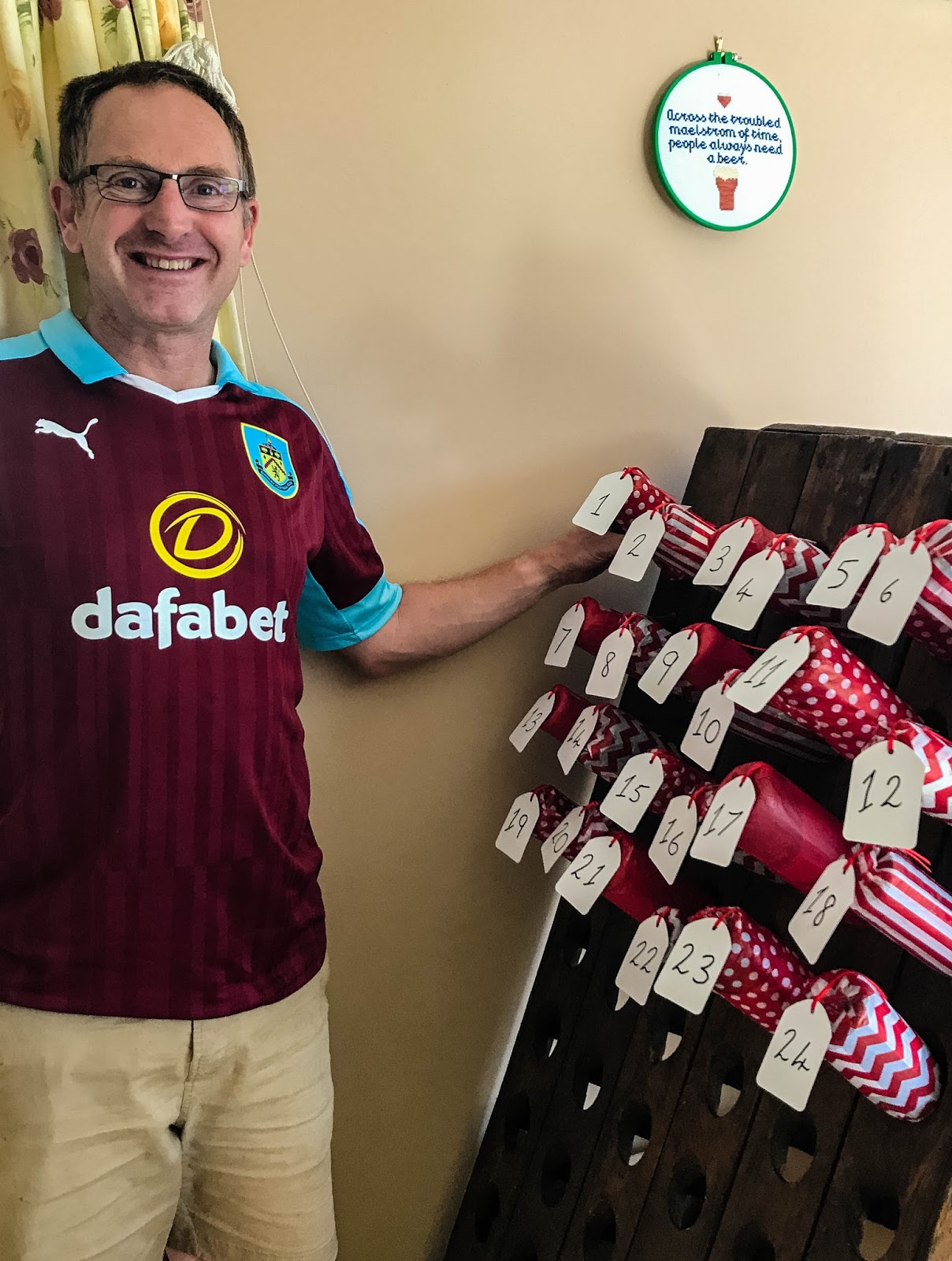
Here is the annual tradition of our Advent Beer Calendar - getting though the month leading up to Christmas one day (beer) at a time. He buys me the even numbers and I buy Him Outdoors the odd ones - make of that what you will...

 
Beer 1: Prickly Moses Saboteur IIPA (10.4%) 
A touch grainy with strong citrus hop - 3.75/5
Beer 2: Brew by Numbers 03 Porter Traditional (6.6%)
A lot of roasty coffee flavours but not enough richness or chocolate for me - 3.75/5
Beer 3: Haand Bryggeriet Framboos (8%)
More sour than I was expecting - great fruit flavours and tart funk - 4.25/5
Beer 4: Prickly Moses The Raconteur (6.4%)
Full of hops and malty goodness: a very tasty brew - 4.25/5

Beer 5: Ganstaller Brau Affumicator Smoked Dopplebock (9.6%)
Smoke and dark malt and smoke and leafy freshness and smoke. And did I mention the smoke?

Beer 6: Bacchus India Milk Stout (5%)
Perfect contrast of milky sweetness with hoppy bitterness - 4.5/5

Beer 7: Buxton Brewery Guatemalan Coffee Extra Porter (7.4%)

Very bitter coffee taste from the roasted barley, almost tipping the scales towards astringency; some chocolate comes through as it opens out - 3.5/5
Beer 8: Brouwerij De Molen Amarillo Imperial IPA-ish (9.3%)


Sweetness from alcohol strength and caramel malt with piney earthy hop flavours and a crisp bitter finish - 4.25/5
Beer 9: Temple Brewing Co. Okinawa Sour (4%)
Lemony with sharp citrus zest and a strange aftertaste, which is possibly the top-billed Shikuwasa fruit, but I wouldn't know - 3.5/5
Beer 10: Venom Brewing Black IPA 6%


Tasty, malty and much softer than most black IPAs; I like it - 4/5
Beer 11: Hairyman Brewery Salt Dog Leipzig Gose (4.6%)
It's got more body that I would expect from a gose; more like a salty golden ale - 3.25/5
Beer 12: Brouwerij Emelisse Vanille Ice Cream Stout (5.5%)
Tried it again and I like it more now: there's a decent mouthfeel and well-rounded taste - 3.75/5

Friday, 29 December 2017

Friday Five: Best Theatre Productions of 2017

Pip Utton becoming Maggie
This year I saw twenty-three theatrical productions in Canberra from sixteen different companies across ten different venues. Without further ado, these are my top five of the year (in chronological order of viewing - I couldn't pick an absolute favourite).

Top 5 Theatre Productions of 2017:
  1. Churchill/ Maggie (produced by Imagination Workshop and Street Contemporary Drama at Street 2) - Pip Utton performs solo shows on consecutive nights, portraying political giants Winston Churchill and Margaret Thatcher. He weaves anecdotes, musings and facts into his 70-minute monologue on Churchill, a colossus of his time: "History will be kind to me for I intend to write it." During his embodiment of That Woman he invites questions from the audience, while achieving the voice, mannerisms and dismissive tone so successfully it made my skin crawl. His enthusiasm is boundless and his knowledge equally indefatigable. 
  2. Trelawny of the Wells (produced by Canberra Repertory Society at Theatre 3) - Tony Turner directs a spirited cast in this touching and amusing late-nineteenth-century drama. The revolving set (designed by Ian Croker) allows for all the scenes to be played in the balance of affectation and naturalism which was becoming popular at the time and which is crucial to the play's ethos. Deliberately bombastic performances from the flamboyant characters such as Sir William Gower (Jerry Hearn), Mrs Mossop (Elaine Noon) and  Avonia Bunn (Jess Waterhouse) provide a delightful counterpoint to the more subtle sentimentality of Rose Trelawny (Alessandra Kron) and Tom Wrench (Robert de Fries). Slapstick extremes are tempered with emotional speeches, and the entire effect is a beautiful piece about acting and performance.
  3. The Play That Goes Wrong (produced by Lunchbox Theatrical Productions Pty Ltd at The Canberra Theatre Centre) - The fast-paced, critically well-timed production provides a really enjoyable night out. There are laughs a-plenty in the first act, which feels like comedy; fewer in the second, which feels like farce. Strangely enough, I've never enjoyed watching women trying to upstage each other while fighting in their underwear (it's just not funny, although many men seem to think so), but the stage crew logistics were superb, and the risk-assessment necessary is mind-blowing. The acting is all highly-stylised and unsubtle (co-writer Henry Lewis credits The Art of Coarse Acting, Monty Python and Laurel and Hardy, so that's hardly a surprise) and the story (of who murdered whom and why) becomes increasingly irrelevant as theatre tropes come flying from all directions, along with the props and set itself.
  4. Cyrano de Begerac (produced by Sport for Jove Theatre Company at The Playhouse, Canberra Theatre Centre) -Sparkling with wit and energy, this adaptation by Damien Ryan (who also directs and stars as the titular character) is an utter delight. The sensational staging is epic in its proportions, whether we are watching a bumbling pastry chef, a charismatic sword fight or a poignant battle scene. It’s full of humour and detail – eyes and ears must be keenly focussed so as not to miss a moment. The choice to set it in the years leading up to and encompassing WWI is inspired as the glory and pomposity of words are punctured by the reality of events. We all know the story of the heroic soldier poet Cyrano who is in love with Roxanne (Lizzie Schebesta) but is afraid to voice his affection on account of his appearance, so pens romantic verses for his handsome, young comrade Christian (Scott Sheridan) instead. The sustained vibrancy of this production makes the tale heart-breakingly beautiful rather than tired and trite. This Cyrano is not a saint and there is a bite to his wit as there is an edge to his sword that makes the production modern and relevant while losing nothing of its traditional appeal.
  5. Love/ Chamberlain (produced by Moral Panic and Ainslie and Gorman Arts Centres at Ralph Wilson Theatre, Gorman Arts Centre) - Playwright Bridget Mackey imagines that Courtney Love and Lindy Chamerlain might have a lot in common. Despite coming from contrasting backgrounds with seemingly disparate outlooks, they were both pilloried by the media for not responding to grief and trauma the way women are expected to react. In her play directed by Cathy Hunt, Love (Emma Macmannus) and Chamberlain (Heidi Silberman) meet several times in several contexts as they jump back and forth in time across the Federal Highway; strewn with the paper detritus of old news. They are aided and abetted by the versatile barb barnett in a dozen different and well-developed roles, but even as the Oracle (dispensing advice from a cardboard booth like Lucy in Peanuts) she doesn't have all the answers. It's great to see new work by local theatre artists, especially when it is as thought-provoking as this.
Damien Ryan as Cyrano de Bergerac

Tuesday, 26 December 2017

Love is Stronger than Fear. Kindness is Stronger than Greed: SIEVX Memorial

On the grounds of Weston Park where the hill slopes down towards Lake Burley Griffin, 353 painted poles dot the ground in what appears to be a random structure, but turns out to be anything but. Each one represents a life lost in the sinking of a boat crammed full of refugees that has come to be known as SIEV X. At the height of the Federal Election Campaign in October 2001, the dawn rose on what one survivor referred to as looking 'like birds on the water'.


The acronym SIEV stands for Suspected Illegal Entry Vessel. It was the tenth unknown vessel the navy had intercepted (hence the X), packed with refugees from Saddam Hussein's Iraq. Many of the passengers were women with children who had been travelling for years and to try and find a safe place to live; some attempting to join their husbands who had already gone ahead to Australia, only to be caught in the changing political tide and locked in detention or a newly devised Temporary Visa system which took away their rights to re-unite. Left without support, these mothers and young children were easy prey for people smuggling operators.

Armed Indonesian military supervised the boarding of the boat and a patrol boat escorted it from the port of Lampong. Crowded onto a fishing boat only 19.5 metres long, packed so tightly that teenagers had to climb on the roof and mothers hold children on their laps, the passengers were terrified even before they left port. The design of the poles is laid out to represent a procession of boats and the tiny size of the vessel itself.


There were forty survivors, but 353 souls were lost, either in the original sinking or in the 20 hours spent in the water waiting for fishing boats to come to their rescue. Each pole remembers one person who died; the smaller poles for children and the larger poles for adults. They were created by over 300 schools, churches and community groups, across Australia. 

Images include rural, city and desert landscapes, native flora and fauna, and heartfelt poetry. Some of the names are known, but many aren't, and the effect of reading 'Unknown boy', 'Unknown baby', 'Unknown mother' on a plaque on the pole is incredibly poignant.


Ahmed Diya Al Saadi (Aged 6 months) - Ali, Ghazi, Mohammad, Vanessa and Sue, Perth, WA
Naima Jawad, aged 31, by the students of Bateman's Bay HS, Bateman, NSW
Rem Haidar, aged 4, by The Students of St Patrick's College, Prospect, TAS
Ahmed Al Alawy by Port Melbourne Uniting Church

This is a memorial and the thousand or so Australians who created it, many of them children, are paying their respects to those who lost their lives while seeking anew life. It is also, despite denials, a political statement. On the calm sunny shores of the capital's lake it begs to question how this tragedy happened and to attempt to ensure that it does not do so again. It is calm and peaceful, but it is a protest, and one which it is hard to ignore. An information panel alludes to these sentiments.
"You may feel the sadness of such an end for these families, and the grief of those fathers and husbands detained here in Australia, unable to help or protect them. But please also feel the hope and promise that young Australians cared so much to create this beautiful memorial." 

The intention of the SIEVX Memorial is to affirm that these lives are sacred; we will not forget them. It is beautiful, haunting and very powerful. It suggests that Australia is not a country defined by fear and greed. 
"Love is stronger than fear. Kindness is stronger than greed."

Friday, 15 December 2017

Friday Five: Recent Theatre Excursions

And here are another five shows I have seen and enjoyed, to various extents.

David Pearson as Sweeney Todd
  1. Sweeney Todd: The Demon Barber of Fleet Street produced by Dramatic Productions at Gunghalin College Theatre - The staging of this show is problematic, as the pivotal scenes (such as the action in the barber's shop and the hellish production detail of the pie-shop) are shunted too far up-stage to receive the full attention they deserve. As is often the case with amateur musicals, director Richard Block has largely jettisoned acting ability in favour of singing voices. David Pearson as the titular barber has strong presence and a commanding voice, but doesn't bring sufficient contrast to his performance, striking the same sneering pose throughout. Kate O'Sullivan in an understudy role as Mrs Lovett has better acting chops than most, although she struggles a bit with the higher register. Demi Smith is the complete opposite bringing a piercing clarity to her singing that is noticeably absent from her dialogue; Lachlan Agett as Antony Hope does neither, and Max Gambale's Judge Turpin does a fine job of bring the sleaze and cynicsm. While some of the set pieces (No Place Like London; Pirelli's Miracle Elixir; God, That's Good!; By the Sea) are entertaining, they are incongruous with the tone of the whole, and generally filling the stage with chorus members doing a number does this show a disservice. It should contrast the demonic with the divine, but instead comes across as dull and dismal.
  2. The Merchant of Venice produced by Bell Shakespeare at The Playhouse, Canberra Theatre Centre - My problem with Bell Shakespeare is that they often re-interpret the bard's plays to fit their own sensibilities by re-arranging the words and forcing modern meanings into the text. Admittedly The Merchant of Venice is a tricky play with its tones of antisemitism, but the ending is generally one of couplings, suggesting a more tolerant and understanding future, not one of heart-rending guilt. When Jessica says 'I am much ashamed', it is in Act II and refers to her dislike of being seen in male clothing by her lover. Bell Shakespeare moves these lines to the end of the play as she rocks back and forth and pretend they reveal her feelings about the treatment of her father, Shylock. This may work for schools (and the slick production values and strong acting styles will certainly please teens used to one-dimensional characters and plots) but is insulting to the intelligence of anyone who appreciates the intrigues and subtleties of Shakespeare.
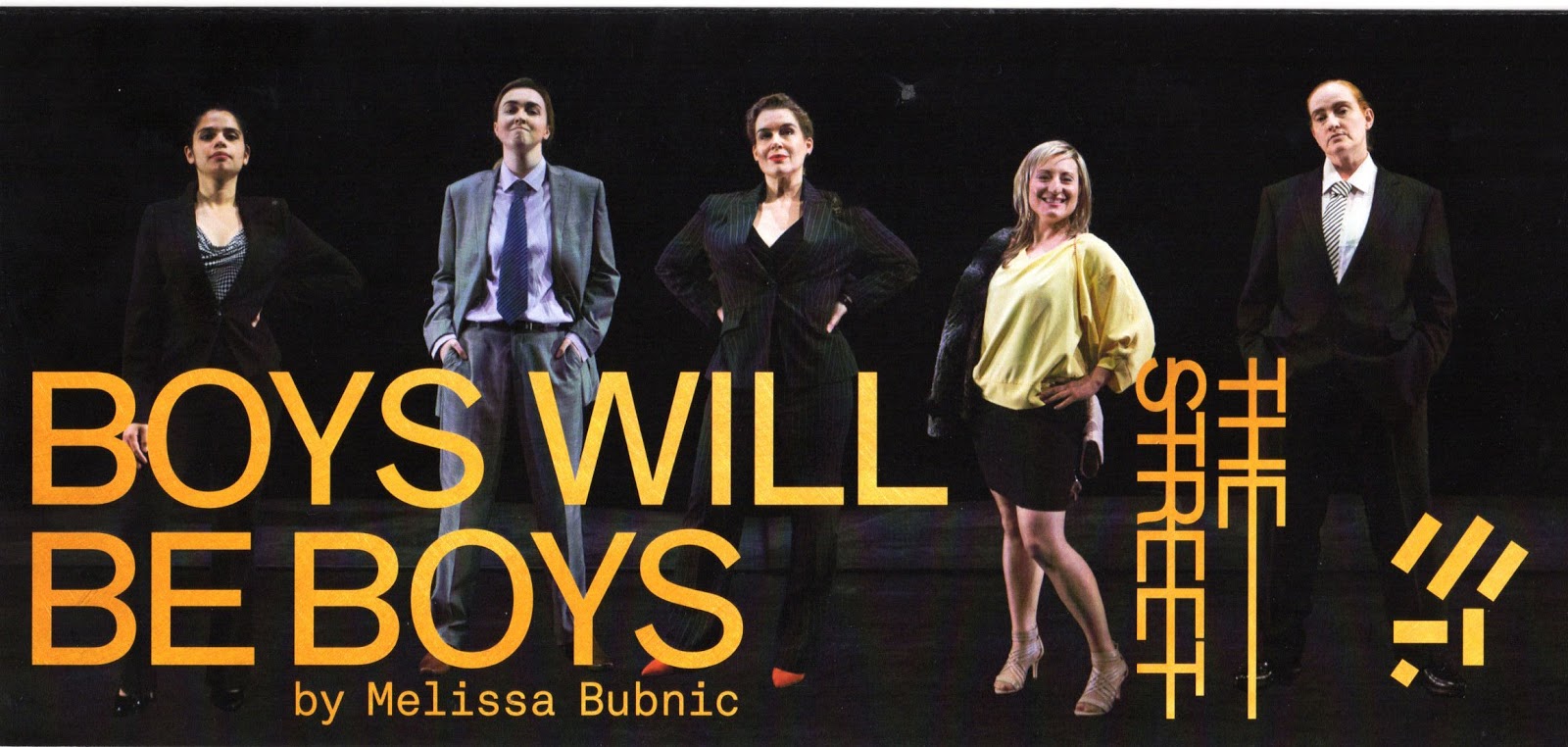
  3. Boys Will Be Boys produced by The Street at The Street - Caroline Stacey directs this hard-hitting boardroom drama in which all the men are played by women in sharp suits and cutting dialogue. The world of financial politics is clinical and unforgiving with no room for compassion, and everyone has a price. The stark set of mirrors and neon reflects the emptiness of the characters' souls, but there is also nowhere to hide. This is a problem for some of the weaker actors who are simply not strong enough to wield the crushing testosterone wrecking balls indicated by the text. Pippa Grandison stands out as Astrid, the woman with the most at stake who strikes the hardest deals and dares reveal a softer side only in song.
  4. Love/ Chamberlain produced by Moral Panic and Ainslie and Gorman Arts Centres at Ralph Wilson Theatre, Gorman Arts Centre - Playwright Bridget Mackey imagines that Courtney Love and Lindy Chamerlain might have a lot in common. Despite coming from contrasting backgrounds with seemingly disparate outlooks, they were both pilloried by the media for not responding to grief and trauma the way women are expected to react. In her play directed by Cathy Hunt, Love (Emma Macmannus) and Chamberlain (Heidi Silberman) meet several times in several contexts as they jump back and forth in time across the Federal Highway; strewn with the paper detritus of old news. They are aided and abetted by the versatile barb barnett in a dozen different and well-developed roles, but even as the Oracle (dispensing advice from a cardboard booth like Lucy in Peanuts) she doesn't have all the answers. It's great to see new work by local theatre artists, especially when it is as thought-provoking as this.
  5. Australia Day produced by Canberra Repertory at Theatre 3 - What is the purpose and relevance of the national celebration? Jonathan Biggins opens this can of worms in his satire set in a fictional country town. Lofty ideals clash with political expediency, torrential rain and an outbreak of food-poisoning. Anyone who has ever sat through tedious committee meetings will appreciate the contrasting personalities and sensitivities encompassed in the preparations conducted in a scout hall, which is freezing in the winter and boiling in the summer. The set is basic, and so is the acting and the direction by Cate Clelland, but this is not necessarily a criticism, as the script is allowed to take centre-stage where it belongs without distracting interpretations or excessive 'input'.

Monday, 6 November 2017

Gathering Swallows Twitter in the Skies


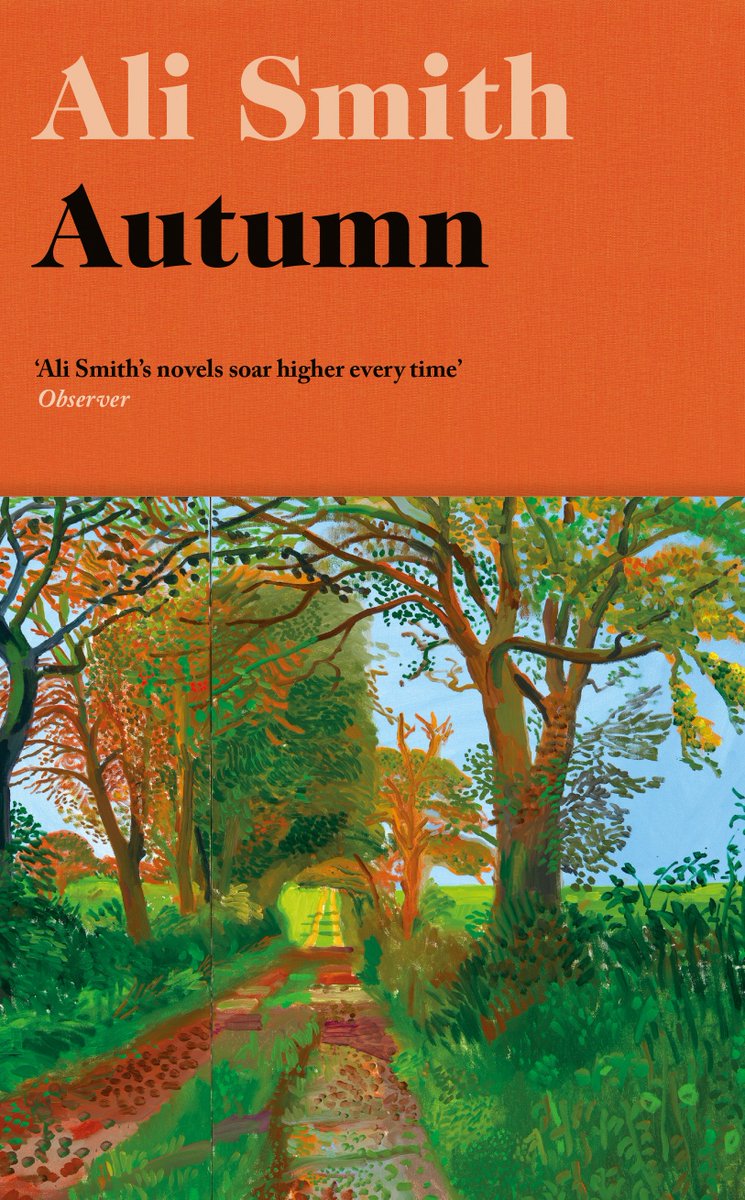
Autumn by Ali Smith
(Penguin), Pp. 260

Shortlisted for The Booker Prize and hailed as the first post Brexit novel, Ali Smith’s Autumn shoulders a weight of expectation for a slim novel. While it stands steady on its exquisite legs, it is also part of a series of novels due to represent all four seasons. It recalls the ode to autumn with its mists and mellow fruitfulness; there is a sense of melancholy but it is also suffused with hope, colour and a love of all things bright and beautiful.

Elisabeth Demand befriends her elderly neighbour, Daniel Gluck, and slowly learns his stories, while he challenges her imagination and perceptions of society. Her mother is horrified that she chooses to spend time with an adult male and cannot conceive that it is entirely innocent. Is it? The novel flicks back and forwards through time but with helpful explanations such as ‘It was a Tuesday evening in April in 1993. Elisabeth was eight years old.’ Daniel described artworks and paintings to her, including the works of the first female pop-artist, Pauline Boty.

Elisabeth later becomes a lecturer in art history, two topics which are intrinsically intertwined. She was told by a lecturer that there were no female pop artists and she is determined to champion Pauline Boty, who refused to fit the boxes created for female artists and died prematurely in 1966. With her witty collages and subversive paintings, Boty becomes a symbol of all those who are “Ignored. Lost. Rediscovered years later. Then ignored. Lost. Rediscovered again years later. Then ignored. Lost. Rediscovered ad infinitum.” Time is fluid; it is linear but cyclical; very messy and frequently repetitive. Now Daniel is in a nursing-home coma and Elisabeth visits him, pretending to be family: he has erotic fantasies about which she will never know. He had experiences of the Holocaust, and there are clear parallels drawn between the treatment of foreigners then and now.

It is self-consciously literary and also aware of the cyclical nature of history. From the opening line – “It was the worst of times, it was the worst of times.” – it is clear that everyone is feeling unsettled as the country tears itself apart.

“All across the country, there was misery and rejoicing… All across the country, people felt it was the wrong thing. All across the country, people felt it was the right thing. All across the country, people felt they’d really lost. All across the country, people felt they’d really won. All across the country, people felt they’d done the right thing and other people had done the wrong thing.”
Britain has just voted to leave the EU. Half of the village isn’t talking to the other half. A mysterious barbed-wired compound has sprung up nearby complete with security cameras and patrolling guards. Elisabeth’s mother, who is obsessed with antiques, decides to get herself arrested by throwing items of historic significance at the enclosure, “bombarding that fence with people’s histories and with the artefacts of less cruel and more philanthropic times”. A house in which immigrants live has the words GO HOME spray-painted on the wall. But later, the words, WE ALREADY ARE HOME, THANK YOU have been added, and bouquets of flowers left by supporters and well-wishers. There are seeds of hope and humanity scattered in this forlorn and morally bereft landscape.

Ali Smith acknowledges the pain of division and the beauty of inclusion. From nature with its seemingly haphazard approach to procreation and fertility, to the apparent clinical approach to grammar and semantics, she suggests that organic development will always triumph over control. Daniel dreams of becoming imprisoned in a tree and returning to the earth. Smith admires the polyglot of languages with words coming from all over the world (such as an intriguing section on a book young Elisabeth reads about a gymkhana).

This is a time of fear and certainty based on lies and fabrications. Daniel explains that the power of the lie is “Always seductive to the powerless.” We make sense of our world through the stories we tell and the ones we hear, whether they are presented as anecdotes or news. “Whoever makes up the story makes up the world, Daniel said. So always try to welcome people into the home of your story. That’s my suggestion.” We need more inclusion; we need more acceptance; we need more open-mindedness; and we need more books by Ali Smith.

Friday, 20 October 2017

Friday Five: Double Bills

Scene from Dunkirk
Often films mirror each other in unintended ways. Sometimes it is due to the ubiquity of an actor or the anniversary of an event; sometimes it is mere coincidence that certain themes resonate more strongly. Having taken a few long-haul flights recently, I've seen several films which remind me of others, so I shall compare them here.

5 Cinematic Double Bills:
  1. Dunkirk and Their Finest - both films deal with reporting WWI and the evacuation of Allied troops from Dunkirk in 1940. While the former is a triptych war film (deliberately sectioning the action into land, sea and air), the latter is a more light-hearted comedy drama. This much is clear from the choice of actors: Kenneth Brannagh and Mark Rylance v Gemma Arterton and Bill Nighy and the reliance of set piece action shots as opposed to witty dialogue. They are both of a high calibre and present well-known facts in a fresh and involving way; stirring and memorable but without being mawkish.
  2. The Beguiled and Get Out - Having watched both of these films on the same day, I am persuaded that the states in southern America are decidedly dodgy, and grandiose-seeming houses occupied by close companions are to be avoided at all costs. Whether one is an injured Yankee soldier hiding from the Confederates or a black boyfriend at an all-white family gathering, it is very dangerous to be 'the other'. Murky motives assume nightmarish proportions through drugs, pain and hallucinations. 
  3. Captain Underpants and Wonder Woman - One of these films is about a super-hero invented by a society which feels a need to be saved from tyranny and oppression, by foisting all its anguish and suffering onto the broad shoulders of a crusading scapegoat with supernatural powers. The other is a shambles of tedious backstory, uninspiring action sequences and sketchy motives, although it does have one galvanising moment on a battlefield.
  4. Lady Macbeth and My Cousin Rachel - Featuring atmospheric tension and knowing the value of silence, these films work a good pause. Both hint at trauma and temptation without committing to a definitive version of events, with gothic overtones and mysterious motives. The leading ladies (Florence Pugh and Rachel Weisz) are mesmerising and calculating, teaching audiences never to underestimate the passion of the mid-nineteenth century wife. 
  5. The Lost City of Z and King Arthur: Legend of the Sword - What could have been interesting films (solid plot; establishment of reputation; appeal to the imagination) are let down by flabby story-telling and monochromatic acting. The beginning of both films is turgid and ridiculous (whether it's an adventurer trying to obtain military promotion, or giant elephant monsters in some identikit fantasy battle) and once the narratives do get going they are plagued with frequent pointless interruptions. The Lost City of Z is pedestrian in pace, which suits the upriver journey, while King Arthur: Legend of the Sword is directed by Guy Ritchie so therefore aimed at the ADHD generation on caffeine, but the acting by Charlie Humdrum, sorry Hunnam, hits the same one-dimensional note in both.
'Tra la la!' - Captain Underpants

Monday, 9 October 2017

And Why Not?


Mustn't Grumble by Joe Bennett
(Simon & Schuster), Pp. 280

Joe Bennett lives in Christchurch, New Zealand where he writes columns for syndicated newspapers and books of witticisms and comment. In the introduction to this book he writes, “I am English, but I have spent most of my adult life abroad. When a publisher asked me if I would like to come back, travel around England for a bit and write a book about it, I said yes.” Well, who wouldn’t? Inspired by the 1927 work of H.V. Morton, In Search of England, he decides to follow his footsteps, but by hitch-hiking his away around the country. He soon falls out of love with both Morton and the attempt to hitch-hike as he finds no one stops.

Although he has lived abroad for nearly 25 years, Joe Bennett still identifies with his home country. “I remain English and will die English. And I am happy with that. In a primal way over which I have no control, I still love the place.” He relishes peculiarities and idiosyncrasies, from the way accents indicate class as much as regions, to the courtesy of motorway driving (he borrows a friend’s Audi to tour the country) or “the remarkable ability of the English to eat ice cream in chilly weather.” He even enjoys the climate, the delight in bemoaning which lends his book its self-deprecating title.

Most of his daily excursions finish at the pub. “I am often asked if there is anything I miss about England. There isn’t. I have lived so long abroad that I don’t yearn. If I did, I’d come back. But there are some things that I relish when I do come back and one of those is pubs.” He is definitive about what constitutes a good pub. “People come in to talk to whoever happens to be there… They laugh a lot. There is nothing that cannot be discussed... It’s a coincidence of paths, a random intersection of lives that will never come again. We meet, we laugh, we go away again. I like that.” As anyone who has left England and returned, he notices the lack of space and the sense of history and culture, “There are few parts of this cramped country that have not been written about. It’s going to be hard to escape literature on this trip. I don’t think I’ll bother to try.”

His attitude is generally affectionate, but he doesn’t love everything. He dislikes the council buildings of the 1950s, thrown up in haste and unfortunately permanent. Like many before him, he bemoans the utilitarian modernity and there is a hint of axe grinding in his scathing assessment, “Cathedrals strive so hard to deny that they’ve become theme parks.”

He is a good writer, able to make the commonplace interesting. Squirrels “ripple across the grass, their spines undulating like waves along a skipping rope…” While mainly direct, he occasionally becomes verbose when he warms to a theme, such as when he writes of the lack of response received at the breakfast table.

Joe Bennett has asked many people (usually in his pub conversations) what it means to them to be English. While many are proud to be so, they have struggled to define it. Some can only express their identity by knowing what it is not, and what it is not is European. (This book was published in 2006; ten years before Brexit). The image of Englishness perplexes him, as he notes that Morton was harking back to an England he expected his readers to want and so he delivered it to them. 

Bennett is frequently told that the old way of life has changed due to progress and immigration. He concedes he is in no position to judge whether England is overrun by migrants, as he has mostly seen the England of the shires. “Yet I have heard any number of middle-class, middle-aged whites, most of them living in towns that are ninety-eight per cent white, telling me that immigration is ruining the country.”

He soon grows weary of H.V. Morton and his elegiac prose, which he feels is calculating and was propagandist even when written. Bennett begins to deliberately stray from Morton and his beaten track because he feels he is being manipulated. “I don’t want stuff packaged. I don’t want my way to be eased...” He would rather drop in unexpectedly on places and take them as they are. 

He is a curmudgeon who won’t be patronised. He thinks of himself as a free spirit, wandering the countryside at will, while most at home propping up the bar and chatting to strangers without commitments or consequences. He finds humour in adversity and fascination in mundanity. If H.V. Morton went in search of England, then Joe Bennett probably found it.