Monday, 14 November 2022
Due Care and Attention
Friday, 11 November 2022
Friday Five: The Latest Theatre
- This Changes Everything - Echo Youth, The Q: In a dystopian future, a group of young adults try to set up their own society, called The Community, on a platform out in the sea - the set with hierarchical levels and isolated pods works well for symbolism and lighting opportunities (Direction by Jordan Best; Lighting design by Jacob Aquilina). Written by Joel Horwood, it's not necessarily a novel idea (I wouldn't be the first to call it Animal Farm meets Lord of the Flies) and many of the motifs of a disingenuous leadership model are familiar - rules written on the wall are altered to suit and the founder of the group mysteriously vanishes, said to have fled and abandoned the remainers. As a British viewer, it's impossible not to think of Brexit, but there are many other issues and themes ('the negatives of Capitalism; the inequalities bred by exponential growth; a culture failing to engage with causes or impact of climate change') which are all generally well-handled, although the 'abuse trope' seems glib and unnecessary. The play also explores the fine line between Socialism (in which each works according to their talents) and Communism ruled by a totalitarian dictator, in which the level of violence and oppression are well-pitched at an adolescence; they can all be aware and concerned, but not still safe and not traumatised. Jade Breen has solid conviction as the Stalinist overlord, Maja; Tara Rose Blake as Kim, the one who switches sides to become the enforcer is believable and nuanced, and Will Best also stands out as Basic Jane, the cynical one trying to keep their head down and avoid being noticed (Animal Farm's Benjamin, if you will). There are the usual awkward moments and projection issues seen in junior casts, but generally this is a respectable piece of theatre that should be encouraged.
- First Seen: Barren Ground by Helen Machalias - The Street, Street Theatre: Helen Machalias is such a great talent and I was intrigued to see what she would do next. This rehearsed read did not disappoint. I loved the exploration of the liminal spaces between life and death; myth and relaity; advertising dreams and political realities. Refugee's stories at an off-shore detention centre (on Christmas Island between 2010 and the closure of the centre in 2018) are told against a supporting framework of The Tempest where 'brave new world' poetry collides with 'stop the boats' rhetoric. When this returns as a full production, I will be first in line.
- Hand to God - Everyman Theatre, ACT HUB: I've not seen this play before, but I read that it won the Off Broadway Alliance Award for Best New Play and received five Tony Award nominations in 2015, although it closed early when it transferred to London and didn't garner such glowing reviews. I'm not surprised. It's crude, crass, blindingly obvious, and, according to the original playbill, an 'irreverent puppet comedy... about a possessed Christian-ministry puppet'. The widowed Margery (Steph Roberts) runs a Bible-promoting puppet-class attended by her son Jason (Michael Cooper), the sleazy teenager Tim (Joshua Wiseman), and quirky girl next-door, Jessica (Holly Ross). Men expect respect for no apparent reason, and women exist to give it to them - Steph Roberts deserves better than the demeaning cougar-seduction role she's given. Sure, she does it well - she does everything well - but this borders on hot-for-teacher-soft-porn fantasy. To make this message more palatable (and supposedly satirical), Jason becomes fused with his demonic puppet, Tyrone, and Pastor Greg (Jarrad West filling in for Arran McKenna) has to perform an exorcism, while also trying to woo Margery despite the fact that her husband has only just died. Michael Cooper is quite brilliant at physical comedy and the combination of his acting skills and Jarrad West's slick slapstick direction make this less than just a repulsive piece of low-brow misogyny (mocking organised religion is hardly cutting-edge). In its favour, at least the entitled incel released his toxic masculinity with his hand up a puppet, not on a gun.
- Romeo and Juliet - Canberra Repertory Society, Theatre 3: Co-directors Kelly Roberts and Chris Zuber use a young cast who display energy and enthusiasm, although many lost the poetry with the pace of their delivery, rushing the words and trying too hard to put their own stamp on this classic. Annabelle Hanson plays Juliet as a determined teenager who decides what she wants and goes for it, although it appears to be more independence from her parents (Richard Manning and Crystal Mahon) rather than love for Romeo (Pippin Carroll).Through her strong stance, balled fists and rigid posture, she radiates power and poetry with no need of any love interest - indeed she convinces more in her individual scenes than in those with Romeo, which lack chemistry or passion - this is not helped by the setting of their intimate scenes (the meeting; the balcony scene the bed scene) on distant parts of the stage. Carroll works hard on diction and projection but sacrifices passion and feeling, leaving the audience to rather engage with Mercutio (a fine performance by Anneka van der Velde whose restless movements imply there are hidden depths to the character hidden behind a facade of bravado) and the Nurse (Tracy Noble), who both bring the necessary energy and choric interpretation.
- Ngadjung - Belco Arts, Belconnen Arts Centre: If you get a chance to see any work by Dylan Van Den Berg, see it. He is an original and incredible young talent who makes theatre that moves, inspires, connects, provokes and questions. In his director's notes, Van Den Berg explains that 'Ngadjung emerged from an original provocation to write a play about water - First Nations connection to water, human connection to water.' His play casts two women in a futuristic (and dry) environment, controlled by corporations who have privatised, monetised and politicised water to make it a commodity to which only the wealthy have ready access. Lisa Maza plays Flick, the elder who is desperately trying to maintain her connection to Country in a landscape that is irrevocably changing, and Kylah Day is Cass, the young interloper who stumbles across her patch, hiding from pursuers determined to repossess the secrets she stole. The relationship between these two actors is superb as their stories collide, mingle and separate like tributaries in a river. Production standards are also outstanding from the evocative set (designed by Imogen Keen) to the sound (Peter Bailey) and lighting (Linda Buck) design which create tension and atmosphere. In an extraordinary coup, Belco Arts commissioned this work from Van Den Berg, and it can only serve to enhance the significant reputations of all concerned. As with the inherent call to action against ignorance of climate change, this is one that demands to be seen and heard.
![]() |
| Kylah Day and Lisa Maza in Ngadjung |
Tuesday, 8 November 2022
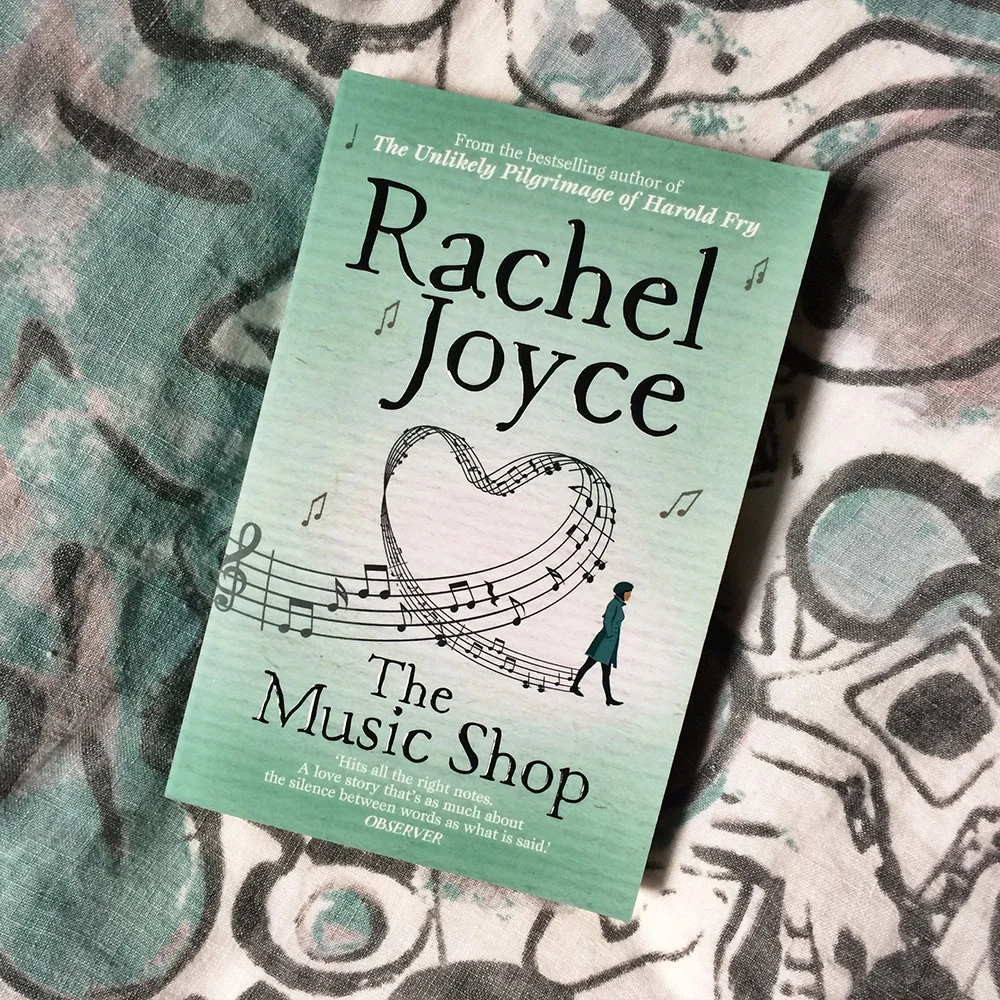
You Spin Me Right Round, Baby: The Music Shop
Frank owns a music shop which
only sells vinyl, and he has the gift of being able to find the right music to
soothe a person’s soul or mend their marriage. One day a beautiful woman, Ilse
Brauchmann (manic pixie dream girl in a pea-green coat), faints outside his
shop and they have a relationship. She says she doesn’t listen to music so he
teaches her how to hear it. It turns out she was a highly proficient violinist
but now has arthritis and can no longer play. And she is engaged to someone
else. Of course she cares for him, but the author introduces deliberate (and
illogical) stumbling blocks to draw out the story. Frank is not actually all
that nice but he’s got lots of friends who encourage him in his romance
(Richard Curtis style) including Maud, the tattooist, a woman who has always
been inexplicably in love with him, and Kit, an incapable but passionate
assistant. It’s very light and fluffy and employs every trope known to rom com,
and yet the added appeal comes from the music and nostalgia.
Frank’s finest characteristic is
his sense of community with the other shopkeepers. “Here they were, living
together on Unity Street, trying to make a difference in the world, knowing
they couldn’t, but still doing it anyway.” Ilse is supposedly cute, but immensely
irritating. They meet for the lessons about music, in a café called The Singing
Teapot, and the waitress becomes involved in their story too, which is charming,
delightful, twee and completely unrealistic. Meanwhile, the author tells us
everything so there is no room for mystery or suspense.
Music has magical properties, and
listening to it can release oxytocin – books are written like this about cookery
all the time; all the chapters are named after songs and there is an
accompanying soundtrack. The novel contains frequent time shifts as we are cast
back to Frank’s relationship with his mother, Peg, who taught him how to really
appreciate music. This rapport is more interesting than that with the girl.
Music, especially vinyl, is part
of the nostalgic focus of the novel, and it should be enjoyed as an experience.
He uses the difference between CDs and records as a metaphor for life (God only
knows what he’d make of music-streaming services), refusing to accept that he
and his music shop are out of date although several reps and customers stop
calling. He maintains that vinyl is messy and fragile, and therefore, more
human.
Tuesday, 1 November 2022
My Newest Favourite Thing: Galeanthropy
![]() |
| Penelope pretending to be a cat |
I have learned a new word, which I absolutely love.
Galeanthropy: A mental condition of thinking that one has become a cat, usually manifest in the adoption of feline mannerisms and habits.
I think Penelope may have it. That is all.
Tuesday, 25 October 2022
Le Carre's Last Stand: Agent Running in the Field
The last book that John Le Carré
wrote is, perhaps unsurprisingly, a fast-paced action with a clear story and credible
characters. Themes of espionage, defection and loyalty may have seemed passé,
but nationalism and protectionism are once again current: the old enemy is
back, reinvented as the new enemy and we may need to defend our nation and
concepts of freedom and democracy all over again from plutocrats like Putin.
The novel is crammed full of code names and secret spy business, played out
against a backdrop of Brexit, Trump and greedy oligarchs in a contemporary
environment.
Nat is a forty-seven-year-old
veteran of Britain’s Secret Intelligence Service who plays badminton and lives a
pleasant and seemingly settled life in London with his wife, Prue, who does pro
bono legal work for worthy causes. He is somehow manoeuvred into playing
badminton at his exclusive private club against a young upstart, Edward
Shannon, who has ideas, and he is not afraid to expound them. With an older
mentor’s indulgent attitude, Nat finds himself looking forward to these
meetings, although the book is written in retrospect as he reflects upon them.
The premise is that Trump has
helped to engineer Brexit so that Britain has to rely on Russia for financial
and political assistance, which is obviously going to be grubby, and be
beholden to the USA once again. Tellingly, Trump does Putin’s dirty work for
him: “pisses on European unity, pisses on human rights, pisses on NATO. Assures
us that Crimea and Ukraine belong to the Holy Russian Empire, the Middle East
belongs to the Jews and the Saudis, and to hell with the world order.”
There may possibly be “an
Anglo-American covert operation already in the planning stage with the dual aim
of undermining the social democratic institutions of the European Union and
dismantling our international trading tariffs.” This operation will also “disseminate
fake news on a large scale in order to aggravate existing differences between
member states of the Union.” One former spy is horrified to think that he
risked his life to see the Great British Empire, liberal conscience and
Christian values replaced by “a cartload of hypocritical horseshit”. In present
circumstances, division and in-fighting will not be difficult to engineer.
The language of spies follows
form: a newspaper in which hand determines whether it is safe to talk or not;
letters written suggest the opposite of what is declared. There is, however, a
refreshing respect for women, which is often absent from male hard-boiled
thrillers. The novel is elevated by its use of witty and decisive one-liners to
describe characters and actions. For example, one high-ranking official has a
“cheery port-and-pheasant voice”, while another “doesn’t do confrontation,
which is something we both know. His life is a sideways advance between things
he can’t face.”
Wednesday, 19 October 2022
With a Pinch of Salt
"The first step in every community which wishes to preserve honesty should be to set the people above want. The throes of hunger will ever prove too powerful for integrity to withstand."
This is as true now as it was in 1788, or in 1864 when the bushrangers stole from the landowners. And it seems trenchantly symbolic that the victims were awarded an ornament designed for displaying and sharing condiments in turn created to enhance and complement fancy food. With this and the pithy wit of Brian Bilston 'the poet laureate of Twitter' in mind, I crafted the following (with apologies to both).
You were always keen as mustard,To spice things up,Not to curry favourBut to rub salt in the wounds.So you got us all in a pickleThen sat back gingerlyAll big cheese and toffee-nosed,As though butter wouldn't melt.
Thursday, 13 October 2022
The Campbell Epergne
When I visited the Orange Regional Museum a couple of years ago, I was struck by this decorative table piece (not literally - it was displayed behind glass). I read that the national Cultural Heritage Account had assisted the museum with the purchase of this item to the tune of $90,000. I thought that was a fair whack for a candlestick, so I read all the information about it - turns out it is quite the icon, so here are the facts, as presented by the museum.
"This sterling silver epergne was presented to David and Amelia Campbell of Goimbla, Eugowra in 1864 by residents of the district to mark their respect and admiration for her role in defending her family's property. The gift was in recognition of the heroism shown by Mrs Campbell and her husband in resisting an attack on their property Goimbla by Ben Hall, Johnny Gilbert, and John O'Meally. The bushrangers attacked the property and set the Campbell's barn and stables on fire. O'Meally was killed in the attack.
The epergne is a decorative table centrepiece which stands 72cm high and was made in London in 1862 by Thomas Smily. The epergne was purchased from Hardy Brothers Sydney for £150 with funds raised by community subscriptions. Modelled in a rococo revival style, the epergne has a tri-form base with leaf feet, scrolls and beading, rising to a naturalistic trunk with six scrolling arms, three with candle fittings and three supporting loop-handled baskets with a centre basket. The entire epergne is ornately decorated with vines and grapes.
Although the inscription is to both David and Amelia Campbell, contemporary accounts of the presentation event describe Mr Campbell being given a gold watch, now in the State Library of NSW, while the epergne was a gift to Mrs Campbell along with a silver-plated coffee urn inscribed by the ladies of Upper and Middle Adelong, and a printed silk address signed by 92 male residents of Forbes and District. The presentation of these lavish gifts was made at Goimbla in October 1864.
![]() |
| David and Amelia Campbell (taken from a lantern slide: National Museum of Australia) |
Approximately 16 gold and silver bushranger medals were presented to police and members of the public to mark their heroism during encounters with bushrangers. This is the only presentation-epergne associated with bushranger attacks and the only presentation made to a woman. Its delicacy of design and execution has a particularly feminine character.
Amelia Campbell was lauded as a 'daughter of Australia - a lady brought up and educated in Sydney who did not flinch under gunfire.'
Her heroism is emblematic of the often-overlooked dangers of many women living on lonely farms in regional Australia. Sadly, other women who stood their ground and fended off attacks by bushrangers received little public recognition. This epergne represents an important aspect of Australian colonial history and is one of the most notable and significant items of nineteenth-century Australian women's history."
![]() |
| Ben Hall |