Friday, 15 May 2020

COVID-19 Friday Five: ISO TV

The Durrells Third Series
While I cannot watch live sport or live theatre, I have had to find other ways to entertain myself. As well as listening to a lot of podcasts and reading a lot of books, I have also been watching a lot of TV series. I've been finding it hard to concentrate of late so my usual art-house films and documentaries are on hold, and I don't really like reality TV. I haven't got Netflix or Stan so these are all on free-to-air services.

Harlots Second Series
5 COVID-Friendly TV Series:
  1. The Durrells (BBC First) - practically the definition of comfort TV; the adventures of a dysfunctional but charming family led by the matriarch played by Keeley Hawes, and set on the idyllic island of Corfu just before the outbreak of WWII 
  2. Friday Night Dinner (ABC iview) - brothers Adam and Jonny Goodman, siblings in an eccentric Jewish family, return home each week for a free meal and to deal with their wonderful parents (Tamsin Greig; Paul Ritter) and their weird neighbour (Mark Heap) - there are six series of this spanning nine years, and I've only just found it! 
  3. Harlots (SBS On Demand) - strong roles for women (excellent portrayals from Samantha Morton and Lesley Manville, although the less said about Liv Tyler; the better) as the feuding brothel keepers spit insults at each other in an almost obscenely enjoyable period drama  
  4. No Offence (ABC iview) - UK police drama set in Manchester, and in which the three main leads are women with all the ballsy dialogue and attitude you would expect from creator Paul Abbott - also, coincidentally, starring Paul Ritter 
  5. Stateless (ABC iview) - excellent Aussie drama with great acting (including Cate Blanchett, Yvonne Strahovski, Asher Keddie and Marta Dusseldorp) and directing but, set around the world of detention camps and illegal immigration, it can be a bit hard to watch in places 

Tuesday, 12 May 2020

That Way Madness Lies: The Warlow Experiment


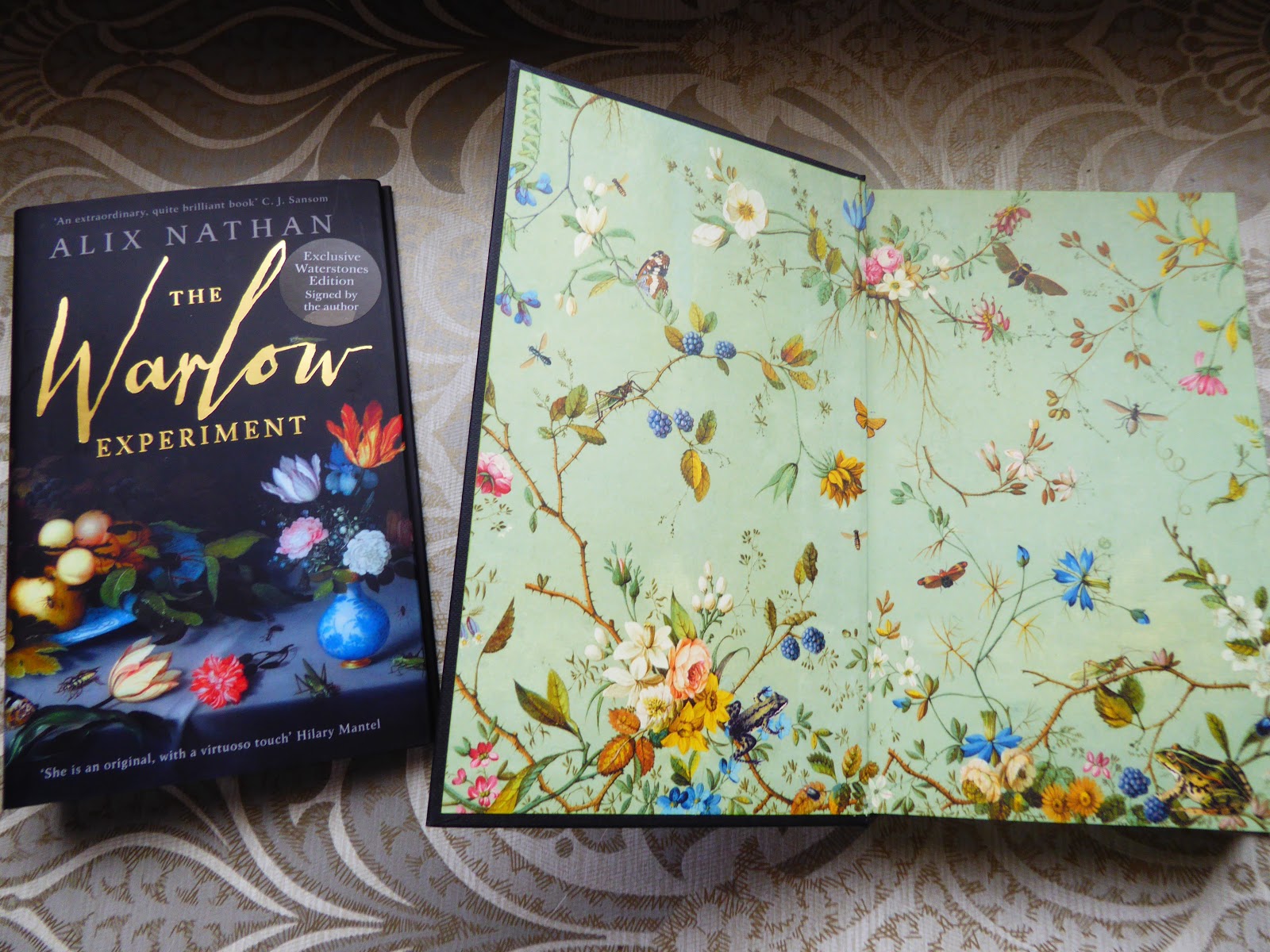
The Warlow Experiment by Alix Nathan
Serpent's Tail
Pp. 276

This novel is based on the true story of an eccentric Victorian gentleman, Herbert Powyss, who conducted an experiment; he placed an advert in a newspaper asking for a man to volunteer to be placed in isolation in his cellar for seven years with ‘every convenience desired’ but ‘without seeing a human face’. John Warlow was the only person who answered the advert, ‘a semi-literate labourer with a wife and six children to provide for’. Alix Nathan imagines how this experiment might have worked, or not, and she has created a rich novel of mental manipulation. She imagines that Powyss wants to see how a mind would cope without social contact and write up his findings to present to the Royal Society.

Powyss is typical of his era in that he likes to collect and catalogue things. He imagines that a human would be no different to his plants, “where so often he’d exerted order and precision, used good sense and experience, where reason had ruled”. Many of the metaphors are flora-related; he also hangs paintings on his walls of the Dutch masters and the cover of the book is a Flemish Vanitas image with fruit and flowers surrounded by insect life. Even the endpapers are glorious depictions of wildlife on wallpaper, representing both the care with which Powyss took to furnish Warlow’s underground apartments, and the never-ceasing ecological effects of co-existence.

Everyone in the house is affected by the presence of the man in the cellar, including the cook and the butler. The novel frequently switches perspective mid-chapter from Powyss to Fox, his old schoolfellow, or Hannah, Warlow’s wife, to Catherine, the housemaid. As one expects, madness ensues, and there are clear echoes of Frankenstein, Pygmalion, and even Jekyll and Hyde. Science without nature is abhorrent and potentially impossible. Life is fragile and unpredictable. Alix Nathan’s book is a superb rationale for the Ethical Conduct of Human Research Committee.

Wednesday, 6 May 2020

The 2018 Archibald Prize - Part Two

Further to a previous post, here is the second installment in my visit last year to see the touring Archibald Prize at the marvellous Orange Regional Art Gallery. The Archibald Prize is awarded annually to the best portrait 'preferentially of some man or woman distinguished in art, letters, science or politics, painted by any artist resident in Australia.' Often I don't know the subject, so I really enjoy finding out about the people as much as I appreciate the artwork itself.
Don by Mirra Whale
It was the colours in this portrait that caught my eye as they remind me of those 3D paintings or  that have fuzzy flashes of red and blue around the image to make it stand out when one dons special glasses. I had no idea who the subject is, but apparently he is the Honourable Don Harwin, the New South Wales Minister for Resources, the Minister for Energy and Utilities, and the Minister for Arts. The artist claims to be impressed with his "passion, curiosity and dedication to the arts."
"Painting Don, it became very evident that politics is never black or white. In some respects he stands in contrast to the seemingly conservative government he represents. For his portrait, I decided to take this notion further. Using a traditional portrait background, I applied colour to reflect not only his personality but his dynamic contribution to the arts."
Elisabeth Cummings in her studio at Wedderburn 1974 and 2018 by Noel Thurgate 
I really enjoy the kind and generous expression on this woman's face. I presume she is an artist because of the background to the portrait, and I like to see this in context - one should appreciate an artist at work as well as by their output. She appears confident and calm in her ability; her hands have seen much work and knowledge. The way in which the artist has incorporated the wood and other materials into his picture indicate that these have a specific relevance to the subject. I read that he was inspired by a 1974 photo of a young Elisabeth, aged 40, standing beside a tree trunk admiring the construction of her house/ studio in which she would make all the works for a future exhibition.
"Entering the studio, ideas and images immediately tumbled into place. The tree in the 1974 photo is the centre post supporting the roof. The very fabric of the building - stone, clay and wood - reflects the rich, earthy, materiality always evident in Elisabeth's palette. Numerous skylights reveal glimpses of trees and sky, and flood the interior with top-light, while Elisabeth quietly, calmly gets on with it, looking forward to starting the next painting."
The Letter - I really wanted to paint Germaine Greer but she said 'no' (self-portrait) by Stephanie Monteith
The purple and orange hues are exotic and the neat collection of oranges contrasts with the busy pattern of the tablecloth - it is an arresting blend of still-life and portraiture, with fruit, drink and flowers foregrounding the profiled figure. I became even more interested when I read that the artist wanted to paint Germaine Greer whom "I admire for many reasons".
"I made some requests and it became clear that it was unlikely to happen. And so, among other things, this painting is a metaphor for that stereotypical Archibald experience - the search for a desirable sitter... 
"I didn't want to paint myself for the Archibald but I was a convenient, available sitter. I prefer to work directly from life rather than photographs, and the time needed for this can be difficult for other people. To paint myself in profile like this required an arrangement of mirrors reflecting one another."
Uncle Ron Kennedy by Blak Douglas
What stands out to me here are the colours of the Aboriginal flag, and the instant recognition that this is an indigenous artist and subject. The image implies strata (in the background) and contours (in the hat) reflecting the connection to land. The rich reds and yellows contrast with the monochrome black and white to tell a story of appropriation and native representation. It did not surprise me, therefore, to learn that the subject is 'a celebrated Wiradjuri artist, renowned for his naive-style depictions of his mission upbringing'.
"Given Roy's past practice as an etching printmaker, I wished to honour this by depicting him in monotone. This is completely new to me and was much like attempting to speak a foreign language. Metaphorically though, I saw a spiritual man who now lives a lifestyle that is the polar opposite of his mission upbringing. Aesthetically, I've used a cracked acrylic surface - my trademark - around his face in the ochre colours of the earth. This represents the hardness of a man forged from an ancient past whilst living within a fractured present."
Self-portrait with studio wife by Del Kathryn Barton
This is just bonkers with swirling textures, busy colours and the inclusion of a pet. The peculiar perspective is dreamlike and the foreground focus on the hands implies a lambent creativity. The similarity of the slightly unfocused gaze of human and animal indicates a deep and supportive connection between them, which is separated from the viewer. I read that Del Kathryn Baton has won the Archibald Prize twice before and this is her fifth time as a finalist. She began painting this self-portrait halfway through her mother's two-year battle with terminal cancer, and the 'studio wife' in question is her French bulldog, Cherry Bomb.
"With my fierce little Cherry-Bomb-studio-wife keeping a look-out on my shoulder, I was taken aback when finishing the work by how child-like I look. Little-Del-the-daughter is very present.
"I completed the painting four months after Mum's death. My hands open in a state of uncertainty and loss. A single finger touches a giant leaf. This leaf, vibrating the life energy of the universe, is my departed mother.
"Cherry-Bomb is witness to and defender of my creative life. I remain forever grateful for her play-like-it's-the-end-of-the-world presence in my life, especially at a time of indescribable loss. Her deep eye contact is one of the most healing elements in my journey with grief."
Courtney Barnett and her weapon of choice by Melissa Grisancich
I like Courtney Barnett a lot; I like her music and her attitude.The first time I ever saw her, she was singing a duet with Billy Bragg (a cover of Sunday Morning by The Velvet Underground) and that was enough for me - my affection was assured. Her youthful energy is embodied by the childlike print of the wall behind her, while she cradles the guitar with a passion that her singer's cynical expression both reflects and refutes. She and the artist are friends; Gisancich writes,
"I'm a big fan of her music with its unique mix of rock, folk, indie and grunge. I also love her guitar playing, and see her as a strong representative of the positive shift happening for women in Australian music today. 
"Courtney was happy to sit, quietly playing a tune and looking round the room as if I wasn't there. She had a casual warmth about her that I wanted to capture. Her music and witty lyrics are quite colourful, so I have used a lot of colour. The background is inspired by 1930s Australian art-deco patterns, which often feature in my work." 

Sunday, 3 May 2020

What is Truth? - True History of the Kelly Gang


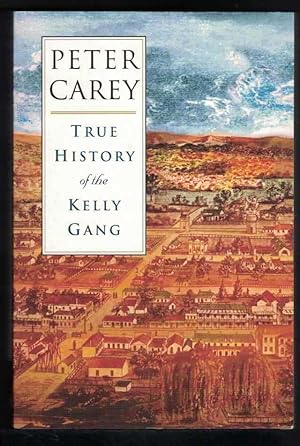
True History of the Kelly Gang by Peter Carey
University of Queensland Press
Pp. 400

Peter Carey is often touted as Australia’s literary representative, so his take on one of its biggest questionable icons is bound to be interesting and exciting. The book purports to be written by Ned Kelly in thirteen parcels of stained and dog-eared papers, and it includes excerpts from newspapers and transcripts of conversations. Towards the end of the novel, the printer, Thomas Curnow, purportedly says, “What is it about us Australians, eh? What is wrong with us? Do we not have a Jefferson? A Disraeli? Might not we find someone better to admire than a horse-thief and a murderer? Must we always make such an embarrassing spectacle of ourselves?” This is the question which Carey address in his ‘true’ history.

The beginning contains accounts of Ned’s upbringing, schooling, interactions with the police, his father’s brutality (beatings with the belt and drunken rages), and his mother’s (Ellen) subsequent suitors, one of whom is Bill Frost (whom Ned later shoots. Life was hard and brutal with death and violence all around. His uncle tried to burn their house down after being rejected by Ellen, and he was sentenced to hang. Ned was a Catholic amongst mainly Protestants; the family was poor and anti-establishment so they were picked upon and bullied in “a district of English snobs”.

It is written in a sort of vernacular, but the narrator is very erudite and falsely descriptive. There is no swearing; ‘bastards’ is redacted and other words are substituted with “adjectival”. His use of metaphor is rich and, while the structure is unrealistic for a poorly educated farm boy, the vocabulary is credible. “The memory of the policeman’s words lay inside me like the egg of a liver fluke and while I went about my growing up this slander wormed deeper and deeper into my heart and there grew fat.” His similes enrich the novel and raise it above the monotonous account it might otherwise have been, and he employs pathetic fallacy in a way that would make Thomas Hardy proud.


Peter Carey paints Ned as a rural lad who wants nothing more than to support his family, farm the land and breed horses, but his plans are thwarted by perceived persecution and his mother’s men. The nature of the relationship between Ned and his mother, Ellen, has long been a topic of historical debate. Ned is the oldest son with a primitive love for his family and a macho need to protect them. He cares for the family, although he doesn’t notice that his sister has grown into a young woman, and he is mainly concerned for his mother, rushing to defend her and fighting over her reputation. 

He loves his mother – some say to an unseemly extent – although she sells him into apprenticeship with Harry Power, and seeks out the company of other men. Ned takes up with Mary Hearn, in a supposedly touching but very plain fashion, and introduces her to his mother although he claims not to know that his mother and his girlfriend share a lover (George King) who has made both of them pregnant.


Mary Hearn pleads for Ned to leave Australia with her and their child for their safety, but obviously he doesn’t. Her lines are very similar to those spoken by Etta Place in the film, Butch Cassidy and the Sundance Kid, suggesting a very limited view of roles for women in stories of legend. Ellen, however, has a rebellious spirit (the spade is her favoured weapon), and she tells stories of the Irish legends, heroes and great women.

Ned holds some belief in fairy stories of banshees, curses and bad luck, but also understands the realities and corruption of the world. The police slander his family; he is angry and hungry and carries within “that flame the government of England lights in a poor man’s guts every time they make him wear the convicts irons.” He dislikes talk of colonials not being able to farm properly, and despite his Irish heritage, he considers himself Australian. In Peter Carey’s telling, he becomes one of the original founders, and claims he and his ilk were formed by the harsh treatment they received.
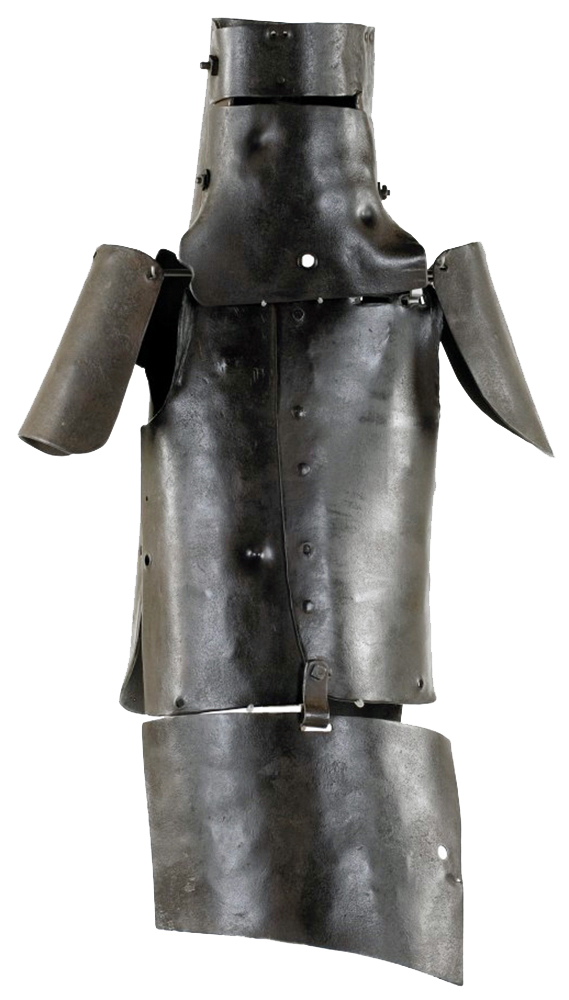

Carey includes all the details of the legend in his ‘history’. He mentions the undertakers, leather cords specifically created for the purpose of binding a body to horseback, which were used as evidence that the policemen had come to the Kelly gang with the intention of killing them. He also devotes pages to the creation of the iconic suits of ‘armour’. In 1879 Ned Kelly dictated an 8,000 word manifesto to Joe Byrne, known as the Jerilderie Letter, in which he tried to justify his crimes. Intended for publication, it was instead handed in to the police. Carey questions the making of the legend – was Kelly seeking fame, justice or acknowledgement? There is a great legend woven around Ned Kelly, and although Peter Carey suggests he will clarify it with his ‘true history’, he gleefully obfuscates even further.

Friday, 1 May 2020

COVID-19 Friday Five: Podcast Listening


I have a colleague who became a friend, who used to start many conversations of a morning with, "I was listening to this podcast..." and she would proceed to regale us with an 'interesting fact'. Obviously, the idea of whether something is interesting or not is highly subjective, so we decided in the office that we would be the judge of the fascinating factor of her shared information. Her name is Lyn so we would ask her if it was really interesting, or just 'lynteresting'. I miss seeing her in the office, so in her honour, here are five podcasts to which I have been listening a lot in the coronaverse (this is in addition to my usual favourites).


5 Current Podcasts:
  1. You're Dead to Me (BBC Radio 4) - "The history podcast for people who don’t like history… and those who do. Greg Jenner brings together the best names in comedy and history to learn and laugh about the past." Recent episodes have seen the Horrible Histories author and historical consultant tackle topics such as Eleanor of Aquitaine, The History of Chocolate and Neanderthals (Tim Minchin was the featured comedian on that one).
  2. Is it Just Me (acast) - "Each week Jo Elvin, James Williams and a celebrity guest debate the funniest, weirdest and most pressing dilemmas: from social media to mental health, to, erm… bra washing. Are you alone in your strong opinions on trivial stuff? Tune in and find out!" Guests have included Ben Miller, Claudia Winkleman, Marcus Wareing and Lisa Snowdon.
  3. The Infinite Monkey Cage (BBC Radio 4) - "Witty, irreverent look at the world through scientists' eyes. With Brian Cox and Robin Ince." In the last few weeks I have both learned things and been entertained by discussions on quantum worlds, coral reefs, fire, and conspiracy theories - among the featured guests on these podcasts, comedians (Shazia Mirza; Marcus Brigstocke; Ed Byrne; Katy Brand) sit alongside marine biologists, physicists, psychologists, and forensic chemists. 
  4. Ladies, We Need to Talk (ABC) - "a podcast for women, by women, that isn’t afraid to dive head first into the tricky topics we often avoid talking about. Join host Yumi Stynes as she tears open the sealed section on life. With sensitivity, personal stories, and serious smarts, this is for women who feel the squeeze between work, their private life, and their pelvic floor." This podcast addresses a variety of issues about which you might have wanted to know but been afraid to ask: erotic literature; toxic mums; body image; coronavirus anxiety; how to make friends as an adult, to name but five.
  5. Evil Genius with Russell Kane (BBC Radio 4) - "It’s good, bad, ugly - and very very funny. Changing the way we see heroes and villains in history." No (deceased) subject is safe from Russell Kane and his panel of guests as he detonates 'fact bombs' and forces them to make the reductive choice of evil or genius about icons from Emmeline Pankhurst to Pablo Picasso; Winston Churchill to Joan Crawford; Enid Blyton to Albert Einstein. You thought you knew them? Think again. 

Tuesday, 21 April 2020

One Trick Pony: Boy Swallows Universe


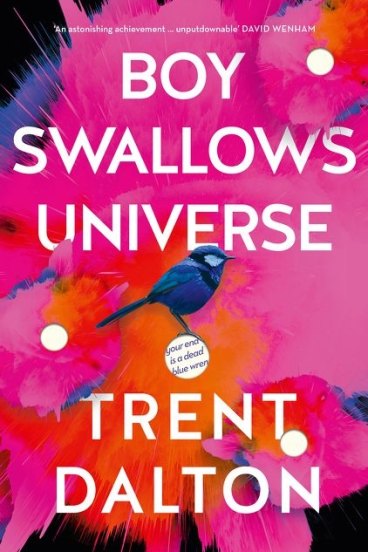
Boy Swallows Universe by Trent Dalton
Fourth Estate
Pp. 471

Set in Brisbane in 1985, this novel focuses on a boy, Eli Bell, and his terrible life. His father is absent; his drug-addicted mother is in gaol; his brother, August, doesn’t speak but writes words in the air with his finger, predicting things he couldn’t possibly know and that don’t make any sense; his stepfather is a dealer; and he’s surrounded by violent criminals. It is reminiscent of Bridge of Clay in style, where a young boy narrates but with a much older voice than the teenage kid he is meant to be.

Eli seems anxious to show off his disadvantage; he is brought up by drug-dealing thugs and potential killers, and told many prison stories. At one point his mother’s boyfriend drags her by the hair down to the dog kennel and forces her to eat their food from the dog bowl; at another he has his index finger chopped off with a cleaver. Referring constantly to the seedy underside of life and proudly intent on exposing the dark side of the country,, his unrelentingly grim descriptions sound like a kid trying to be hard-boiled, thinking he’s Holden Caulfield and hiding behind a tough exterior.

The style constantly gets in the way of the story, to the point that it is tedious to follow. Dalton writes in the present tense, in frequently overblown prose, with short snatches of description that aren’t actually sentences. “This room of true love. This room of blood. Sky-blue fibro walls.” The many full stops do not create emphasis, but merely sound like empty aphorisms; one could try to work out whether they mean anything, but mainly they just sound like an advert for carpet. Many of the references are to male narratives he probably wouldn’t have read: Ken Kesey; Henry Miller; Papillon by Henri Charriere; Steinbeck’s The Grapes of Wrath; Patrick White; Hermann Hesse; John Le Carré; Joseph Conrad; Hemingway and Herman Melville.

There are also allusions to The Wizard of Oz and The Jungle Book, and a scene in which Eli escapes from hospital by getting another child patient to create a diversion, which is his take on the escape from One Flew over the Cuckoo’s Nest. Eli’s mute brother, August, writes words in the air: Your end is a small blue wren; Caitlin Spies. These all, obviously, turn out to be prophetic. Eli ruminates, “Maybe we’d all be much more effective communicators if we all shut up more.” Ooh, deep!

Eli writes to Slim’s friends in prison, and Slim (his babysitter and a previous criminal who served time) advises him to put details into the letters: “The boys appreciate all that detailed daily life shit they don’t get any more.” Eli hones his observation skills because this builds up knowledge, which leads to power. It is, also, however, monotonous and smacks of product placement. The number of times he mentions the brand of his shoes and tracksuits; he could be sponsored by Dunlop and Adidas.

He thinks of his mother as a saint or an angel, but she’s a dealer and a junkie who winds up in gaol. There is a sentimental view of mothers which is familiar from stock criminal narratives. His father (Robert), Slim (Arthur) and Lyle are men who teach Eli wisdom whereas women don’t teach him anything; they are mothers, nurses, and love interests. He is well aware of the toxic masculinity that surrounds him and believes that “every problem in the world, every crime ever committed, can be traced back to someone’s dad... Mums maybe too, I guess, but there ain’t no shit mum in this world that wasn’t first the daughter of a shit dad.”

All of the chapters are introduced with three-word headings such as Boy Writes Words, Boy Receives Letter, Boy Meets Girl, Boy Seeks Help, Boy Parts Sea, Boy Steals Ocean, Boy Conquers Moon. The reason for this becomes apparent later when a newspaper editor asks Eli to describe his story in three words: Boy Swallows Universe.

The novel certainly contains a lot of detail, is grimly pessimistic and, although Dalton claims it is a love story, it is more of a tirade. He may claim that love and family is the answer rather than drug addiction, but he has a good wallow in poverty porn before he reaches that conclusion.

Wednesday, 15 April 2020

COVID-19: We Aren't Gathered Here Together


Last weekend it was Easter. I am a 'wishy-washy Anglican' (not actually my words, but I have been called thus) and only really attend Church at the major religious festivals - Christmas, Easter and Whitsun being the big dates in my calendar. Of course, this year I could not go to Church - no one can - and I missed it. I missed singing the songs and saying the prayers; I missed turning to my fellow members of the congregation and wishing them peace and good will. And I missed them doing the same for me. I missed that communal feeling.

For the same reason, I love watching sports and theatre; I enjoy a shared experience. Knowing that you feel the same thing as others is a wonderful thing. When I breathe in the hallowed turf of Anfield, it is a spiritual moment; all the home players and supporters know what I mean - we stand and sing together and no one cares how out of tune we are; we are in time. Our time. Any true fan will tell you the same (although they will worship at a different shrine). 


When the curtain raises on the stage and everyone takes a collective breath, we are all waiting to see what unfolds together. This moment will never be repeated - every performance is different - and we know we are privileged to witness it. And when the curtain falls and people applaud, they do it together. I have been part of a cast that received a standing ovation. It was magical and unforgettable. We did it for the audience and the audience appreciated us; and we were one. It was incredible.

I like listening to a band, but I prefer going to a gig or a festival. I don't need to then hear this gig again; I'm not a fan of live albums because generally the sound quality isn't as good, and the whole point is the being there. I am pleased the National Theatre, The Globe and the RSC are screening some of their performances so we can all enjoy things that we couldn't otherwise see - but we are still watching them alone. The roar of the greasepaint and the smell of the crowd is missing. (Yes, that was deliberate.)

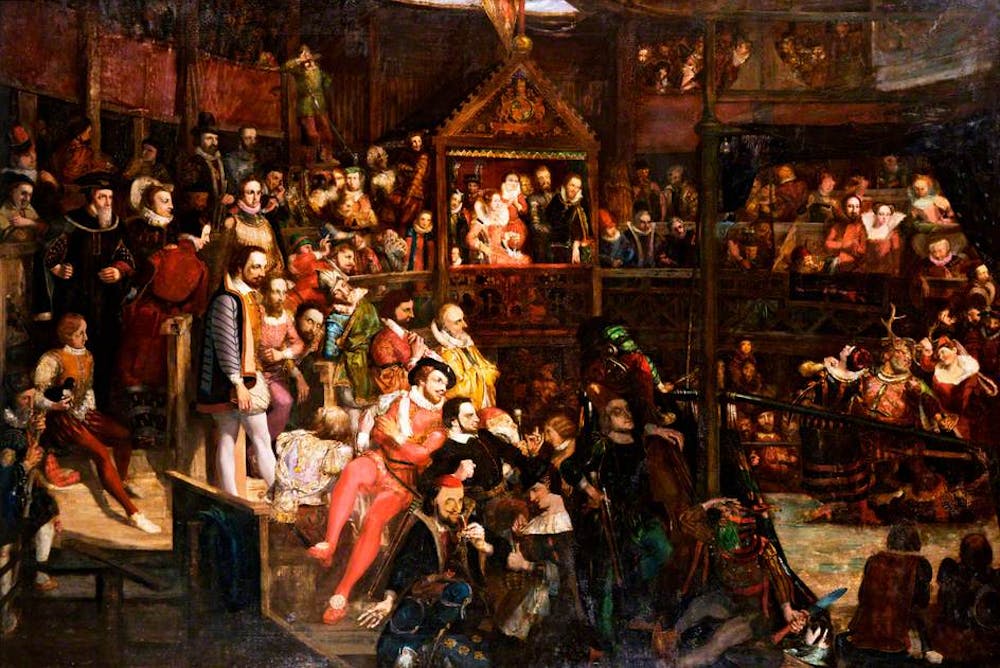
'Queen Elizabeth viewing the performance of The Merry Wives of Windsor, at the Globe in Merrie England' by David Scott
I like a drink as much as the next person. But there's a reason I go to pubs and clubs, even if the beer is often ridiculously overpriced. I like the atmosphere of sharing things with like-minded folk. Restaurants and cafes are better when they're busy (not cramped and heaving full, but with a low-level hum of noise). Silence is good when it is shared. Have you had a moment's silence in public? Then you know what I mean: there is nothing more moving than a collective memorial. 

Over the last few weeks I have held many on-line conversations and 'attended' conferences and meetings; I have done group trivia quizzes and play readings; I have watched re-runs of football matches and 'live' theatre. But I have missed the physicality. I will stay at home, and I will practice the physical distancing, because it saves lives and that's what matters. But when all this is over, I will find my flock and I will join them again, and we will sing our songs. 

Because it may be elitist; it may be exclusive; but being there is everything.