Wednesday, 3 May 2017

To every thing there is a season

Mr Wigg by Inga Simpson
(Hachette) Pp. 292


Mr Wigg is a widow who potters about his orchard, preserving fruit, listening to cricket, mourning his wife, telling stories to and cooking with his grandchildren, and watching as his new neighbours plant vines on the old farm land. The tagline is, “A novel that celebrates the small things in life”, and there is a gentle feel to the prose as it follows the seasons with planting, pruning, harvesting and preserving. This is deceptive, however, as there are spectres looming at the edges of progress and destruction; Vietnam and family rifts; ageing and loss.

Mr Wigg sees his fruit trees as personalities and imagines that they talk to each other with personalities and petty jealousies. The orchard encapsulates all his memories and aspirations. Inga Simpson writes of the different fruit like a poetic greengrocer, but always in Mr Wigg’s words, conjuring them and their stories from the air and the soil. Who knew that the provenance of these common fruits would be interesting? It is, because Mr Wigg remains in awe of the fruits he grows, engaging the reader with his ruminating non-didactic style.

Fruit isn’t always sweet, and neither, for all its bucolic images of collecting eggs, pruning fruit trees and chopping wood, is farming. Mr Wigg’s son frequently visits him to remind him of the things he can no longer do with his Parkinson’s and forgetfulness. Mr Wigg used to help the blacksmith and now has his tools; making things in his shed with the honest labour of the land. He invents a fruit-drying machine, but when he attempts to build one from his sketches, he has an accident with the bench saw. He fights against modernisation because he enjoys the old ways; why should he use time-saving devices when he doesn’t know what to do with his extra time?

His attitudes are also archaic, and it is his inherent sexism which caused a family schism. It never occurred to him to interest his daughter in the running of the farm; always assuming his son would take over. When he gives the farm to his son and nothing to his daughter, she is understandably upset, and lawyers become involved.

His late wife dominates his thoughts, as one would expect. Their relationship was full of love but not without irritation. He captures the momentous (such as family conflict and illness) along with the mundane: “His wife had buttoned his shirt cuffs for him even before the Parkinson’s came on. His dress shirts, in particular, had such tiny buttonholes.” He initially struggles with the pointlessness of existence without her, but he comes to realise that, “Life had a way of going on whether you were interested or not, and then you found yourself taking pleasure in a few small things, and a few more.”

Future generations provide continuity, and his happiest moments are with his grandchildren, cooking and telling stories. “Not everything that is new is better”; but not everything that is new is bad, either.

Friday, 28 April 2017

Friday Five (Seven Actually): Recent Theatre Excursions

I have seen a fair bit of theatre recently but have not had time to write full reviews, so here are some edited highlights:

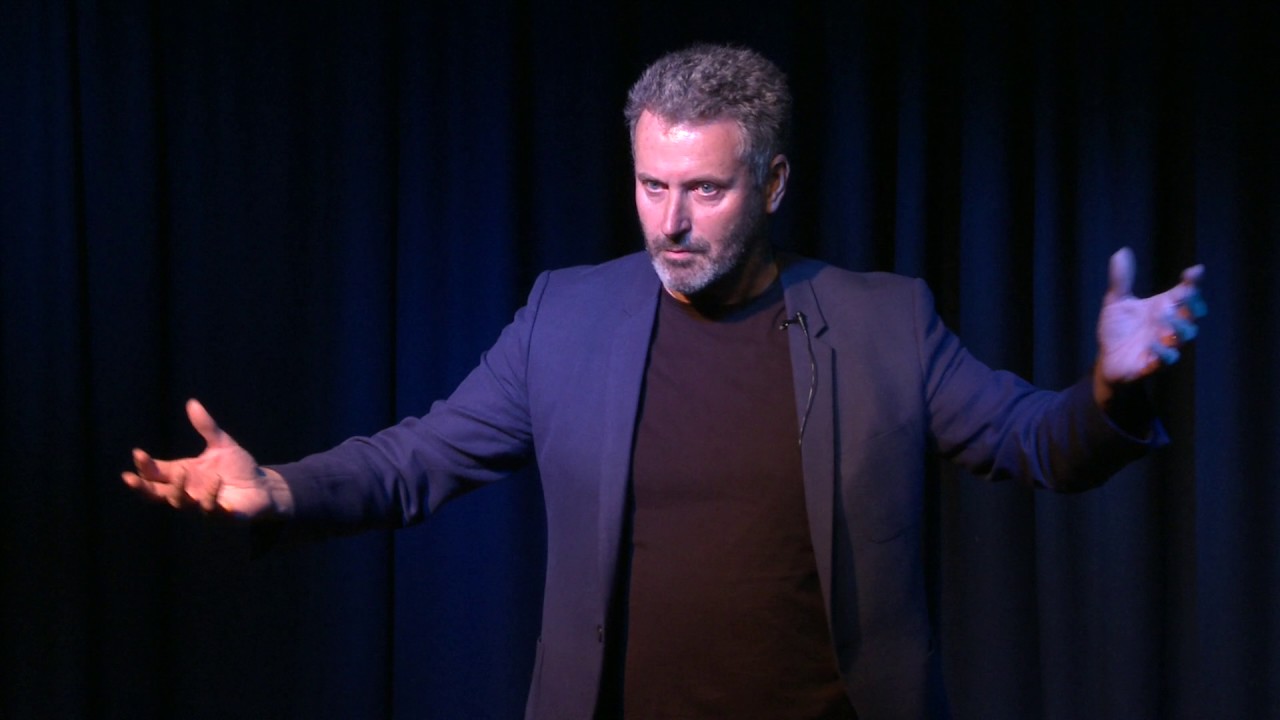
Pip Utton as Winston Churchill
  1. Churchill & Maggie by Pip Utton, produced by Imagination Workshop and Street Contemporary Drama at Street 2 - Pip Utton performs solo shows on consecutive nights, portraying political giants Winston Churchill and Margaret Thatcher. He weaves anecdotes, musings and facts into his 70-minute monologue on Churchill, a colossus of his time: "History will be kind to me for I intend to write it." During his embodiment of That Woman he invites questions from the audience, while achieving the voice, mannerisms and dismissive tone so successfully it made my skin crawl. His enthusiasm is boundless and his knowledge equally indefatigable.  
  2. Wait Until Dark by Frederick Knott, produced by Canberra Repertory Society at Theatre 3 - Jordan Best directs this classic thriller with attention to detail on a meticulous set (designed by Michael Sparks) as a blind woman (Jenna Roberts as Susie) comes under threat from unscrupulous criminals looking for drugs they believe are stashed in her apartment. The tension was lacking from previous productions I've seen perhaps because I knew the story so well, perhaps because Roberts never displayed any vulnerability or uncertainty, or perhaps because the villains were neither as charming or as threatening as they might have been.
  3. Cold Light adapted by Alana Valentine based on the novel Cold Light by Frank Moorhouse produced by Street Contemporary Drama at The Street - Trying to personalise politics in the most bureaucratic town in Australia is tricky. Sonia Todd plays Edith Campbell Barry, a (fictional - although many people are deceived) woman who tries to make her mark in international relations. It packs a great deal of history into a lengthy piece with multiple threads and tangents. The ensemble cast perform multiple roles with varying degrees of aplomb, but almost mimicing the projection of Canberra's street design, there is a feeling that we are being driven around in circles and getting lost in cul-de-sacs.

  4. The Age of Bones

  5. The Age of Bones produced by Satu Bulan, Teater Satu, Performing Lines and Ainslie and Gorman Arts Centres at Gorman Arts Centre - A mixture of Indonesian shadow puppetry, music, digital projections and contemporary satire tells the story of Ikan, an Indonesian boy who goes fishing one day and fails to return. He is imprisoned 'down under' in an oceanic world where he is befriended, pursued and judged by fantastical creatures (bubble-headed deep sea divers, a shark and an octopus). We are clearly meant to draw parallels with the plight of Indonesian boys incarcerated in adult jails throughout Australia for their involvement in human trafficking. While this is an original and commendable approach, certain technical aspects (such as the English surtitles failing to coincide with the spoken words) hamper the production, while the attempt to appeal to all ages (childlike repetitive motions alongside hard-hitting issues of abuse) means the production overall fails to connect with any particular audience.
  6. Chicago produced by Canberra Philharmonic Society at Erindale Theatre - Interesting staging and directorial choices (by Jim McMullen) highlight different aspects of the play to usual - including the fact that the characters really are all horrifically unpleasant. Vanessa de Jager and Kelly Roberts as Roxie and Velma are both excellent in isolation but their dancing duets remain individual; Shell Tully has a great voice but no depth as Mama Morton; Will Huang presents a lawyer who seems merely slightly smarmy rather than truly repulsive; and Miss Mary Sunshine (Ben WIlson) is utterly peripheral. Most of the songs are still good (although Class was especially disappointing) but other facets, such as the sloppy follow spots, are mediocre. Curious staging makes us question whether we are in a gaol at all, as the protagonists pop out to the lawyer's office in their underwear. The fact that there are far too many people unnecessarily on stage literally jumping through hoops spoils what should be tight choreography, and the hanging scene is hugely underwhelming. The menace and terror of being locked up and possibly awaiting the death sentence is entirely absent: it's more like a circus in which everyone gets to run around and show off how good they look in a corset. 
  7. Trelawny of the Wells by Arthur Wing Pinero produced by Canberra Repertory Society at Theatre 3 - Tony Turner directs a spirited cast in this touching and amusing late-nineteenth-century drama. The revolving set (designed by Ian Croker) allows for all the scenes to be played in the balance of affectation and naturalism which was becoming popular at the time and which is crucial to the play's ethos. Deliberately bombastic performances from the flamboyant characters such as Sir William Gower (Jerry Hearn), Mrs Mossop (Elaine Noon) and  Avonia Bunn (Jess Waterhouse) provide a delightful counterpoint to the more subtle sentimentality of Rose Trelawny (Alessandra Kron) and Tom Wrench (Robert de Fries). Slapstick extremes are tempered with emotional speeches, and the entire effect is a beautiful piece about acting and performance. 
  8. Richard III by William Shakespeare, produced by Bell Shakespeare at the Playhouse (Canberra Theatre Centre) - Bell Shakespeare have taken the history out of the history play and turned it into a tragedy, in which the lead performer (Kate Mulvany as RIII) hams it up deliciously as Tricky Dicky, and the rest of the cast frolic about in a drawing room, like one of those frightful parties where you don't really like the host. As the actors do not leave the stage, there is no difference between intimate and group scenes, leading to a lack of tension and confusion as to the identity of many of the characters. The political is no longer important; it's all about the personal. This is the modern world, where I fear we have lost more than we have gained.
Kate Mulvany as Richard III

Wednesday, 26 April 2017

Fishing for Compliments


The Princess Diarist by Carrie Fisher
(Bantam Press)
Pp. 251

This book was published shortly before Carrie Fisher died, which gives much of it added poignancy. It is mainly about her experience filming Star Wars; her youth and her inability to deal with unanticipated fame; her affair with Harrison Ford; her reaction to the conventions; and her irritation at being expected to still look the same now as she did then. The book is not particularly well-written, but it is honest and candid – the inclusion of her diaries and poetry written during the filming of Star Wars is a brave move – and ultimately very readable.

No one was prepared for the reception that Star Wars would receive. Her life was changed forever by the film refused to remain on screen. She was defined by one character with whom she has a love/hate relationship. “I had never been Princess Leia before and now I would be her forever. I would never not be Princess Leia. I had no idea how profoundly true that was and how long forever was.”

She writes with attempted nonchalance and sangfroid and is candid about her own drug addiction. Her style is deliberately self-effacing and jocular in tone, and although she presents her thoughts as raw and elemental, she has clearly polished the words into something she imagines is witty. There are a few insights into the behind-the-scenes goings-on during filming (such as the fact that due to her grimacing each time she fired the laser gun, she had to take shooting lessons from the man who prepared Robert De Niro for his role in Taxi Driver), but film geeks will probably know all of these already.

Her renowned advocacy for gender equality is evident and she had crippling anxiety about her looks, relating that she got the part in Star Wars on the proviso that she would lose ten pounds. But she also confesses she enjoyed the one-sided nature of the film, and to loving the male attention that came from being “the only girl in an all-boy fantasy.”

The main thing to emerge from this book, however, is her affair with Harrison Ford. She mockingly refers to their relationship as ‘Carrison’ and, although it comprises over half of the book, she pretends to dismiss it; forty years afterwards, she still tries to downplay it, which conversely gives it excessive importance. Obviously, this is one-sided account, but Harrison Ford doesn’t present very favourably. He seems like a predator from the first time he takes her home drunk from a cast and crew party. She was young and naïve, and he was careless of her sensitivities and her desperate neediness. She fixated on him like a smitten teenager.

He doesn’t talk to her, make her happy or feel good about herself, and he exacerbates her insecurities and anxiety. It seems that he is cold towards her, but perhaps that is just his nature? She records in her diary, “I act like someone in a bomb shelter trying to raise everyone’s spirits.” While it is brave to include the diaries and gauche poems, they are excruciatingly painful to read. Every teenage girl has written self-indulgent nonsense like this, but not always about Harrison Ford. One could argue that she knew the situation – he was married – but she tries to manipulate the reader into feeling sympathy for her.

She concludes with her feelings towards the fans at Star Wars conventions, and it is clear that she is not comfortable with the entire charade. It’s fair to say that Carrie Fisher’s relationship with Princess Leia and Star Wars in general, is both complex and unresolved, which is distressing as it will now forever remain that way.

Saturday, 22 April 2017

Politics and Parenthood


Dad Joke written and performed by Mark Swivel
The Street, 21-23 April

Describing himself as something between a storyteller and a stand-up comic, Mark Swivel commands the small stage of The Street 2. His premise is that he has to deliver a speech on the event of his son's 21st birthday and he is a little nervous. They have a perfectly fine relationship (about as good as a father can have with his son who lives on the other side of the world), but he claims to be struggling with the fine line between proud dad and aged embarrassment. He asks the audience to help as he runs through his rough draft, and he is so personable and charming that we all comply with his request.

Of course this is all a ruse, designed for Swivel to show off his intelligence, humour, range of subjects, and even a pretty decent singing voice. His renditions of Russian folk songs - "we have no idea what the words mean, but they sound good" - segue seamlessly into musings of political icons both Australian and British - "Anyone remember David Cameron?" He regales us with tales of his own upbringing in the days before one had to engage with one's children, and during which his dad used to drop cryptic one-liners when he came in from removing leaves from the pool "like a wistful gondolier". His reminisces are touching and remarkably poignant, especially when he talks about dealing with a parent toward the end of their life. 

There are many different styles of parenting these days: snow-plough; free-range; helicopter; attachment; cotton wool; combine-harvester... okay, I admit I made that last one up. Although the first recorded use of the word in this sense comes from the 1660s, the word 'parent' was not widely recognised as a verb until recently. It stopped being a thing one just was, and became a thing one had to do, and at which one could be judged. And boy, how we love to judge! There is so much expectation and pressure involved that the whole business (and it is increasingly a business - isn't everything?) becomes quite stressful. One of the best ways to deal with pressure and stress is to laugh at it, and ourselves, and Swivel does that expertly.

At the end of the evening we have learned a lot about Mark Swivel and his family. He cleverly polishes the poignant memories and anecdotes, mining them for the humour without discarding the essence. But this is more than just personal, or political, or even social (and there is a social justice warrior lying very close to the surface). It is an engaging evening such as you might have with your mates down the pub as they confide their hopes and fears to you. I haven't got kids; I didn't grow up in Australia and I haven't had to bury my parents (although even thinking about it brings a lump to my throat), but I was fully engaged throughout the hour-long "slightly inebriated TED talk". Mark Swivel's riffing on parenthood and politics crosses continents and generations - it's a great night out and highly recommended.

Monday, 27 March 2017

A portrait of an author ahead of her time


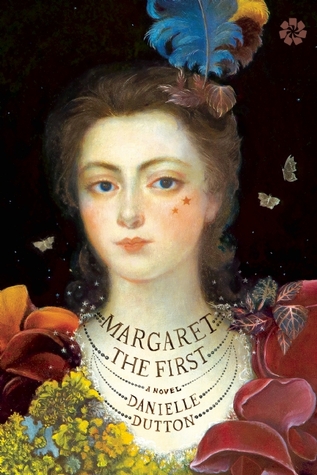
Margaret the First by Danielle Dutton
(Scribe)
Pp. 160

Margaret Cavendish was a poet, philosopher and visionary. As a child she created imaginary worlds (populated with thinking-rocks, humming-shoes, her favourite sister and Shakespeare, Ovid and Caesar) and stitched little books together with yarn. “Eventually she achieved fame, but it was not necessarily that which she sought, as children chased after her carriage calling out to ‘Mad Madge’ and she became a cautionary tale for young girls who dreamed of becoming too intelligent.

With the civil war raging, she joined the court of Queen Henrietta Maria and followed her into exile in France, where she met and married the much older William Cavendish, Duke of Newcastle. William was generally very supportive of her work and encouraged her to speak up and express her thoughts. Through him, Margaret came into contact with many of Europe’s leading thinkers; but she was bashful and awkward in society. When she was invited to speak at The Royal Society (the first woman to be so invited, and the last for 200 years) she could only stammer appreciation and rush away; causing Samuel Pepys to write, “A mad, conceited, ridiculous woman. I do not like her at all.”

As a woman who published books of her thoughts, she was considered doubly shocking. First that she had them, which was scandalous enough, but to voice them was even more so. Furthermore, she was childless, attempted cures for which included syringing herbs into her womb and “a drench that would poison a horse.”

Many of her thoughts centred on the physical world. As well as poetry and philosophy she wrote and published works of extraordinary utopian science fiction and fantasy. In her book, Philosophical and Physical Opinions, 1655, against the prevailing ideas of the time, “I argued all matter can think: a woman, a river, a bird. There is no creature or part of nature without innate sense and reason, I wrote, for observe the way a crystal spreads, or how a flower makes way for its seed.”  

In contrast with much current weighty (in size) historical fiction, this short novel (160 pages) covers historical events in brief detail; The English Civil War is dealt with very succinctly:
“The King of England was convicted of treason. Then the King of England was dead. It was Tuesday. It was 1649. Parliament hacked off Charles I’s head outside the Banqueting House at Whitehall.” Halfway through the novel, Danielle Dutton changes from first-person to third-person narration. This ambitious move reflects the fame Margaret sought as people began to talk about her after the coronation of Charles II, and the Cavendishes’ return to London.

While Danielle Dutton doesn’t claim Margaret specifically as a proto-feminist, she does dwell on her issues with equality, or the lack thereof. Indeed, the title comes from her own self-honorific. “Though I cannot be Henry the Fifth, or Charles the Second, yet I endeavour to be Margaret the First”. She was far from saintly, however, and, jealous of William’s success, she upstaged him at the opening of his play by attending the theatre with her breasts bared and her nipples painted.

Margaret Cavendish was a remarkable woman. She has been championed by Virginia Woolf and deserves wider renown. Unfortunately, with society’s attitude towards women, she will be better remembered for her outfits and her manners than her literary and artistic achievements.

Friday, 17 March 2017

Exposure to the elements: Broken Hill Regional Art Gallery

Rick Ball in front of three of his paintings
The artists featured in the Broken Hill Regional Art Gallery are unsurprisingly obsessed with the elements - many of the works incorporate earth, wind, fire and water (or rather, the lack of it). The area relies heavily upon the water found in the Murray Darling River systems, and it is diminishing rapidly. Apparently, when full, the four lakes of the Menindee Lake System hold more than three times the volume of water of Sydney Harbour.

Curiously, there has been a lot of rain recently, and Lake Menidee is full for the first time in three years. This does not lessen the ecological crisis gripping the region and environmental concerns for the future of the towns. When we visited, the exhibition, Contemporary Primeval, highlighted the work of Rick Ball and Ann Evers, and through paintings and sculpture they both addressed this issue.

Rick Ball's expansive canvases relate in an abstract fashion to his surroundings. Having lived in Broken Hill for the last 25 years, he also acknowledges the influence of mining in his images. He claims to be an interpreter for the land rather than a painter, and he layers natural pigments and substances onto each creation. Paint, sand, crushed shells, vermiculite and tennis-court whiting are all present, recalling handfuls of colourful mining deposits thrown against the linen.


Many of his works are triptychs or multiple canvases positioned side to be side to try to capture the enormity of the landscape. Sydney and the Bush is awash with purples, pinks, reds; great gobs and streaks of oil as the city seems to emerge from the bush over it's iconic bridge, or is it being swallowed up and returned to nature? In Evening stroll beside Lake Menindee before the water disappeared we see long human shadows at sunset, or are these aerial images of dried-up riverbeds? Questions are left unanswered, but the physicality of the work is unmissable. In a co-operative touch, each artist has supplied a brief introduction to the other's art.
“All ideas of art being a ‘beautiful illusion’ have been banished from the room. Instead we are surrounded by images that are both strange and familiar in equal measure. One is reminded of the stories of those first Europeans as they confronted this continent’s trees, animals and human culture. While very young, Rick says that he felt inundated by the ancientness of the natural world, while his human world was generally obsessed with newness.” – Ann Evers 
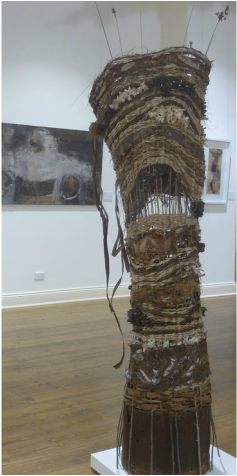
Singing in the Barrier Ranges by Ann Evers
In turn, he writes of her art;
“Ann Evers’ unusual fibre art holds the element of surprise. Her clever use of materials as a weaver is like a bird’s use of skin, bones and feather for flight. Evers is no mere basket-maker. Each piece of her work, large or small, is a story of time and of place. She is a weaver of stories and materials, of nature and culture. She weaves the north to the south. Sharp humour abounds alongside an equally abundant earthy circumspection, obvious in any exhibition of her work.” – Rick Ball
She incorporates found objects into her sculpture giving them elements of both traditional and contemporary reference. Into pit-fired pots woven with natural fibres, bark and wire, she places bones, sticks, rocks and seeds. Three tall twined vessels of Singing in the Barrier Ranges include arid land snail shells, baby clams, local seedpods and capsules; all held together with rock sida, lignum and sedge, used as uprights. 

Ann Evers with some of her creations
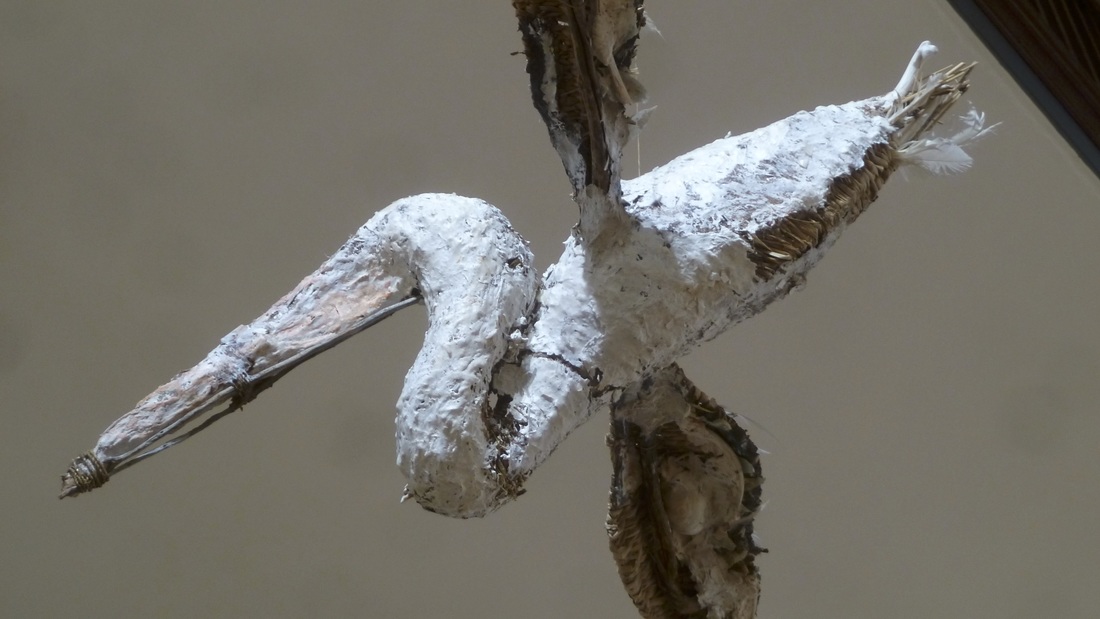
Waiting for Water comprises six figures in flight made from handmade paper and pigment, handmade string and linen thread. All other materials are collected on and around the beach of the "now-empty lake Menindee". Serving as monuments to times past and receptacles of foretold growth, these creations hang from the ceiling indicating impermanence and fragility. 

Waiting for Water by Ann Evers
The gallery is housed in the former Sully's Emporium and has won numerous heritage awards for the restoration and refurbishment of the building. Its wooden floors and dramatic staircases provide a fantastic counterpoint to the artworks. There are all the usual still lifes; portraits; landscapes; naïf art; abstracts; Aboriginal animal spirits; story poles; dot art and granite sculptures, but some pieces stand out to make a statement. 

Clarendon Spring, Make Sure the Sun Wipes It's Feet (1984) by John Olsen
I love the riot of colour – primarily mustard yellows – as swirls and tendrils connect like cells in John Olsen's vivid Clarendon Spring, Make Sue the Sun Wipes Its Feet. Lana Roberts has rolled up ties and stitched them together, separated by beads, into a series of necklaces called Men’s Dress Ties Revisited­. Sidney Nolan's Little Boy Lost is both disturbing an uncomfortable as a small child all in white and wearing a sunhat stands starkly against a background of red earth and ominous sky, calling to a primal fear in all of us of alienation and abduction.

Little Boy Lost (1983) by Sidney Nolan
Another iconic Australian artist, Kevin Charles (Pro) Hart is featured with The Yabbie Catchers, as little figures in bright colours both stand out from and are dwarfed by the enormity of their environment - the trees and river are far more timeless and enduring than their uncertain activities.

The Yabbie Catchers (1987) by Pro Hart
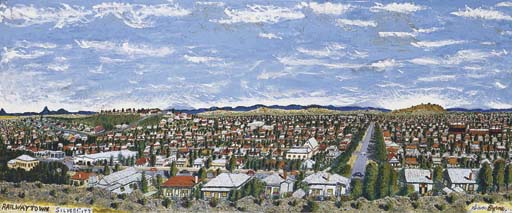
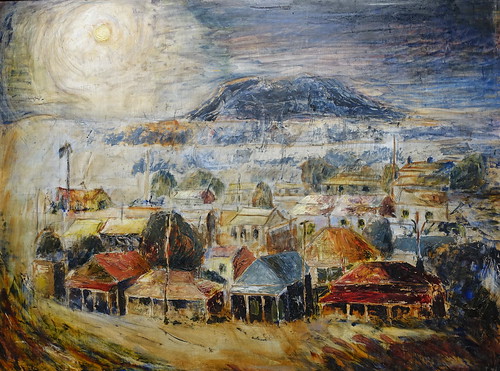
Images of Broken Hill itself range from the sublime to the surreal. Sam Michael Byrne gives us bright colours and highlighted dots to display prosperous streets with a Toytown perspective in Silver City (1957), whereas Eric Minchin's North Mine (1970) is in bleached tones with dramatic greys and streaks of orange. Meanwhile the houses in the foreground of May (Florence) Harding's Broken Hill, Nocturne (1967) are all but overshadowed by the burning orb and the looming mine, which dominate the landscape. 

Silver City (1957) by Sam Michael Byrne
Broken Hill, Nocturne (1967) by May (Florence) Harding
A spectacular red gum sculpture highlights the work of Badger Bates and his symbolic lino cuts. Plesiosaur and Ngatyi: The Past, the Present and the Future (2003) represents the future of the Darling River through the fact that an opalised Plesiosaur was found at White Cliffs, bringing tourists, scientists and historians to examine the archaeological marvel. Ngatyi is the Rainbow Serpent of Aboriginal mythology; a creator god, which gives life through its association with water, but acts as a destructive force when angry - once again reminding us of the elements and the regional geography. In this carving the two beasts are intertwined with their heads together symbolising reconciliation, as we must work together to protect our country. 

But I'll finish this post with this powerful picture of a flood of pink flowers in calming, swirling patterns; blooming with unexpected beauty in the middle of the desert - just as Broken Hill itself is a small oasis of society in the middle of a vast swathe of nothing.

Wildflowers Dreaming by Emily Kame Kngwarreye

Monday, 20 February 2017

Middling Mediterranean Novel

Not Quite Nice by Celia Imrie
(Bloomsbury) Pp. 326


This is the passable but not outstanding writing debut from the superb actor, Celia Imrie. It centres on a group of ex-pats living in Bellevue-Sur-Mer, a town near Nice in the South of France. The cast of characters are dealing with marriage break-ups, awful children and failed careers; most are retired and all are attempting to start a new life. In a 2015 Guardian interview, Celia Imrie said, “All the parts I’m writing are parts I’d like to play”, and that is obvious in this mixture of Marigold Hotel and Year in Provence.

The fluffy, comfortable, undemanding style of writing envelops unrealistic, pantomime characters and ludicrous plots. The women: Theresa, Sally, Carol and Faith are practically interchangeable, and the men include a gay couple, an ex-con and current fraudster, and an Australian lothario who refers to the set as “mollycoddled or henpecked men [and] their female jailors” – he’s not far wrong. There are dramatic events but they are all resolved with no lingering ramifications, and everything seems a little too easy. When one of the characters sets up a cooking class to make a little extra money, it all goes wonderfully, and of course the recipes are included, which is all a bit passé.

A resounding theme is that the younger generation are all mercenary and mean, and the older generation struggles to come to terms with the way they have turned out. A couple of the women are bullied mercilessly by their children and are tied to their lives to the exclusion of their own. They are obsessed with their offspring, and this is pointed out to them by those who don’t have any. “You never stop talking about your children. You spend your hours tirelessly maundering on about your tiresome adult offspring. Don’t you realise that there is nothing so boring as other people’s children, except, perhaps, other people’s dreams?” Quite.

It’s unsurprising that Celia Imrie writes about women of a certain age rediscovering their sense of self rather than their obligations to others, and all of these characters have come to this village for a fresh start and to lead the life they want. Of course the towns are picture-perfect and delightful. Her descriptive passages are derivative and it’s depressing to think one can publish any old tosh as a celebrity, whereas this would never be accepted from an unknown author.

There is an element of that smug middle-class Englishness that is inherent to these living-abroad-with-all-the-charming-but-peculiar-foreigners novels. None of them speak French, quite patronisingly expecting the French to speak English to them, and to mix with their ‘own people’. Why don’t they either move somewhere English-speaking or make more of an effort? A few sentences later they are declaiming, “What made Bellevue-Sur-Mer so nice was that it still kept hold of an everyday reality – the majority of shops and restaurants were for locals, not tourists.”

Celia Imrie may want to play these people, but they are quite ghastly and snobbish; hard to like and harder to care about.